Six Sigma Principles: A Complete Guide to Process Improvement
Businesses look for ways to raise product quality, cut operating costs, and give customers a better experience. Inconsistent processes, repeat errors, delays, and waste make those goals harder to reach. Six Sigma is one way to work on them.
Six Sigma is a data-driven approach to process improvement. It helps organizations find the causes of defects, reduce variation, and make operations more consistent. Teams use statistical analysis, structured problem-solving, and continuous improvement so decisions rest on evidence rather than assumptions.
The Six Sigma principles are useful for project managers, business leaders, quality professionals, and operations teams. A manufacturer can use them to improve quality. A service team can use them to simplify customer work. An internal team can use them to make a workflow more efficient. In each case, Six Sigma gives a structured way to solve the problem.
This guide explains what Six Sigma means, its five core principles, the DMAIC methodology, common tools, and how organizations use Six Sigma on real processes.
What Is Six Sigma?
Six Sigma is a quality management and process improvement method. It focuses on reducing defects and cutting variation in business processes. Teams use data and statistical methods to see how a process performs and where it can improve.
The name comes from statistics. Sigma (σ) is standard deviation, a measure of how far values sit from the average. In the traditional Six Sigma quality benchmark, a process is tied to a target of about 3.4 defects per million opportunities, using the conventional 1.5-sigma shift assumption.
In practice, Six Sigma helps organizations answer questions such as:
- Where are errors occurring in a process?
- What factors are causing delays or inconsistent results?
- How can teams reduce defects and rework?
- Which process changes will produce measurable improvements?
- How can improvements be maintained over time?
Teams define the problem, measure performance, analyze root causes, implement improvements, and monitor results. They do not rely on guesswork.
Why Are Six Sigma Principles Important?
Six Sigma principles give teams a base for making processes more reliable, efficient, and consistent. They keep the work focused on customer expectations, the causes of operational problems, and measurable evidence.
Applying these principles can help businesses:
- Improve product and service quality: Identify defects and reduce the likelihood of recurring errors.
- Increase customer satisfaction: Align processes with customer requirements and expectations.
- Reduce operational costs: Minimize rework, waste, delays, and unnecessary activities.
- Improve productivity: Make workflows more efficient and predictable.
- Support better decisions: Use data and analysis to identify effective solutions.
- Encourage continuous improvement: Monitor results and identify opportunities for further progress.
Process improvement initiatives often require teams to plan activities, coordinate responsibilities, and monitor progress. Understanding Agile project management can help teams organize improvement work and adapt to changing business requirements.
What Are the Five Core Principles of Six Sigma?
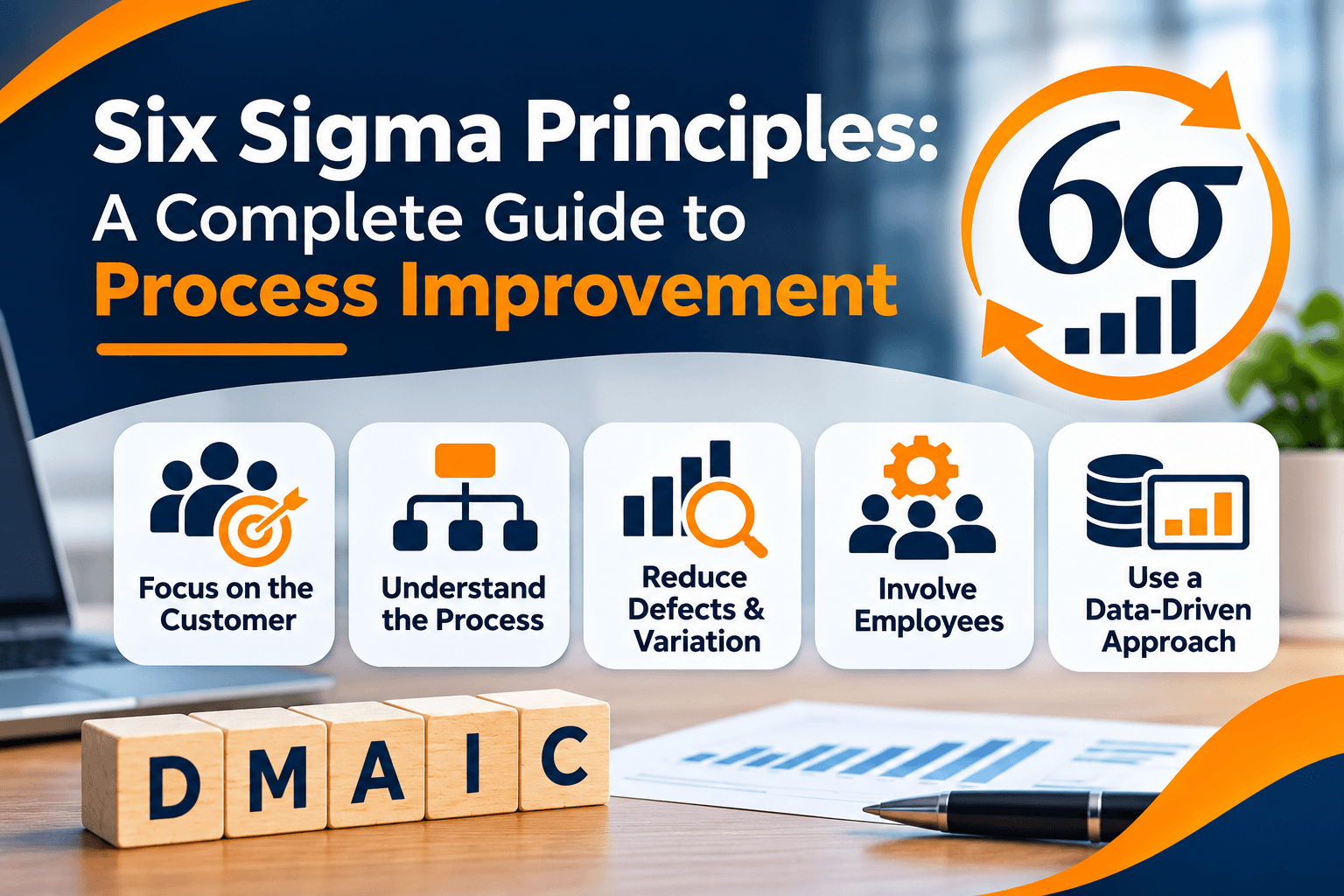
Six Sigma is often explained through five core principles. Together, they help an organization understand customer needs, find process problems, reduce variation, involve employees, and hold onto improvements.
1. Focus on the Customer
Customer satisfaction sits at the center of Six Sigma. An organization needs to know what customers value and what they expect from a product, service, or process.
A process can look efficient inside the company and still miss what the customer expects. Six Sigma starts by identifying those requirements and turning them into measurable quality standards.
For example, an online retailer may find that customers are unhappy because orders arrive later than promised. The business can define delivery time as an important customer requirement and measure how consistently fulfillment meets that expectation.
How businesses apply this principle:
- Collect customer feedback and complaints.
- Identify critical-to-quality (CTQ) requirements.
- Measure performance against customer expectations.
- Prioritize improvements that directly affect customer experience.
2. Identify and Understand the Process
Six Sigma asks teams to understand how a process works before they try to improve it. That means the steps, inputs, outputs, dependencies, and people involved in delivering a product or service.
A process map can show unnecessary activities, bottlenecks, handoff problems, and the points where errors happen.
For example, a company processing customer applications may have several approval stages. Mapping the workflow can show that applications wait too long between departments, or that employees enter the same information more than once.
How businesses apply this principle:
- Document the current workflow.
- Identify process inputs and outputs.
- Map dependencies and handoffs.
- Measure processing times and error rates.
- Identify where defects and delays occur.
3. Eliminate Defects and Reduce Process Variation
Variation means a process produces inconsistent results. Some variation is natural. Too much variation, or variation nobody controls, leads to defects, delays, and results that are hard to predict.
Six Sigma uses data analysis to find the factors behind that variation and decide how to control or reduce them.
For example, if a manufacturing line produces products with inconsistent dimensions, a team may look at machine settings, materials, equipment conditions, and operating procedures to find the root cause.
How businesses apply this principle:
- Measure defect rates and process variation.
- Investigate the root causes of recurring problems.
- Standardize important process steps.
- Use quality checks to detect issues.
- Monitor results after implementing improvements.
4. Involve Employees and Build a Culture of Improvement
People who do the work every day often see operational problems more clearly than anyone else. Six Sigma asks employees, process owners, managers, and improvement specialists to work on the problem together.
A successful improvement effort needs clear responsibilities, the right training, communication, and support from leadership.
For example, a customer support team may keep missing its response times because case assignment is unclear. Asking support agents to review the workflow can surface practical fixes that management would otherwise miss.
How businesses apply this principle:
- Involve employees in identifying process problems.
- Provide relevant Six Sigma training.
- Encourage teams to share improvement ideas.
- Assign clear ownership for improvement activities.
- Communicate progress and results across departments.
5. Use a Systematic and Data-Driven Approach
Six Sigma uses measurable evidence. Teams collect the relevant data, analyze performance, test possible solutions, and check whether the change produced the result they expected.
A structured approach also helps an organization keep an improvement in place, instead of making a temporary change that never touches the underlying problem.
For example, a logistics company with frequent delivery delays can measure delivery times, examine route performance, identify recurring causes, and test changes before rolling them out more widely.
How businesses apply this principle:
- Define problems using measurable terms.
- Collect accurate and relevant process data.
- Use analysis to identify root causes.
- Test improvements and compare results.
- Monitor performance to maintain progress.
Understanding the Six Sigma DMAIC Methodology
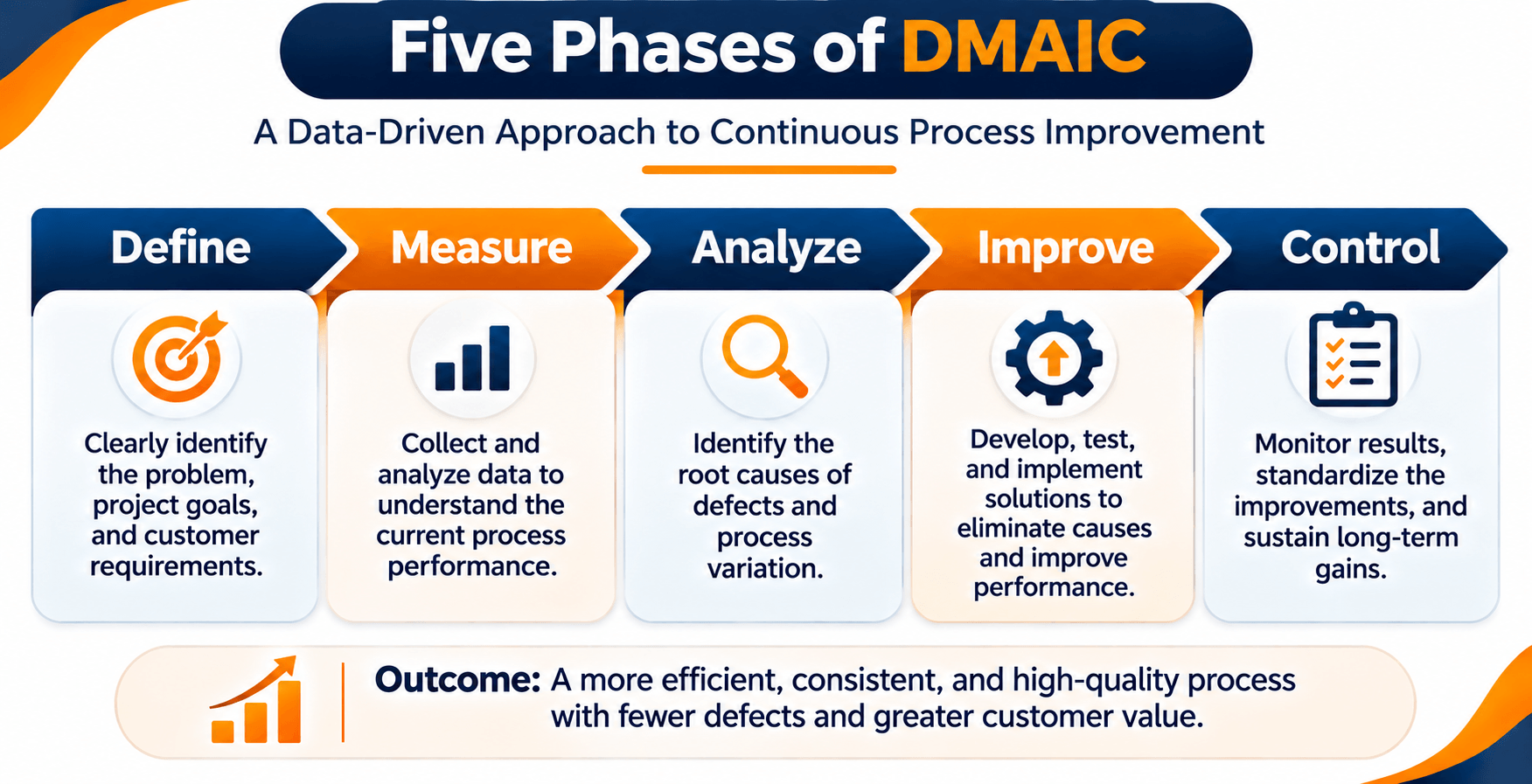
DMAIC is a structured problem-solving framework used in many Six Sigma projects. DMAIC stands for Define, Measure, Analyze, Improve, and Control. It takes a team from naming a problem to putting a solution in place and keeping it there.
1. Define
In Define, the team names the problem, sets the project scope, and decides what a successful improvement looks like.
Typical activities include:
- Writing a clear problem statement.
- Identifying customer requirements.
- Defining project objectives and scope.
- Identifying stakeholders and process owners.
- Establishing expected outcomes.
Example: A customer service department wants to reduce the average time required to resolve support requests.
2. Measure
Measure sets the current performance of the process. Teams collect reliable data so they know how the process works before they change it.
Typical activities include:
- Identifying important performance metrics.
- Collecting baseline data.
- Measuring defect rates and processing times.
- Reviewing data accuracy and consistency.
- Documenting current process performance.
Example: The customer service team measures average resolution time, the number of unresolved tickets, and the percentage of requests resolved within the target period.
3. Analyze
In Analyze, teams study the data to find the root causes of poor performance. The goal is to understand why the problem happens, not only to treat the symptoms.
Typical activities include:
- Identifying patterns and trends.
- Investigating possible root causes.
- Using cause-and-effect analysis.
- Comparing performance across process stages.
- Validating which factors contribute most to the problem.
Example: Analysis reveals that support requests are delayed because tickets are frequently assigned to the wrong department and require reassignment.
4. Improve
In Improve, teams develop, test, and implement solutions that address the verified root causes.
Typical activities include:
- Brainstorming possible solutions.
- Prioritizing improvement opportunities.
- Testing changes on a smaller scale.
- Evaluating results against baseline performance.
- Implementing effective solutions.
Example: The support department introduces clearer ticket categories and automated routing rules to reduce incorrect assignments.
5. Control
Control checks that the improvement keeps delivering the expected results. Teams monitor performance, document the updated procedures, and put controls in place so the original problem does not come back.
Typical activities include:
- Creating a process control plan.
- Monitoring key performance indicators.
- Documenting updated workflows.
- Training employees on new procedures.
- Responding to performance changes.
Example: The support department regularly reviews ticket assignment accuracy and resolution times to ensure the new workflow remains effective.
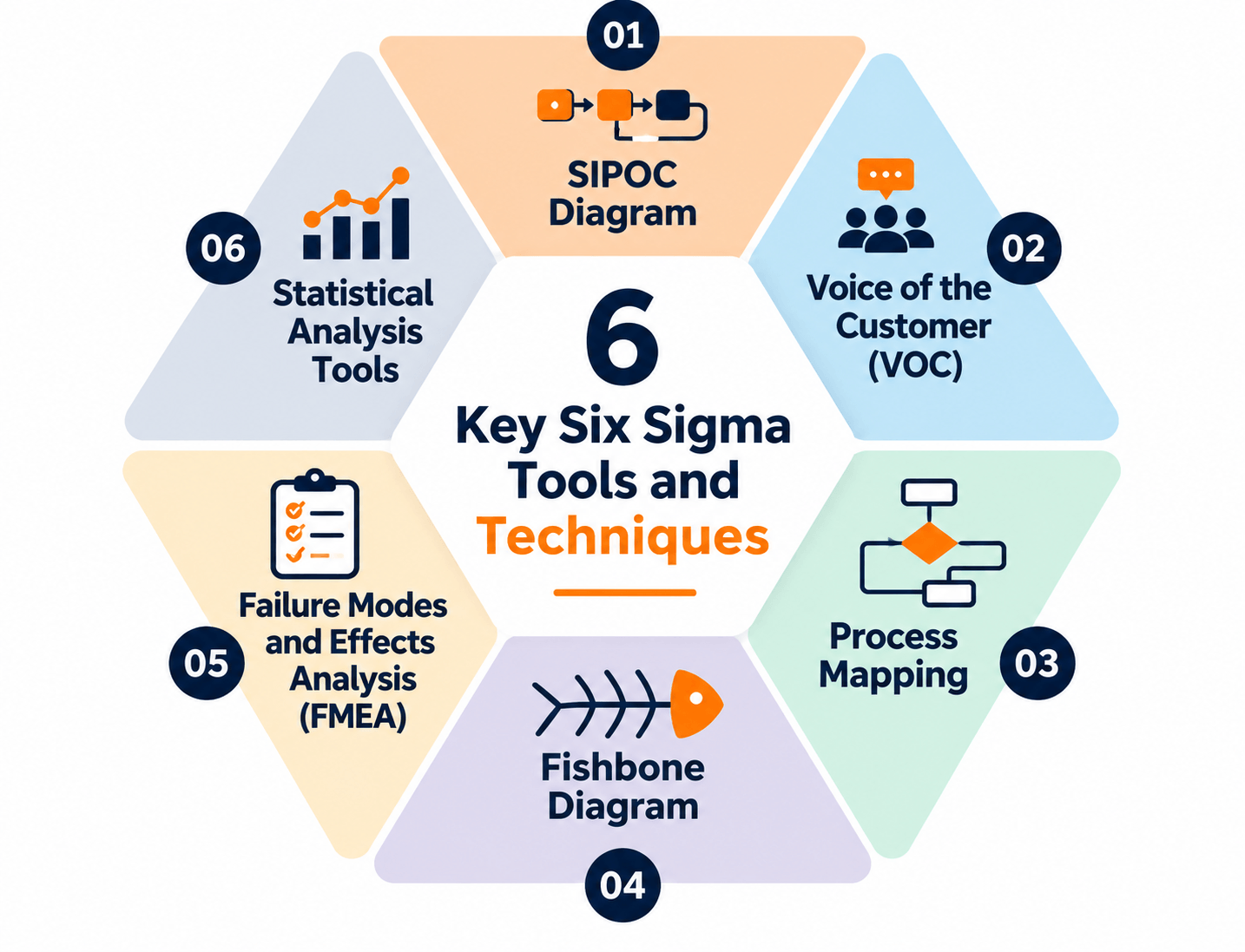
Common Six Sigma Tools and Techniques
Six Sigma uses a range of analytical and process improvement tools. The right tool depends on the problem, the data available, and the stage of the project.
1. DMAIC
DMAIC is the overall structure for improving a process that already exists. It helps teams define the problem, measure performance, find root causes, implement a solution, and keep the result.
2. SIPOC Diagram
SIPOC stands for Suppliers, Inputs, Process, Outputs, and Customers. It gives a high-level view of a process and shows its boundaries and the main people involved.
3. Fishbone Diagram
A fishbone diagram, also called an Ishikawa diagram, organizes possible causes of a problem into categories. Teams use it during root cause analysis.
4. Pareto Chart
A Pareto chart ranks issues by frequency or impact. It shows which problems account for the largest share of defects or operational trouble.
5. Control Charts
Control charts show process data over time. They help teams separate common-cause variation from a signal that a specific change may have occurred.
6. Process Mapping
A process map shows the steps in a workflow. Teams use it to find bottlenecks, unnecessary activities, repeated work, and places to improve.
7. Failure Mode and Effects Analysis (FMEA)
FMEA is a structured way to identify potential failures, understand their effects, and prioritize risks so the team can act before the failure happens.
8. Root Cause Analysis
Root cause analysis investigates why a problem occurs. The Five Whys is one technique that moves past the visible symptom to the underlying cause.
Six Sigma Belts and Roles Explained
Many Six Sigma training and certification programs use belt levels to describe knowledge, responsibility, and how involved someone is in an improvement project. Training requirements and certification standards vary by provider.
| Level | Typical Role | Main Responsibility |
|---|---|---|
| White Belt | Introductory participant | Understand basic Six Sigma concepts and support improvement activities. |
| Yellow Belt | Team member | Support projects and contribute to process improvement tasks. |
| Green Belt | Project contributor or leader | Apply Six Sigma tools and lead or support smaller improvement projects. |
| Black Belt | Improvement specialist | Lead complex projects and guide teams in advanced problem-solving. |
| Master Black Belt | Senior expert or mentor | Provide strategic guidance, coaching, and support for Six Sigma programs. |
Real-World Examples of Six Sigma in Different Industries
Six Sigma principles apply across industries because most organizations have processes they can measure and improve.
1. Manufacturing
A manufacturing company may see a high rate of defective products. A Six Sigma team can measure how often defects occur, look at machine settings and material quality, and add process controls to reduce variation.
2. Healthcare
A healthcare organization may use process improvement to reduce delays in patient registration or laboratory testing. Teams can map the workflow, measure waiting times, find bottlenecks, and test improvements while keeping appropriate patient safety standards in place.
3. Banking and Financial Services
A bank may use Six Sigma to improve loan application processing. By looking at approval stages, documentation errors, and processing delays, teams can simplify the workflow and make results more consistent.
4. Retail and E-Commerce
An online retailer may look into frequent order fulfillment errors. By examining picking, packing, inventory, and shipping, the business can see where mistakes happen and add better checks.
5. Customer Service
A customer support department may use Six Sigma to shorten response times and improve first-contact resolution. Measuring ticket categories, assignment accuracy, and resolution patterns can show where service delivery can improve.
Six Sigma vs. Lean: What Is the Difference?
Six Sigma and Lean are both process improvement approaches. They focus on different parts of operational performance.
Six Sigma focuses on reducing process variation and defects. Lean focuses on improving flow and removing activities that do not add value for the customer. Lean Six Sigma combines ideas from both.
| Comparison | Six Sigma | Lean |
|---|---|---|
| Primary focus | Reducing defects and variation | Reducing waste and improving flow |
| Main objective | Improve process consistency and quality | Deliver value with fewer unnecessary activities |
| Common approach | DMAIC | Value stream mapping and continuous flow improvement |
| Typical tools | Control charts, Pareto charts, FMEA, statistical analysis | Value stream mapping, 5S, Kanban, standard work |
| Combined approach | Lean Six Sigma integrates waste reduction with variation and defect reduction. | |
How to Implement Six Sigma in an Organization
Implementing Six Sigma takes more than a few tools. An organization needs clear objectives, leadership support, employee involvement, reliable data, and a plan for keeping the improvements.
Step 1: Identify a Process That Needs Improvement
Start with a process that has a measurable problem, such as a high defect rate, long processing times, frequent customer complaints, or repeated rework.
Step 2: Define Clear Improvement Goals
Set specific objectives that can be measured. For example, a business may aim to reduce order processing errors or improve the percentage of customer requests resolved within a target time.
Step 3: Build the Right Team
Bring together process owners, employees, managers, and people with the right analytical or quality improvement skills. Make responsibilities clear before the project begins.
Step 4: Measure Current Performance
Collect baseline data so the team understands the current process. The information needs to be accurate, and everyone needs to know how performance will be measured.
Step 5: Analyze Root Causes
Use process mapping, data analysis, and root cause investigation to understand why the problem occurs. Do not implement a change based only on an assumption.
Step 6: Test and Implement Improvements
Develop possible solutions, test them where that is practical, and compare the results with baseline performance. Implement the changes that show a measurable benefit.
Step 7: Monitor and Maintain Results
Set performance measures, assign process ownership, document the updated procedures, and review results regularly so the improvement stays in place.
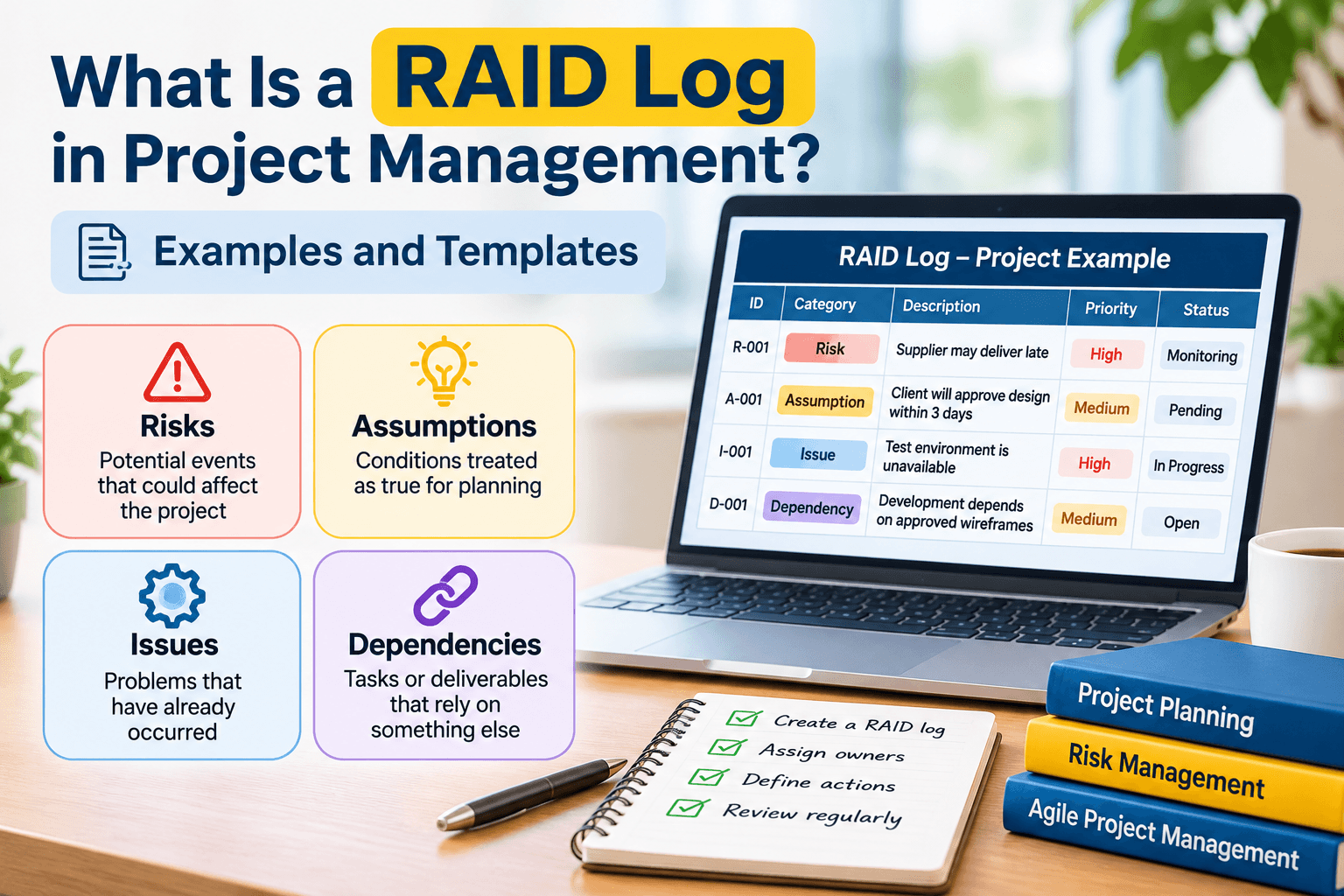
Teams can also document risks, assumptions, issues, and dependencies throughout an improvement initiative. A RAID log provides a structured way to track these items and keep project stakeholders informed.
Common Challenges When Applying Six Sigma
Six Sigma gives a structured way to improve a process, and organizations can still run into problems during implementation.
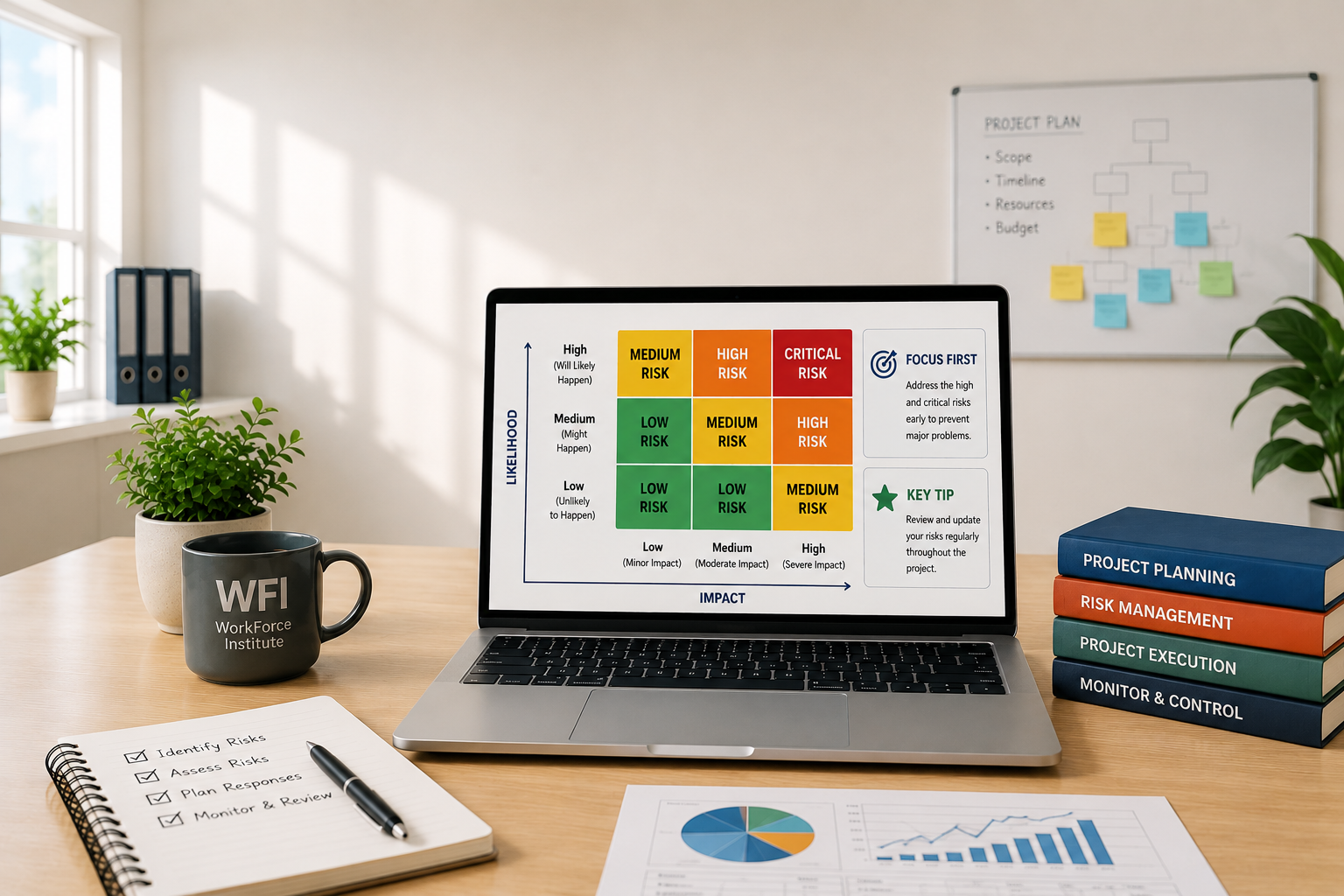
Process improvement projects can face obstacles such as resource limitations, employee resistance, and unexpected workflow changes. Applying effective project risk management practices helps teams identify potential problems early and prepare appropriate responses.
| Challenge | Why It Happens | How to Address It |
|---|---|---|
| Lack of leadership support | Improvement projects may not receive sufficient resources or attention. | Secure leadership sponsorship and align projects with business goals. |
| Poor data quality | Incomplete or inaccurate information can lead to unreliable conclusions. | Validate data sources and establish consistent measurement procedures. |
| Employee resistance | Teams may be uncertain about new workflows or responsibilities. | Communicate the purpose of changes and involve employees early. |
| Unclear project scope | Projects may attempt to solve too many problems at once. | Define specific objectives, boundaries, and measurable outcomes. |
| Failure to sustain improvements | New procedures may not be monitored or maintained. | Assign ownership, document controls, and review performance regularly. |
Frequently Asked Questions About Six Sigma Principles
What are the five principles of Six Sigma?
The five principles usually named are customer focus, understanding the process, reducing defects and variation, involving people, and using a systematic data-driven approach to improvement.
What does Six Sigma mean?
Six Sigma is a data-driven quality management methodology that aims to reduce defects and process variation. It uses statistical analysis and structured improvement methods to make processes more consistent.
What is the DMAIC process in Six Sigma?
DMAIC stands for Define, Measure, Analyze, Improve, and Control. It is a structured method for identifying process problems, measuring performance, finding root causes, implementing improvements, and maintaining results.
What are the main Six Sigma tools?
Common Six Sigma tools include SIPOC diagrams, process maps, fishbone diagrams, Pareto charts, control charts, Failure Mode and Effects Analysis (FMEA), and root cause analysis.
What is the difference between Six Sigma and Lean Six Sigma?
Six Sigma focuses on reducing defects and process variation. Lean focuses on eliminating waste and improving workflow. Lean Six Sigma combines both approaches to improve quality and operational efficiency.
Can Six Sigma be used outside manufacturing?
Yes. Six Sigma can be used in healthcare, banking, retail, customer service, logistics, information technology, and other industries where an organization wants to improve a process it can measure.
Is Six Sigma useful for project managers?
Six Sigma can help project managers identify process risks, analyze performance, reduce recurring problems, and make decisions with measurable evidence. It can sit alongside project management practices when a team is improving a workflow or delivering a project outcome.
Improve Your Project Management Skills with WorkForce Institute
Understanding Six Sigma principles is an important step toward improving business processes. However, successful improvement initiatives also require professionals who can plan projects, coordinate teams, manage risks, monitor performance, and make informed decisions.
Build the skills to manage projects more effectively and support continuous improvement across your organization.