Agile Project Management: Principles, Methods, and Real-World Examples
Organizations must finish projects efficiently even as requirements, customer expectations, and market conditions shift. Traditional project management works well when the scope stays clear, but frequent changes in priorities can expose its limits. Agile project management offers a better fit in those situations.
Agile project management breaks a project into smaller pieces, allowing teams to deliver work, hear from customers, and adjust their process as they go. It keeps collaboration and flexibility in place from start to finish. Agile methods let teams adjust as conditions change while keeping their goals in view. They apply to software development, product design, marketing, and day-to-day business work.
This guide explains Agile project management, its main principles and methods, practical examples, benefits, challenges, and the steps businesses can take to adopt it successfully.
What Is Agile Project Management?
Agile project management breaks a project into short cycles. Teams plan, do the work, gather feedback, and make improvements before moving on. Rather than follow one long sequence from start to finish, they divide the workload into smaller tasks and deliver useful results along the way.
After each cycle, the team reviews its progress and reshapes its priorities around feedback and current business needs.
Agile grew out of the Agile Manifesto, written in 2001 by software developers who wanted a more flexible, cooperative way to create software. Since then, its principles have shaped project management well beyond the software industry.
How Does Agile Project Management Work?
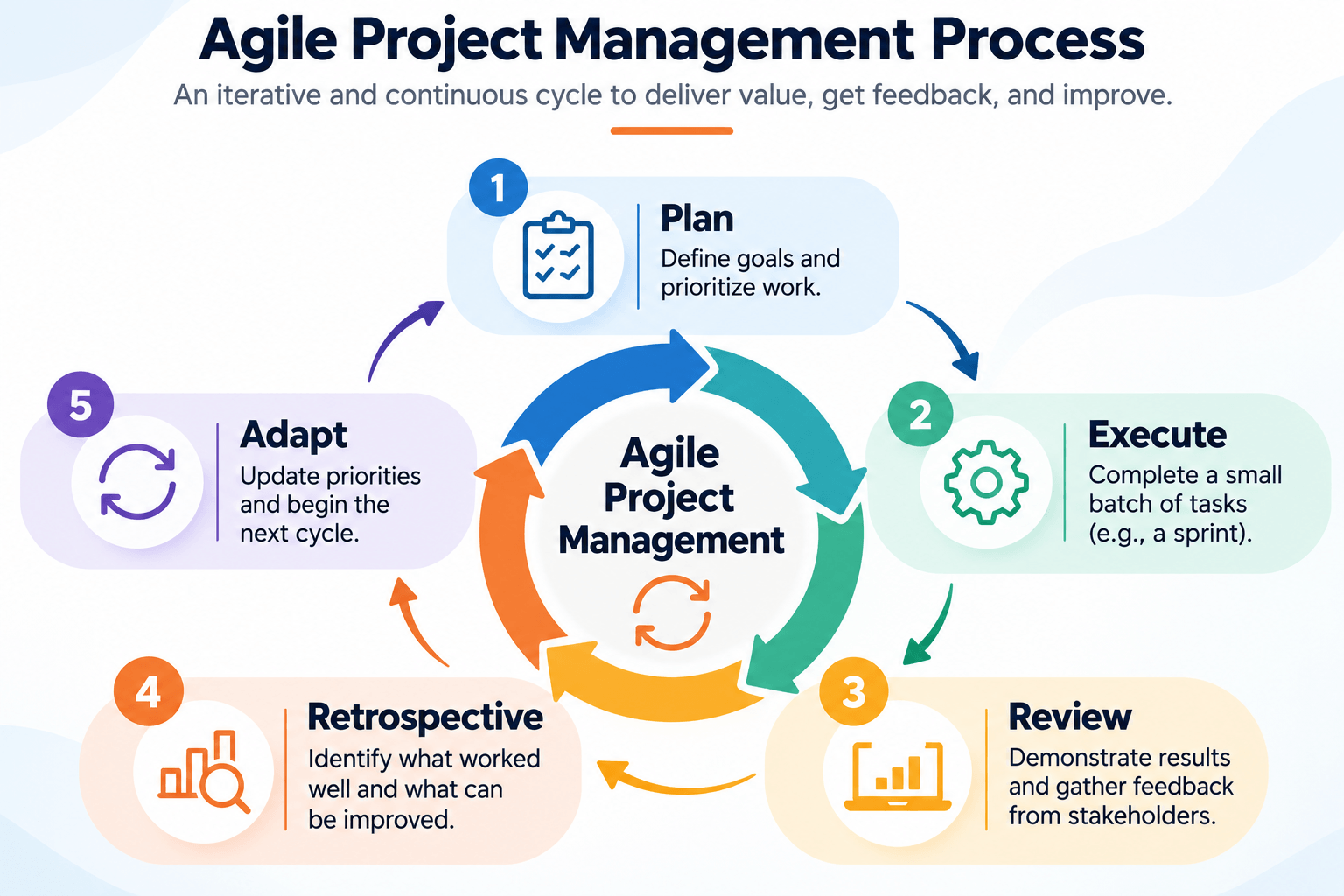
The exact approach depends on the method, but most Agile projects repeat a basic cycle:
- Plan: Set the project goal, decide what matters most, and identify the work to be done.
- Break the work into smaller tasks or deliverables so the larger objective feels manageable.
- During each short cycle, complete a focused set of tasks, then show the finished work to stakeholders and gather their feedback.
- Use that feedback to decide what worked and what needs to change next time.
- Repeat the cycle until the project meets its objectives or the product reaches the desired level of maturity.
The 4 Core Values of Agile Project Management
The Agile Manifesto rests on four core values that shape how Agile teams work. The items on the right still matter; the point is that the principles on the left deserve greater weight.
| Agile Value | What It Means |
|---|---|
| Individuals and interactions over processes and tools | Strong communication and teamwork matter more than depending entirely on software or fixed procedures. |
| Working software over comprehensive documentation | Teams focus first on delivering useful, functioning results while keeping the documentation they actually need. |
| Customer collaboration over contract negotiation | Teams stay in close contact with customers and stakeholders, shaping the product around their needs. |
| Responding to change over following a plan | When requirements or priorities shift, teams adjust instead of clinging to the original plan. |
The 12 Principles of Agile Project Management
The Agile Manifesto also sets out 12 principles that guide teams as they put Agile values into practice.
- Satisfy the customer: Provide useful work early, then keep delivering it.
- Adapt to changing requirements, using them to make the product better and add value.
- Release useful work often, ideally in short cycles.
- Bring business stakeholders and delivery teams into regular collaboration.
- Give motivated people the trust, support, and resources required to do their jobs well.
- Keep communication direct and clear so misunderstandings do not spread.
- Judge progress by working deliverables, not by activity alone.
- Work at a pace the team can sustain over time rather than pushing through short bursts of intensity.
- Strong technical work matters: Protect quality and sound design so the product can keep improving.
- Cut anything that adds effort without real value. Simpler work is easier to maintain.
- Give teams room to organize themselves and decide how to get the job done.
- Set aside time to review how the team is working, then change the process where it falls short.
Popular Agile Project Management Methods
Agile does not prescribe one method. It provides a group of values and principles that teams can put into practice through frameworks such as Scrum, Kanban, Extreme Programming, or Lean.
1. Scrum
Scrum is an Agile framework built around short, fixed-length work cycles known as Sprints. Teams usually set each Sprint to last between one and four weeks, based on what suits their work.
The framework gives teams clear responsibilities and a regular rhythm for reviewing progress and delivering valuable results.
Common Scrum accountabilities include:
- Product Owner: Sets priorities in the Product Backlog and works to increase the product's value.
- Scrum Master: Guides the team in applying Scrum and helps it work more effectively.
- Developers: Build the product increment during each Sprint.
Scrum is common in software and product development, particularly when a team needs regular planning and review cycles.
2. Kanban
Kanban gives teams a visual way to manage work and improve its flow. Tasks appear on a Kanban board and move through stages such as To Do, In Progress, and Done.
Kanban makes the full workflow visible, keeps too much work from piling up, and encourages teams to manage and improve their process continuously. It also requires clear workflow rules.
The approach suits marketing and support teams, operations departments, and other groups handling a steady stream of requests.
3. Extreme Programming (XP)
Extreme Programming (XP) is an Agile method for developing software, with particular attention to strong engineering practices and reliable results. Teams release updates often, gather feedback throughout development, and work closely together.
Common XP practices include:
- Pair programming.
- Test-driven development.
- Continuous integration.
- Frequent small releases.
- Regular refactoring supported by simple design.
XP suits software teams that must preserve quality while adapting to changing requirements.
4. Lean
Lean aims to give customers more value while cutting waste. Teams examine how work gets done, remove activities that add little to the result, and improve delivery.
Lean principles can guide software work, manufacturing, product management, and day-to-day business operations.
Agile Methods Compared
| Method | Main Focus | How Work Is Organized | Best Suited For |
|---|---|---|---|
| Scrum | Teams collaborate while delivering work in iterations | Time-boxed Sprints | Product and software development teams |
| Kanban | Teams make workflow visible and deliver continuously | A visual board with work-in-progress limits | Operations, support, and ongoing work |
| Extreme Programming | Software quality and sound engineering practices shape the work | Frequent releases and technical practices | Software teams facing changing requirements |
| Lean | Value creation and waste reduction | Continuous process improvement | Organizations improving delivery efficiency |
Agile Project Management vs. Traditional Project Management
Traditional project management methods, including Waterfall, move through a set sequence of phases. Agile takes a different route: teams work in repeated cycles, revising their plans as they learn more.
| Aspect | Agile Project Management | Traditional Project Management |
|---|---|---|
| Planning | Teams update plans throughout the work | Most detailed planning happens at the beginning |
| Requirements | Requirements may change during the project | Requirements are usually set early, with changes handled formally |
| Delivery | Work arrives in small, frequent increments | Delivery usually follows a sequence of completed phases |
| Customer involvement | Customers collaborate regularly and provide ongoing feedback | Customer input may be limited to key milestones |
| Change management | The method expects requirements to change | Changes may need formal review and approval |
| Best suited for | Projects whose requirements are still developing | Projects with stable requirements and clearly defined phases |
Neither method is always the better choice. The practical fit depends on the project's requirements and risks, the stakeholders involved, and the environment in which the work operates. Some organizations combine both methods, using Agile practices alongside traditional planning and governance.
Real-World Examples of Agile Project Management
Agile methods are not limited to software projects. Teams in other parts of a business can also work in short cycles, gather feedback early, and improve as they go.
Example 1: Software Development
A team is building a customer portal. Rather than hold the entire project until every feature is finished, it breaks the work into smaller releases.
- Sprint 1: Build user registration and login functionality.
- Sprint 2: Build the user dashboard.
- Sprint 3: Add account management.
- Sprint 4: Improve usability, guided by feedback from users.
Once a Sprint ends, stakeholders examine the working product and share their comments. The team uses that input to reset priorities before starting the next iteration.
Example 2: Marketing Campaigns
A digital marketing team is preparing to promote a new product. Rather than produce every campaign asset upfront, it tests its work in stages and adjusts the campaign as results come in.
- Start with a limited campaign rather than committing the full budget.
- Put a few chosen ads and landing pages live.
- Study the response: who engages, what converts, and what the audience says.
- Use that evidence to revise the wording, creative material, or targeting, and run the next version.
Repeating this cycle lets the team adjust its work as results come in.
Example 3: Product Development
A company is building a new mobile application. The product team starts with a minimum viable product (MVP), containing only the essential features.
Once a small group has tried the MVP, the team reviews their feedback and decides what to change or add next. That way, it does not have to build every feature before seeing how people actually use the product.
Example 4: Business Operations
An operations team is trying to handle internal requests more smoothly, so it maps each request on a Kanban board and looks for points where work gets stuck.
The team keeps the number of active tasks under control and reviews the workflow regularly. That makes delays easier to spot, helps balance assignments, and gradually improves the process.
Benefits of Agile Project Management
Used in the right setting, agile project management can make work easier to adjust and improve.
1. Greater Flexibility
Agile teams can change priorities when requirements shift. That matters when customer expectations, technology, or market conditions keep moving.
2. Faster Feedback
Regular reviews give stakeholders an early look at the work. Teams can catch misunderstandings and fix them before the cost grows.
3. Continuous Delivery of Value
Small, frequent deliveries let teams produce useful results throughout a project instead of making everyone wait for the final release.
4. Better Collaboration
Agile keeps team members, customers, and stakeholders in regular contact. That shared communication helps everyone stay aligned and prevents misunderstandings.
5. Clearer Progress Tracking
Sprint and Kanban boards give teams a quick view of what is underway, how work is moving, and where it has stalled.
Challenges of Agile Project Management and How to Overcome Them
Agile can work well, but adopting it still creates difficulties. Organizations need clear expectations and must support teams as they learn to use Agile practices.
| Challenge | Why It Happens | How to Address It |
|---|---|---|
| Unclear priorities | Requirements shift, but no clear process determines which decisions take precedence. | Keep the backlog ranked and assign decision-making responsibility. |
| Scope creep | Requests keep coming in without considering their effect on the project. | Check each proposed addition against the project's goals and remaining capacity. |
| Insufficient collaboration | Stakeholders may be hard to reach, while communication breaks down or happens irregularly. | Set recurring review meetings and agree on clear channels for updates. |
| Resistance to change | Some teams do not know Agile practices yet or would rather keep the processes they already use. | Offer training, explain why the change is being made, and introduce new practices step by step. |
| Inconsistent implementation | Teams sometimes follow Agile ceremonies without understanding the values behind them. | Prioritize results, teamwork, and ongoing improvement instead of treating the rituals as the goal. |
How to Implement Agile Project Management
Organizations can adopt Agile one practical step at a time.
Step 1: Clarify the Project Goal
Begin with the problem the project needs to address. Then describe the intended result and decide how the team will measure success.
Step 2: Select an Agile Method
The method should match the way the team works. Scrum often suits iterative product development; Kanban tends to fit work that moves continuously.
Step 3: Form a Collaborative Team
Assemble the people whose expertise the project requires, then make each person's responsibilities clear. Leave room for them to work together rather than in isolation.
Step 4: Create and Prioritize a Backlog
Turn the project into smaller tasks or user stories. Rank those items by customer value, business goals, dependencies, and risk.
Step 5: Begin with a Small Cycle
Choose a manageable piece of work and finish it before taking on more. This first cycle gives the team a practical way to improve its estimates, coordination, and delivery.
Step 6: Examine the Outcome and Collect Feedback
Present the finished work to stakeholders, then check whether it matches what they expected. Their feedback should shape upcoming priorities.
Step 7: Improve Continuously
Keep reviewing the team's way of working and make practical changes where needed. Adopting Agile takes ongoing attention; it is not a one-time implementation.
Agile Project Management Tools
Agile software gives teams a shared place to plan work, track progress, handle backlogs, and stay in touch. The best choice depends on how the team works and how complicated the project is.
- Jira: Software teams commonly use Jira to manage backlogs, Sprints, and project workflows.
- Trello: Its visual boards work well for Kanban-style task management.
- Asana: Asana helps teams organize tasks, projects, and deadlines.
- Monday.com: Monday.com provides configurable workflows for projects along with team collaboration features.
- Azure DevOps: Azure DevOps helps teams plan software work, build it, test it, and deliver it.
The tools can reinforce Agile practices, but they cannot make a team Agile by themselves. That still depends on people working well together, setting clear priorities, and improving their process over time.
Is Agile Project Management Right for Your Business?
Agile project management may suit projects with changing requirements, a strong need for customer feedback, and work that can be delivered in increments.
Agile may not fit projects that must move through fixed stages, where requirements stay locked, or where regulations demand extensive documentation and approval before work begins. A traditional or hybrid method might work better in those cases.
Before choosing Agile, ask:
- How often are the requirements expected to change?
- Can the team produce useful pieces of work in smaller increments?
- Will customers or stakeholders be available to give feedback?
- Does the organization encourage people to work together and improve their methods over time?
- Are any regulatory, contractual, or operational limits likely to affect the work?
The answers will point the organization toward Agile, a traditional method, or a hybrid approach.
Build Your Project Management Skills
Managing a project involves more than watching tasks and deadlines. Strong project managers communicate clearly, adjust when priorities shift, recognize risks early, and keep the team focused on results that matter.
As AI tools spread through project management, professionals can learn to use them responsibly for planning, reporting, risk assessment, and improving workflows.
To learn more about building project management skills for a changing business environment, explore WFI's AI-powered Project Management program.
Conclusion
Agile project management breaks work into repeated cycles, allowing teams to plan, deliver results, learn from feedback, and adjust as they go. It depends on close teamwork, regular customer input, adaptability, and a steady focus on useful outcomes.
Scrum, Kanban, Extreme Programming, and Lean each apply Agile differently, so teams can choose an approach that fits their work. Examples from practice show its value in software development, marketing, product development, and business operations.
However, Agile will not suit every organization. The right method depends on the project, how the team is organized, and the surrounding business conditions. Used with care, Agile helps teams adjust to change and produce stronger results.
Frequently Asked Questions (FAQs)
What is Agile project management in simple terms?
It means dividing a project into smaller pieces, delivering work at regular intervals, collecting feedback, and changing direction when requirements shift.
What are the 4 core values of Agile?
Agile rests on four priorities: people and their interactions come before processes and tools; working software matters more than comprehensive documentation; teams collaborate with customers rather than focus on contract negotiation; and they respond to change instead of following a fixed plan.
What are the most popular Agile project management methods?
Scrum, Kanban, Extreme Programming (XP), and Lean are widely used approaches linked to Agile principles. Each emphasizes something different, so the right choice depends on the kind of work.
What separates Agile from Scrum?
Agile describes a group of values and principles for managing and delivering work. Scrum is one specific framework built around those ideas, with defined accountabilities, events, and artifacts.
Can teams use Agile project management outside software development?
Yes. Marketing, product development, business operations, and other teams can apply Agile practices when they need to deliver work in stages, collaborate closely, and respond to feedback.
Is Agile better than Waterfall?
Neither approach wins every time. Agile tends to fit projects where requirements change and regular feedback matters. Waterfall can work better when the requirements are settled and the work needs to move through clearly defined phases in sequence.
What skills does an Agile project manager need?
They need to communicate well, work with people, set priorities, guide discussions, solve problems, adapt to change, manage risks, and help the team improve its process over time.