Project managers turn business goals into organized work. They coordinate teams, manage risks, and deliver results. As projects get more complex, and as organizations work across industries and locations, employers look for people who can show structured project leadership skills. The Project Management Professional (PMP)® certification is one way experienced project practitioners can validate those capabilities.
The Project Management Institute (PMI) offers PMP certification. It recognizes professionals who can lead projects, manage people and processes, and connect project work with business priorities. It is designed for people with practical project leadership experience, not for complete beginners.
This guide explains what PMP certification is, who can apply, the current eligibility requirements, how the exam works, what it costs, how to prepare, and which career opportunities it may support. It also covers the 2026 PMP exam update, so you can plan preparation around the current requirements.
What Is PMP Certification?
The Project Management Professional (PMP)® certification is a professional credential issued by the Project Management Institute. It shows that a project professional has experience leading projects and can apply project management knowledge across predictive, Agile, and hybrid ways of working.
PMP is an experience-based professional certification. It is not a course completion certificate. Candidates must meet PMI's education, project leadership experience, and training requirements before they can sit for the exam. They must also pass the exam and maintain the credential through continuing professional development.
PMP is not limited to one industry or one project methodology. Project professionals in technology, construction, healthcare, finance, manufacturing, consulting, and other sectors may pursue it if they meet the eligibility requirements.
Who Should Consider PMP Certification?
PMP certification is most relevant if you already lead or direct project work and want to validate those capabilities. It may be useful for:
- Project managers: Professionals responsible for planning, coordinating, and delivering projects.
- Project coordinators: Team members who support schedules, documentation, communication, and delivery activities and are building toward greater responsibility.
- Program and portfolio professionals: Practitioners who coordinate related projects or initiatives and want to strengthen their project leadership foundation.
- Team leads and delivery managers: Professionals who guide cross-functional teams, manage dependencies, and help deliver business outcomes.
- Consultants: Professionals who manage client projects and need to demonstrate structured project management experience.
- Experienced business and technology professionals: People who lead projects as part of their roles, even if their job title does not include the words project manager.
PMP is usually not the first certification to consider if you have no project leadership experience. Early-career professionals may want to explore entry-level learning or the Certified Associate in Project Management (CAPM)® certification before pursuing PMP.
PMP Certification Requirements and Eligibility
To apply, you must meet one of PMI's education and project experience pathways and complete the required project management training. The experience must involve leading projects in a professional setting, and it must fall within the applicable time window.
PMI's July 2026 eligibility outline recognizes the following pathways.
Check the current PMI eligibility page before you submit an application, especially if your qualification is from a country with a different education framework.
| Education background | Required project leadership experience |
|---|---|
| Secondary school or upper-secondary qualification | At least 60 months (5 years) of non-overlapping experience leading projects |
| Recognized associate-level, higher-certificate, or advanced technical/vocational qualification mapped to the relevant post-secondary level | At least 48 months (4 years) of non-overlapping experience leading projects |
| Bachelor's degree or higher from a recognized institution, or a formally recognized equivalent qualification | At least 36 months (3 years) of non-overlapping experience leading projects |
| Bachelor's or postgraduate degree from a program accredited by PMI's Global Accreditation Center (GAC) | At least 24 months (2 years) of non-overlapping experience leading projects |
Document project experience accurately. Overlapping project months cannot be counted more than once. Describe your responsibilities, project objectives, role, and outcomes so they reflect the work you actually performed. PMI may select applications for an audit and request supporting documentation.
Do You Need Project Management Training?
Yes. Candidates generally need 35 hours of project management education or training to apply. An active CAPM® certification can also satisfy the training requirement.
You can complete training through an eligible self-paced course or an eligible live, instructor-led course. PMI has announced a change effective December 1, 2026: live instructor-led training hours will be eligible only when delivered by a PMI Authorized Training Partner (ATP), a China Registered Education Provider (REP), or an eligible accredited academic program, including a PMI GAC-accredited program. Self-paced training can still be completed through any organization, subject to PMI's requirements.
If you completed qualifying training before December 1, 2026, PMI says it remains eligible under the requirements in effect when it was completed. Training rules can change, so confirm the latest details with PMI before you enroll in a course or submit your application.
How to Get PMP Certification: Step-by-Step
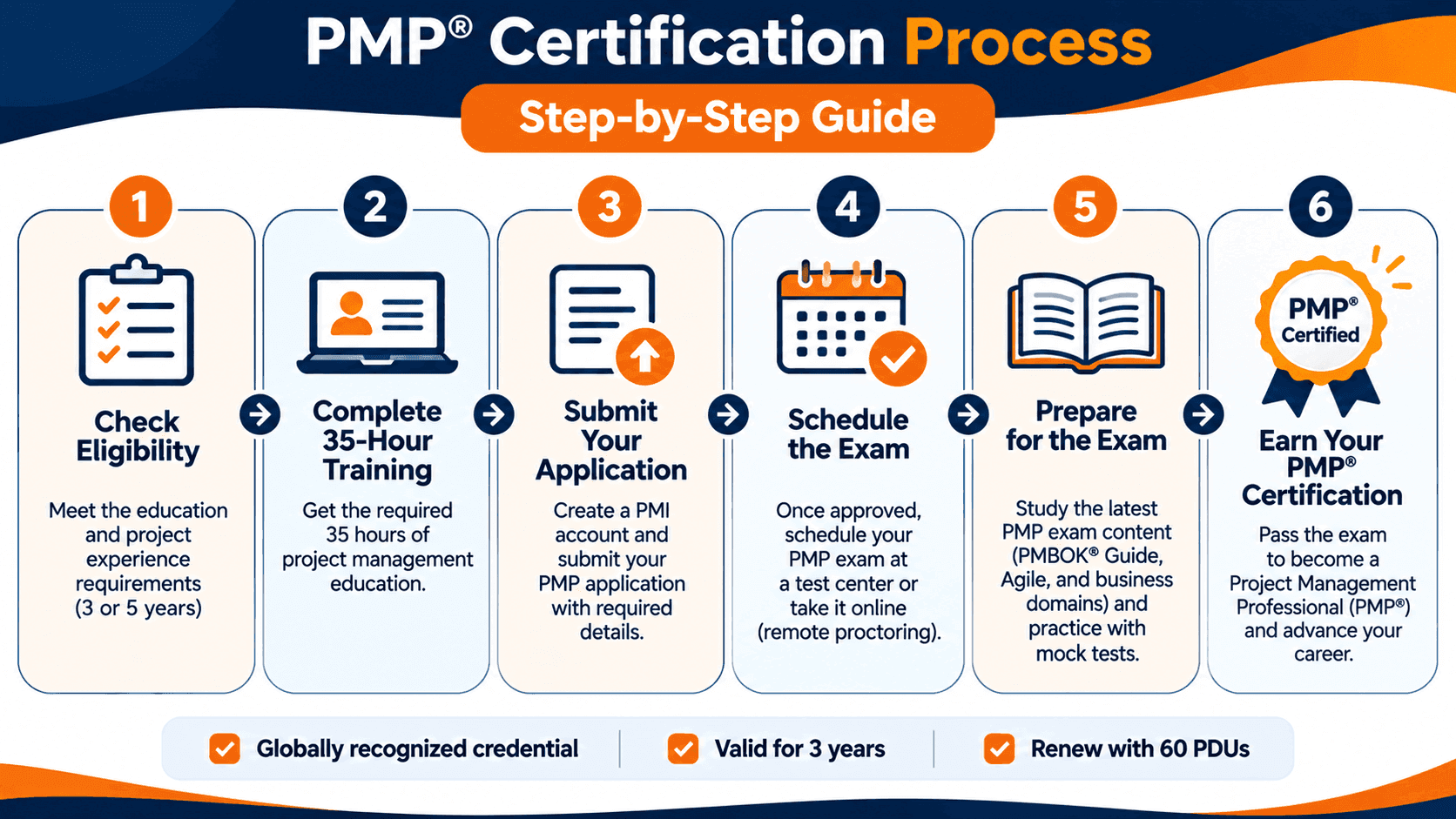
The PMP process means confirming eligibility, completing the application, preparing for the exam, passing the exam, and maintaining the credential. A clear sequence helps you avoid delays and prepare more effectively.
Step 1: Review the Eligibility Requirements
Start by identifying which education and experience pathway applies to you. Check that your project leadership experience falls within the required period and that you have the necessary months of non-overlapping experience.
Step 2: Complete the Required Training
Complete the required 35 hours of project management training unless you hold an active CAPM certification. Keep your course completion record and other supporting information in case you need to verify your training.
Step 3: Document Your Project Experience
Prepare a clear record of the projects you have led. Include the project purpose, dates, your responsibilities, and the work you performed. Focus on the leadership and delivery work you actually did, not only a job title.
Step 4: Submit Your Application to PMI
Create or sign in to your PMI account and complete the PMP application. Enter your education, project experience, and training details carefully. Make sure the dates and descriptions match your supporting records.
Step 5: Complete Any Required Audit
Some applications are selected for an audit. If yours is selected, follow PMI's instructions and provide the requested education, experience, or training documentation. Wait for PMI to confirm your eligibility before you treat the application as approved.
Step 6: Pay the Exam Fee and Schedule Your Exam
After your application is accepted, follow PMI's instructions to pay the applicable exam fee and schedule your exam. Check available testing options, dates, and locations through PMI's exam delivery process.
Step 7: Prepare and Pass the PMP Exam
Use the current PMP Exam Content Outline to guide your preparation. Study the domains, practice applying concepts to realistic project situations, and become familiar with the exam format. Once you pass, follow PMI's instructions to access and maintain your certification.
PMP Exam Structure and Topics
The PMP exam checks whether you can apply project management judgment in realistic situations. It is more than a test of memorized definitions. You need to understand project leadership, delivery approaches, stakeholder needs, business context, and how to respond when project conditions change.
According to PMI's current certification information, the exam contains 180 questions and has a total testing time of 240 minutes. The exam includes two 10-minute breaks. Check PMI's current exam guidance for the latest delivery details and available languages.
Current PMP Exam Domains
The July 2026 exam update changed the weighting of the three domains. The current distribution is:
| Exam domain | Weight | What it covers |
|---|---|---|
| People | 33% | Leading teams, supporting collaboration, managing conflict, engaging stakeholders, and developing effective working relationships. |
| Process | 41% | Planning and managing project work, delivery, scope, schedule, resources, quality, risks, and changes across different approaches. |
| Business Environment | 26% | Connecting projects to organizational strategy, governance, compliance, business value, and external factors. |
The updated exam places more emphasis on business environment and outcomes, and it still assesses people and delivery practices. It also brings AI, sustainability, and stakeholder engagement into project-based scenarios.
Use the current 2026 Exam Content Outline. Older study materials alone will not cover the updated exam.
Predictive, Agile, and Hybrid Project Approaches
PMP is not restricted to one project methodology. You should understand how to lead work using predictive, Agile, and hybrid approaches.
- Predictive approach: Work is planned in a more defined sequence, with scope, schedule, and key deliverables established early where possible.
- Agile approach: Work is delivered iteratively, with regular feedback and adaptation as requirements evolve.
- Hybrid approach: Predictive and adaptive practices are combined to suit the project's needs, constraints, and delivery environment.
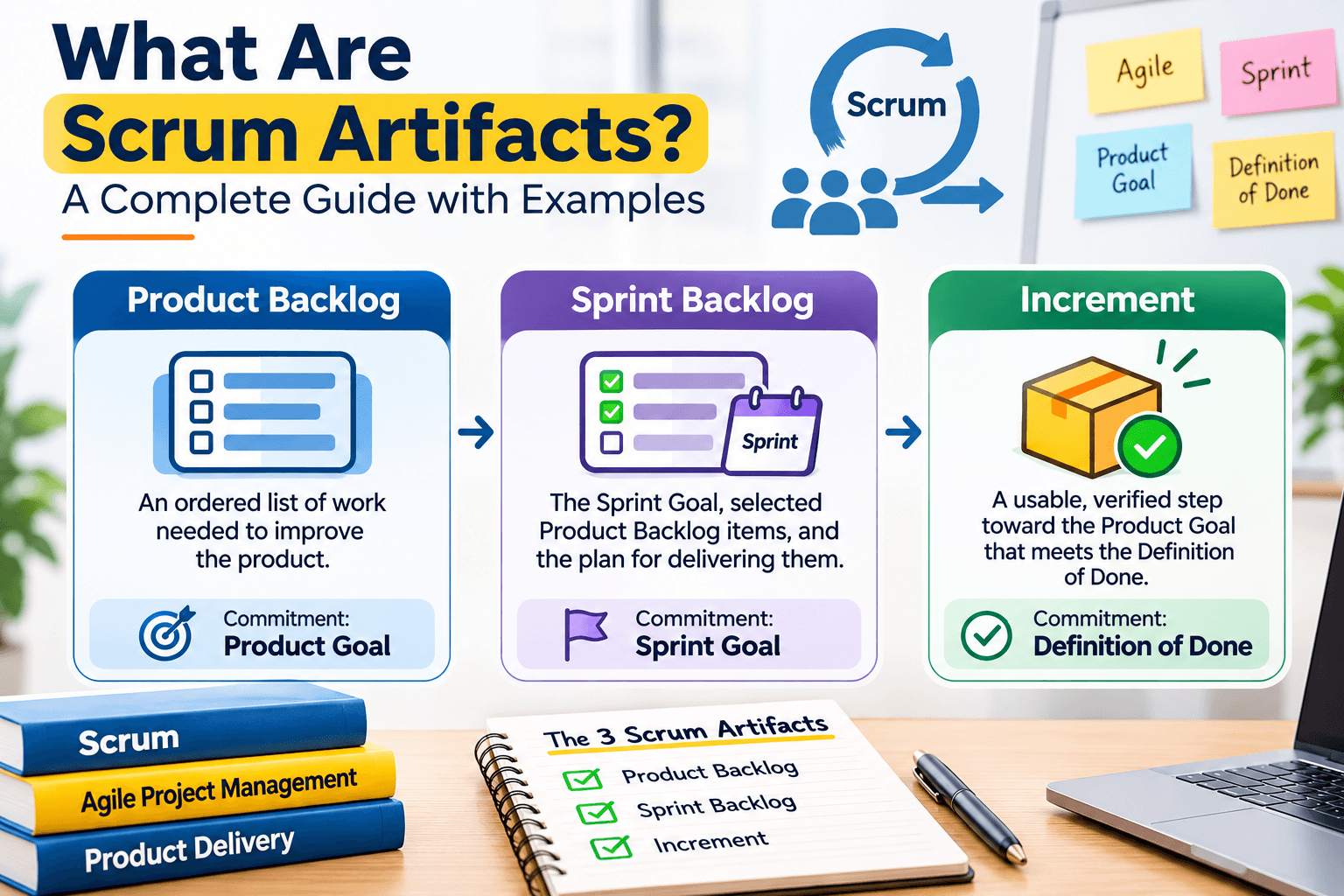
For a deeper explanation of iterative delivery, read WFI's guide to Agile project management, its principles, methods, and real-world examples.
PMP Certification Cost: What Should You Budget For?
The total cost of earning PMP certification can include more than the exam fee. You may need to budget for training, study resources, practice exams, PMI membership if you choose to join, and possible exam retakes.
PMI exam fees can vary by membership status, country or region, and current pricing policies. Do not rely on an old fee quoted in a blog or forum. Check the amount displayed in your PMI account when you apply.
| Cost component | What to consider |
|---|---|
| Exam fee | The fee shown by PMI during the application and payment process. It may differ for members and non-members. |
| Training | The cost of completing the required project management education if you do not already meet the training requirement. |
| Study materials | Books, official exam resources, practice questions, mock exams, or subscription-based preparation tools. |
| PMI membership | Optional membership may provide access to member resources and pricing benefits. Compare the membership cost with the benefits available to you. |
| Retake fee | Additional cost may apply if you need another exam attempt. Review PMI's current retake policy before scheduling. |
| Renewal | After earning PMP, you must meet continuing certification requirements and pay the applicable renewal fee. |
Before you pay for a course or exam, calculate the full cost of preparation and certification. Use PMI's official website for current pricing and policy details.
How to Prepare for the PMP Exam
Effective PMP preparation combines a clear study plan, the current exam outline, your project experience, and repeated practice with scenario-based questions.
1. Start With the Current Exam Content Outline
Download the latest PMP Exam Content Outline from PMI and use it to organize your preparation. Make sure your study resources reflect the July 2026 exam update, including the revised domain weighting and the expanded emphasis on business environment, AI, sustainability, and value delivery.
2. Build a Realistic Study Schedule
Set a target exam date only after you review your availability and preparation needs. Divide study time across the three exam domains, and reserve time for revision and practice tests. Consistent study sessions are generally easier to sustain than trying to cover everything at the last minute.
3. Learn the Concepts, Not Just Definitions
Understand why a project manager would choose a particular action in a given situation. Practice interpreting stakeholder concerns, assessing risks, handling changes, resolving conflict, and balancing delivery constraints.
4. Practice Scenario-Based Questions
Use practice questions to test how well you can apply project management principles. After each session, review both correct and incorrect answers. Focus on the reasoning behind the best response, not only the answer letter.
5. Review Predictive, Agile, and Hybrid Approaches
Be ready to identify which approach fits a project's context. Understand how planning, stakeholder engagement, team leadership, risk management, and delivery practices may differ across predictive, Agile, and hybrid environments.
6. Use Practice Exams to Measure Readiness
Full-length practice exams help you build time-management skills and find knowledge gaps. Review your performance by domain and revisit topics where your reasoning is weak. Practice under realistic time conditions as your exam date approaches.
7. Use Reliable and Up-to-Date Study Resources
Use PMI's official exam outline and current preparation resources as your primary reference. Third-party courses and practice materials can support your study if they align with the current exam.
PMI does not guarantee that any particular course or resource will ensure a passing result.
Benefits of PMP Certification
PMP certification can show project leadership experience and a structured understanding of project management. Its impact depends on your experience, industry, location, employer expectations, and career goals.
1. Demonstrates Project Leadership Knowledge
PMP is a recognized way to show that you have met defined experience, training, and examination requirements. It can help employers and clients understand the scope of your project management knowledge.
2. Supports Career Development
Some employers list PMP as a preferred or required qualification for project management roles. Earning it may help experienced professionals show readiness for roles with greater responsibility. Certification alone does not guarantee promotion or employment.
3. Builds a Shared Professional Framework
Project teams often include people from different functions, locations, and professional backgrounds. A common project management framework can make it easier to discuss scope, risks, stakeholders, delivery approaches, and performance.
4. Applies Across Industries
PMP is not tied to a single industry. Professionals may apply project management principles in technology, construction, healthcare, financial services, manufacturing, education, consulting, and many other fields.
5. Encourages Continuous Professional Development
Maintaining PMP requires ongoing professional development. That encourages certification holders to keep learning as project practices, technologies, and business expectations change.
6. Can Strengthen Professional Credibility
For experienced project practitioners, PMP can signal professional commitment and validated knowledge. Its value is strongest when it sits alongside a record of successful project delivery and relevant leadership experience.
PMP Certification and Career Opportunities
PMP certification may support career progression if you already have project leadership experience. It can be relevant to a range of roles, depending on your industry background, technical knowledge, and level of responsibility.
| Career role | Typical responsibilities |
|---|---|
| Project Manager | Plans and coordinates project scope, schedules, resources, budgets, stakeholders, risks, and delivery. |
| Senior Project Manager | Leads complex or high-impact projects, manages cross-functional teams, and coordinates senior stakeholders. |
| Program Manager | Coordinates related projects and manages dependencies to achieve broader organizational outcomes. |
| PMO Manager | Supports project governance, reporting, standards, resource coordination, and portfolio visibility. |
| Project Management Consultant | Advises organizations on project planning, delivery practices, governance, and process improvement. |
| Delivery Manager | Coordinates teams and delivery processes to help ensure products, services, or project outcomes are delivered effectively. |
Actual job requirements vary. Some positions may also require industry-specific knowledge, technical experience, people-management skills, or additional credentials.
Does PMP Certification Increase Salary?
Certification may be associated with stronger earning potential, but salary outcomes vary widely. They depend on the country, industry, role, years of experience, project complexity, employer, and local demand.
PMI's published salary information reports higher median salaries among surveyed PMP holders than among non-certified project professionals in its research. This is an association. Earning the certification does not automatically increase an individual's salary. Review current salary research for your location, and compare roles with similar responsibilities and experience levels.
PMP Certification vs. CAPM Certification
PMP and CAPM are both PMI certifications, and they serve different career stages. PMP is designed for professionals with project leadership experience. CAPM is an entry-level credential for people who want to demonstrate foundational project management knowledge.
| Comparison | PMP | CAPM |
|---|---|---|
| Typical audience | Experienced project professionals | Early-career professionals and people building project management foundations |
| Experience requirement | Requires qualifying project leadership experience | Does not require the same project leadership experience as PMP |
| Focus | Leading and directing projects across different approaches | Foundational project management knowledge and terminology |
| Career stage | Mid-career or experienced practitioners | Entry-level or career development stage |
Choose the credential that matches your current experience and goals. If you already meet PMP's experience requirements, review the PMP pathway. If you are still building project experience, CAPM may be a more suitable starting point.
How to Maintain PMP Certification
Passing the PMP exam is not the end of the certification process. PMI requires PMP holders to maintain the credential through its Continuing Certification Requirements (CCR) program.
PMP holders must earn 60 Professional Development Units (PDUs) during each three-year renewal cycle. PDUs represent qualifying professional development activities. These may include learning, teaching, creating professional content, volunteering, and other activities accepted under PMI's rules.
PMI's current CCR guidance also specifies minimum education PDUs and limits for giving-back activities. Record eligible activities in PMI's Continuing Certification Requirements System, and submit the renewal payment when it is due.
Track your renewal cycle instead of waiting until the deadline. Regular learning and professional activities make the requirements easier to meet over time.
Common PMP Certification Mistakes to Avoid
Preparing for PMP takes more than reading study material. Avoid these common mistakes during the application and exam process:
- Using outdated exam material: Older resources may not reflect the 2026 exam domains and current eligibility information.
- Misunderstanding experience requirements: Count only qualifying, non-overlapping project leadership experience and check the applicable time window.
- Writing vague application descriptions: Explain your actual role, responsibilities, and project work clearly and accurately.
- Choosing training without checking eligibility: Review PMI's rules, especially the live training provider change effective December 1, 2026.
- Memorizing without understanding: The exam tests applied judgment in project situations, so focus on reasoning and decision-making.
- Ignoring business context: The updated exam gives Business Environment a larger weighting, so study strategy, governance, value, and organizational context.
- Skipping practice exams: Practice helps identify knowledge gaps and improve time management.
- Forgetting renewal requirements: Plan for the 60-PDU renewal cycle after earning the credential.
How to Build Practical Project Management Skills
A professional certification is most valuable when it complements real project experience. Project managers need to communicate clearly, organize work, coordinate people, manage uncertainty, and keep delivery connected to business outcomes.
Practical ways to strengthen these skills include:
- Participate in projects and take responsibility for defined deliverables.
- Practice building project plans, schedules, budgets, and work breakdown structures.
- Learn how to identify, assess, and track risks, assumptions, issues, and dependencies.
- Develop stakeholder communication and conflict-resolution skills.
- Gain experience with predictive, Agile, and hybrid project delivery.
- Use project management tools to track tasks, progress, resources, and reporting.
- Learn how to evaluate project outcomes and communicate business value.
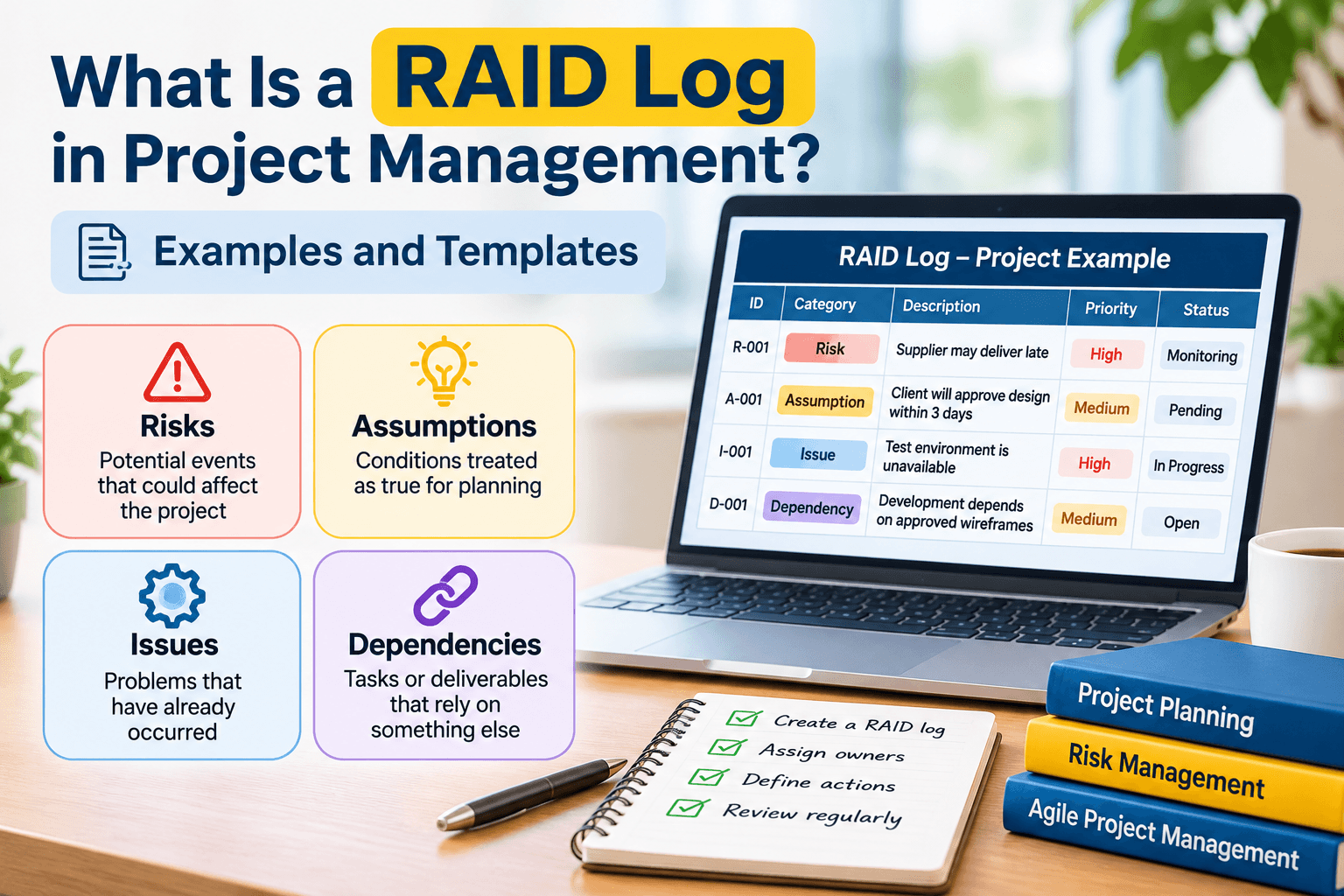
For practical examples of tracking project risks, assumptions, issues, and dependencies, explore WFI's guide to the RAID log in project management. You can also read about Agile project management methods and real-world examples to understand how teams adapt delivery approaches.
How AI Is Influencing Modern Project Management
AI tools are changing how project teams prepare information, communicate progress, and analyze delivery data. Project managers may use AI to draft status reports, summarize meetings, organize action items, identify patterns in project updates, and support scenario analysis.
AI can assist with tasks such as:
- Drafting project charters, plans, and stakeholder communications.
- Summarizing meeting notes and extracting action items.
- Organizing project risks and suggesting questions for further review.
- Preparing progress summaries and recurring status reports.
- Supporting schedule and resource scenario analysis.
- Creating first drafts of project documentation and presentations.
Review every AI-generated output. Project data may be incomplete or sensitive, and automated suggestions can be inaccurate or miss important context. Human judgment, accountability, privacy, and organizational policies remain essential.
PMI's 2026 PMP exam update also brings AI and sustainability into project-based scenarios. That reflects the wider business and technology context in which project professionals now work.
Professionals who want to develop practical project management skills alongside responsible AI workflows can explore WFI's AI-Powered Project Manager Bootcamp. The program focuses on project planning, documentation, stakeholder communication, risk management, Agile and hybrid approaches, and applying AI tools to project work. It also introduces preparation for the CAPM® certification.
Do not present the bootcamp as a PMP exam preparation or PMI-authorized PMP training course unless that status is separately confirmed.
Is PMP Certification Worth It?
PMP certification may be worthwhile if you already have substantial project leadership experience, want to validate your skills, and work where employers value the credential. It can also give you a structured reason to review project management practices and continue professional development.
It requires a real investment of time, preparation, and money. It may not be the right immediate step if you do not yet meet the experience requirements, or if your career goals do not involve leading projects.
Before deciding, consider these questions:
- Do I meet one of PMI's current education and project experience pathways?
- Can I document my project leadership experience accurately?
- Will PMP support the roles or industries I want to work in?
- Can I commit the time needed for training and exam preparation?
- Have I budgeted for the exam, study resources, and future renewal?
- Am I prepared to continue earning PDUs after certification?
If the answers align with your career goals, PMP may be a useful professional development step. If you are still gaining experience, focus first on practical project responsibilities and foundational training.
Frequently Asked Questions About PMP Certification
1. What does PMP stand for?
PMP stands for Project Management Professional. It is a professional certification issued by the Project Management Institute (PMI) for people who meet its eligibility requirements and pass the certification exam.
2. Is PMP certification difficult?
The exam can be challenging because it tests how you apply project management knowledge to realistic situations. Preparation should include the current exam outline, scenario-based questions, and a clear sense of why a particular response is appropriate.
3. How many years of experience are required for PMP?
The experience requirement depends on your education pathway. Under PMI's July 2026 eligibility outline, the pathways range from 24 months for qualifying GAC-accredited degree holders to 60 months for candidates with a secondary-school qualification. Experience must be non-overlapping and fall within the specified period.
4. Do I need a degree to get PMP certification?
No. A bachelor's degree is not the only route. PMI provides eligibility pathways for candidates with secondary-school and recognized post-secondary or vocational qualifications, each with a different project experience requirement.
5. How many training hours are required for PMP?
Most applicants need 35 hours of project management education or training. An active CAPM certification can also satisfy this requirement. Live training eligibility changes on December 1, 2026, so check PMI's current rules before you select a provider.
6. How many questions are on the PMP exam?
PMI currently lists 180 questions and a total exam time of 240 minutes. Check the official PMP page for current exam-day instructions and delivery details.
7. What are the three PMP exam domains?
The current domains are People (33%), Process (41%), and Business Environment (26%). These weightings reflect the July 2026 exam update.
8. How much does PMP certification cost?
The total cost depends on PMI's current exam fee, membership status, location, training, and study resources. Check the fee shown in your PMI account rather than relying on an outdated amount published elsewhere.
9. How long does it take to prepare for the PMP exam?
Preparation time varies with your project experience, familiarity with the exam domains, study schedule, and practice-test performance. Build a realistic plan that gives you enough time to understand the material and review weak areas.
10. Does PMP certification expire?
PMP must be maintained through PMI's Continuing Certification Requirements program. Holders need 60 PDUs in each three-year renewal cycle and must complete the renewal process.
11. Is PMP better than CAPM?
Neither is universally better. PMP is designed for professionals with qualifying project leadership experience. CAPM is intended for people building foundational project management knowledge. Choose based on your experience and career stage.
12. Can PMP certification help me get a project manager job?
PMP may strengthen your profile for roles where employers value demonstrated project leadership knowledge. Hiring decisions also depend on relevant experience, industry knowledge, communication skills, and the requirements of each position.
Conclusion
PMP certification is a recognized credential for experienced project practitioners who want to show they can lead projects and manage people, processes, and business priorities. Earning it means meeting PMI's education and experience criteria, completing the required training, preparing for the current exam, and maintaining the credential through continuing professional development.
The July 2026 exam update makes current study resources especially important. Learn the revised People, Process, and Business Environment domains. Also watch the live training eligibility change that takes effect on December 1, 2026.
Whether PMP is the right next step depends on your experience and career direction. Build practical project leadership skills, review the official requirements, and choose a learning path that supports the work you want to do next.