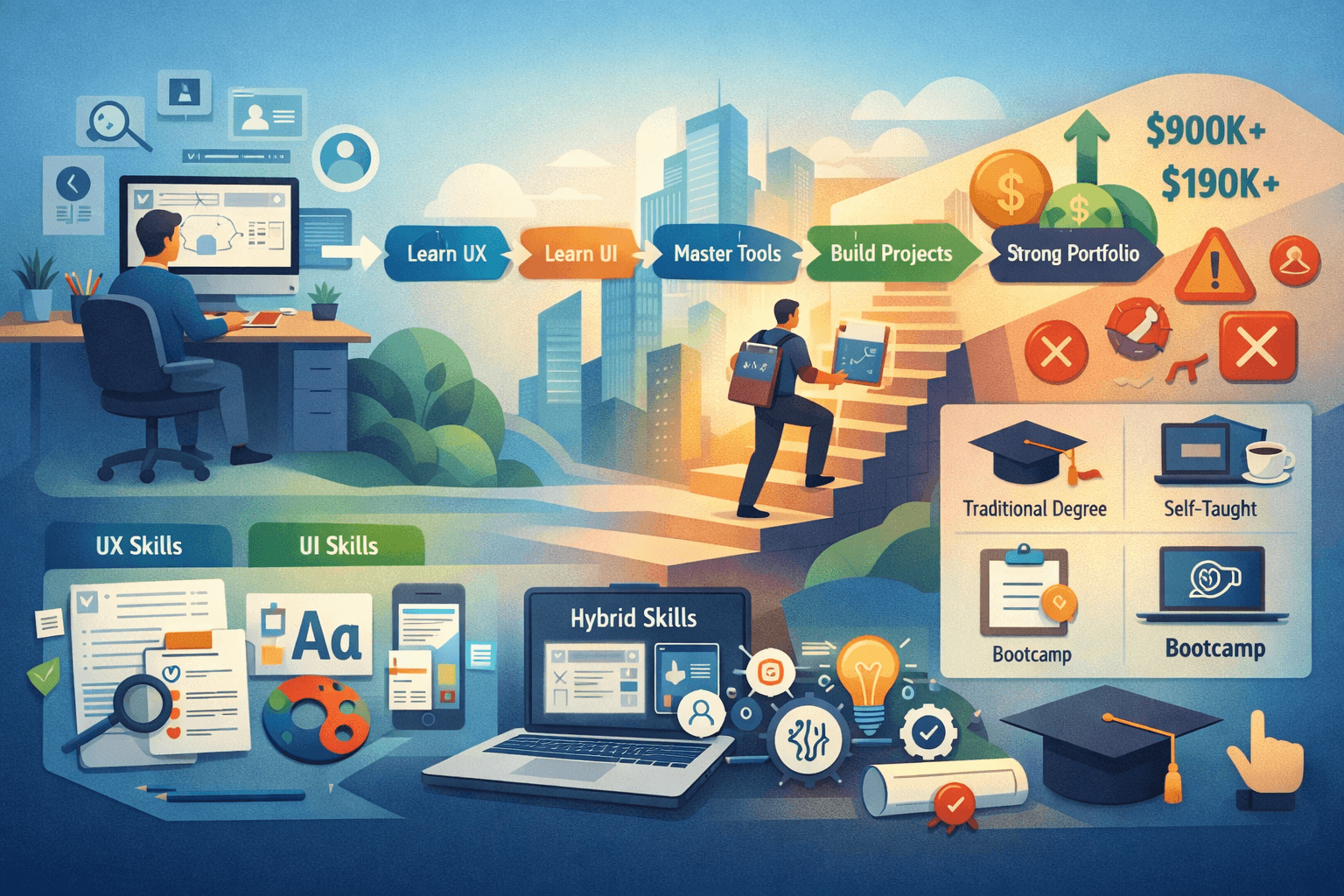
Why a Portfolio Matters More Than a Degree in UX
Breaking into UX can feel confusing. Many people think they need a costly degree first. That belief slows down smart people who already have strong
Before starting your journey toward becoming a UI/UX designer, it’s essential to understand how UX and UI work together to create successful digital products.
With the rise of AI-powered tools, digital products, and remote-first companies, UI/UX design has become one of the most attractive and future-proof career paths. Whether you're a student choosing your first career or a professional considering a career switch, UI/UX design offers flexibility, creativity, strong salaries, and global opportunities.
This guide will walk you through:
Let’s dive in.
The UX skills gap is no longer a quiet problem. It is now one of the biggest hiring blocks in tech.
In 2026, companies are hiring. Products are growing. Apps are launching. Yet teams cannot find enough job-ready UX designers.
This is not about a lack of interest. Thousands of people want to move into UX. Bootcamps are full. Online courses are everywhere. Still, hiring managers say the same thing: “We cannot find designers who are ready for real work.”
The UX skills gap exists because most training does not match what teams need today. Many designers know theory. Few can handle live projects, tight deadlines, and AI-driven tools.
For career switchers in the USA, this creates both risk and opportunity. The risk is training in the wrong way. The opportunity is entering a field where demand is high and supply is weak.
The UX skills gap is not about talent. It is
A growing number of Americans are asking the same question: is college worth it anymore?
A recent national poll found that 63% of Americans believe a four-year college degree is not worth the cost. Many people feel the price is too high for the value received. Others say college does not teach skills they can use at work.
This shift in opinion reflects real frustration. Tuition keeps rising. Wages do not rise at the same speed. Students borrow money before they earn steady income. Many finish school feeling unprepared for real jobs.
When people ask is college worth it, they are often looking for better options. They want training that leads to work. They want skills they can apply right away. They want education that respects their time and money.
User Experience (UX) Design has become one of the most in-demand careers in the digital world. As more companies invest in creating intuitive, user-friendly products and services, skilled UX designers are at the forefront of innovation. Whether it’s improving a website’s layout, designing a mobile app, or creating seamless digital experiences, UX professionals are shaping how we interact with technology every day. Thus, many people are enrolling in online courses for ux design to get potential benefits
In 2025, the UX industry continues to evolve rapidly. Businesses across sectors, from startups to Fortune 500 companies, are looking for designers who can combine creativity with data-driven insights. For anyone looking to enter this exciting field or upskill their existing des
Switching careers can feel daunting, especially if you want to enter the fast-growing world of digital design. Fortunately, bootcamp UI design programs make this transition smoother, practical, and achievable. These intensive courses teach essential skills in a focused timeframe, helping career changers quickly gain confidence and build a portfolio that impresses employers.
Career changers often need structured guidance and hands-on experience. Unlike traditional degrees, bootcamp UI design programs focus on skill mastery and real-world applications. They allow you to dive
UI/UX designers often rely on a mix of creativity, empathy, and best practices. But here’s the truth: even the most intuitive design can fail if it doesn’t align with real user behavior. That’s where A/B testing becomes a designer’s secret weapon, turning assumptions into insights and helping you design with evidence, not just aesthetics.
Design is subjective. What looks “clean” to a designer might feel “empty” to a user. What feels like a bold, modern CTA color may be interpreted as “aggressive” or “untrustworthy.”
According to HubSpot research, even small design decisions can dramatically shift performance; for example, one test showed a red button outperformed a gre
In today’s digital-first world, user experience (UX) is no longer just about aesthetics or convenience; it’s about inclusion, accessibility, and equity. Designing for all users means building digital products that serve people across different abilities, backgrounds, and contexts.
The demand for inclusive UX is rising rapidly as digital platforms reach a global audience with diverse needs. According to the World Economic Forum Future of Jobs Report 2025, by 2030, technological change and demographic shifts will transform workplaces and digital interactions globally, making human-centered and inclusive design both a business imperative and a social responsibility.
UI/UX design is no longer just about creativity; it is about creating meaningful user experiences powered by modern tools. With technology evolving rapidly, staying ahead means gaining both traditional skills and AI-driven design expertise.
Comprehensive UI/UX design course now prepares learners for real-world roles with hands-on training and career-ready portfolios. Whether you are a beginner or a professional seeking advancement, the right course can transform your future. In 2025, AI-enhanced UI/UX training has become the gold standard, equipping designers to work faster, smarter, and more effectively.
If you are curious about what makes a program worthwhile, let’s explore everything—from foundational lessons to advanced AI-driven learning—so you can confidently choos