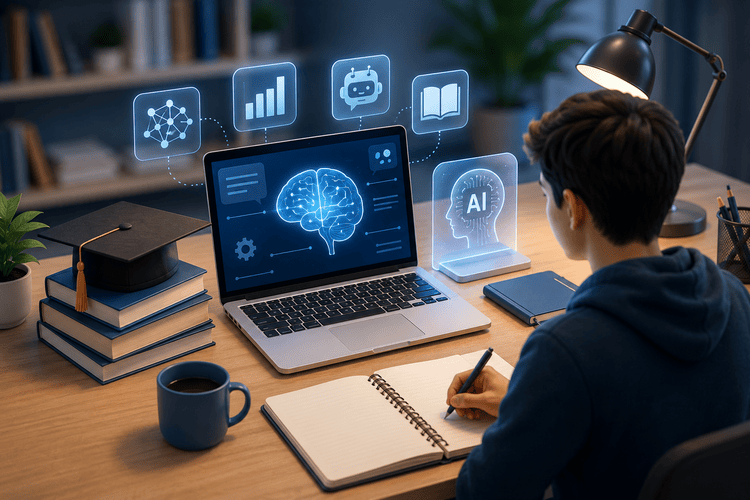
Best AI Courses for Beginners in 2026: A Practical Guide for Students
If you are a student in the United States, AI may already be part of your schoolwork, job search, and career plan. The hard part is not finding AI tools. The hard part is choosing the right training path. AI courses for beginners can help you learn the basics, build proof of skill, and decide which AI career path fits you best.
This guide explains what to look for in 2026, which AI courses make sense for new learners, and when short courses are better than a full program. It also shows how Workforce Institute can help you start with focused micro-courses, then move into a deeper bootcamp when you are ready.
Why AI Training Matters in 2026
AI is no longer only for engineers. Students now use AI for research, writing support, data work, design, code help, and project planning. Employers are also using AI tools across many teams. McKinsey’s 2025 global survey found that 88% of respondents said their organizations use AI in at least one business function.
That means students need more than basic tool use. They need judgment, practice, and proof that they can use AI well. AI courses for beginners help students move from casual use to career use.
A strong course teaches what AI is, how models work, how to write prompts, how to check results, and how to use AI in real tasks. It should also teach the limits of AI. You need to know when to trust a tool, when to check a source, and when to ask a person.
The job market also rewards strong digital skills. The National Skills Coalition found that 92% of jobs studied require digital skills. The same report said one-third of workers lack the base digital skills they need for many roles.
This gap creates a clear chance for students who upskill early. AI courses for beginners can help you build those skills before you apply for internships, part-time roles, or entry-level jobs.
What makes a good AI course for a beginner?
A good beginner course should not start with complex math or hard code. It should begin with clear ideas. You should learn what artificial intelligence means, what machine learning does, and how generative AI creates text, images, and other content.
AI courses for beginners should include hands-on work. Watching videos is not enough. You need to build prompts, test outputs, clean data, write simple reports, or create a project. A course with projects gives you proof that you can show on LinkedIn, in a resume, or in a class portfolio.
The best AI courses also teach safe and fair use. AI can make mistakes. It can give false facts, weak code, biased answers, or poor advice. A strong course teaches students how to review sources, check data, protect private details, and explain their work.
These habits matter in school and at work. They also help you stand out from students who only know how to use a chatbot.
Short courses or full bootcamp: which should you choose?
Many students ask if they should start with short courses or enroll in a full bootcamp. The answer depends on your goal, time, and budget. AI courses for beginners work best when they match your next step.
Short courses are useful when you want one skill fast. You may want to learn prompt writing, AI data basics, digital marketing with AI, or AI design workflows. Short courses help you test a subject before you commit to a larger program. They also fit busy school schedules.
A bootcamp is better when you want a deeper path. Bootcamps often include a full set of lessons, projects, career support, and a clear end goal. A bootcamp can help when you already know the field you want. For example, you may want to become an AI data analyst, AI software engineer, AI project manager, or AI-ready designer.
Workforce Institute gives students both options. Its micro-credentials page lets learners choose a subject area, select focused modules, and expand the learning path later. The page lists 54 micro-credentials across areas like AI Enhanced UI/UX Design , Digital Marketing , E-Commerce , Product Management , AI Data Analyst
Students can start with one self-paced module for $299. Workforce Institute also lists a $999 complete-course option for learners who want broader access within one category.
Best AI courses for beginners in 2026
The best AI courses for beginners are not all the same. Your best choice depends on your major, career plan, and current skill level. Here are the main course types U.S. students should compare.
1. AI foundations and prompt writing
This is the best starting point if you are new to AI. You learn what AI can do, what it ca nnot do, and how to ask better questions. Prompt writing helps you guide tools like ChatGPT, Claude, Gemini, Copilot, and other AI tools.
This skill helps students in many fields, including business, health care, design, marketing, and tech. AI courses for beginners should teach prompt structure, role prompts, examples, tone, limits, and source checks.
You should also learn how to compare outputs. Do not accept the first answer from an AI tool. Ask for sources, test the claim, and improve the prompt. This is how students move from simple tool use to real skill.
2. AI data analyst courses
AI data skills are a smart path for students who like numbers, trends, and clear answers. Data scientists use tools to find insights in data, create models, and share results with charts and reports.
The U.S. Bureau of Labor Statistics projects data scientist jobs to grow 34% from 2024 to 2034. It also reported 2024 median pay of $112,590 for data scientists.
AI courses for beginners in data should cover data basics, clean data, charts, statistics, machine learning, and model checks. Workforce Institute’s Generative AI Data Analyst course is built for beginners and says no prior AI or data analyst experience is required.
The course is 100% online and includes hands-on learning, generative AI projects, labs, and certification preparation. This makes it a strong option for students who want online courses tied to real tasks.
3. AI for software and coding
This path is best for students who already know some code or plan to study computer science. AI tools can help developers write code, review code, test code, and build apps. Yet students still need strong logic and problem-solving skills.
AI does not remove the need to understand what the code does. AI courses for beginners in coding should teach code help, debugging, testing, prompts for software tasks, and responsible use.
Workforce Institute’s AI for Software Engineers Bootcamp is a 14-week online program. It teaches AI across the software lifecycle and includes tools such as ChatGPT, GitHub Copilot, Azure AI, and Google Cloud AI.
This path is best for learners with coding basics. Workforce Institute notes that students do not need prior AI knowledge, but the program is designed for learners with a foundation in software engineering.
4. AI Enhanced UI/UX Design
Design students can use AI to speed up research, drafts, wireframes, and user testing plans. This does not replace design thinking. It gives students more ways to test ideas and improve the user experience.
AI courses for beginners in design should still teach user needs, clear layouts, research, and feedback. AI can help create first drafts, but students must decide what works for real people.
Workforce Institute includes AI Enhanced UI/UX Design micro-credentials on its micro-courses page. This is useful for students who want a design path but are not ready for a full bootcamp yet.
You can start with one design skill, then add more as your goals become clear. This flexible path can support professional development without a large first step.
5. AI in digital marketing
Marketing students can use AI for research, content ideas, audience notes, social posts, email drafts, and reports. The best AI courses for beginners in marketing teach both creativity and review.
AI can draft fast, but students still need to check the message, the facts, and the brand voice. Good marketing also needs search intent, clear copy, and a strong call to action.
Workforce Institute’s micro-courses page includes Digital Marketing as a category with 18 micro-credentials. This can be a strong path for students who want to mix AI skills with SEO, content, social media, email, and analytics.
6. AI project and product management
AI is also useful for students who want to lead teams, plan work, or build products. Project managers use AI to draft plans, track risks, summarize updates, and shape team reports. Product managers use AI to study users, write product briefs, and test ideas.
AI courses for beginners in this area should teach planning, task review, clear prompts, data-driven choices, and team communication. Workforce Institute lists Product Management micro-credentials as part of its micro-course options.
Workforce Institute also offers an AI-Powered Project Manager Bootcamp. The program is online, instructor-led, and includes real project scenarios.
How to choose the right AI course
Start with your goal. If you want to explore AI, take a short course first. If you want a job path, choose a course with projects and career support. If you want a tech role, check if the course needs coding. If you want marketing, design, data, or project work, choose a path tied to that field.
AI courses for beginners should also fit your weekly time. A busy student may do better with online courses that are self-paced. Workforce Institute’s micro-courses are designed for flexible learning. Students can start with one targeted module, build skill, then add more when they are ready.
Look for a course that gives you proof of work. Certificates help, but projects are stronger. A small portfolio can include a data report, AI prompt library, design draft, marketing plan, or software demo. This proof helps you talk about your skill in a job interview.
You should also ask if the course teaches human review. The World Economic Forum says AI and big data, analytical thinking, creative thinking, and technological literacy are set to grow in value. That means students need both tool skills and thinking skills.
Why Workforce Institute is a strong option
Workforce Institute is a strong fit for U.S. students who want practical AI training without guessing where to start. Its micro-courses are built as focused, self-paced modules. Students can choose one skill, pay $299 for a single micro-course, and expand later.
This model works well for middle-of-funnel students. You may know you need AI skills, but you may not know which career path fits. Workforce Institute lets you test the path first. Then you can move toward a full bootcamp when your goal is clear.
AI courses for beginners should make the first step simple. Workforce Institute does that by grouping learning into clear paths. You can start with AI Data Analyst if you like data. You can choose AI Enhanced UI/UX Design if you like design. You can choose Digital Marketing if you like content, search, and growth. You can choose Product Management if you want to plan and lead work.
When you are ready for a deeper path, enroll in a Workforce Institute bootcamp. The AI for Software Engineers Bootcamp is built for learners with software basics. The Generative AI Data Analyst course is better for beginners who want an entry-level AI and data path. Both give students a more complete path than a single short course.
What are the best AI courses for beginners in 2026?
The best AI courses for beginners teach AI basics, prompt writing, safe use, projects, and career use. Students should choose a course based on their target field. Data, software, design, marketing, and project management each need different AI skills. Workforce Institute’s micro-courses help students start with one focused skill, then expand into a full course or bootcamp.
Are AI courses worth it for students in the USA?
Yes, AI courses can be worth it for U.S. students who want stronger job skills. Many jobs now need digital skills, and AI is becoming part of school and work. A course can help students use AI with more care, skill, and proof. AI courses for beginners are most useful when they include projects, not just lessons.
Do I need coding to take AI courses?
No, not all AI courses need coding. Some AI courses for beginners focus on prompts, data, design, marketing, or project work. Coding is helpful for software and machine learning paths. Workforce Institute’s Generative AI Data Analyst course states that beginners can enroll without prior AI or data analyst experience. The AI for Software Engineers Bootcamp is better for students with coding basics.
What is the best first AI course to take?
The best first course is usually AI foundations or prompt writing. After that, choose a field path. If you like data, choose AI Data Analyst. If you like design, choose AI Enhanced UI/UX Design. If you like content and search, choose AI in Digital Marketing. Workforce Institute’s micro-courses are a good first step because students can start with one module.
Are short AI courses enough to get a job?
Short courses can help you build skills, but one short course may not be enough for a full job change. They are best for testing a path, adding one skill, or building a small project. A bootcamp is better if you want deeper training, more projects, and career support. AI courses for beginners should help you move from learning to proof of work.
How much do Workforce Institute micro-courses cost?
Workforce Institute micro-courses start at $299 for one self-paced module. Students can also review the $999 complete-course option when they want broader access in one category. This makes it easier to start small, then expand when ready.
What should I do after finishing a beginner AI course?
After finishing one course, build a small portfolio project. Create a data report, prompt library, design mockup, marketing plan, or simple software demo. Then add it to your resume and LinkedIn profile. When you want deeper training, enroll in a Workforce Institute bootcamp that matches your career goal.
Final take
AI courses for beginners are a smart step for students who want stronger career options in 2026. The best course is not the longest one. It is the one that matches your goal, teaches real skills, and helps you prove what you can do.
Start with Workforce Institute Micro-Credentials if you want a focused, low-risk first step. Choose Generative AI Data Analyst Bootcamp, AI Enhanced UI/UX Design Bootcamp, Digital Marketing Bootcamp, or Product Management Bootcamp based on your goals. When you are ready for a deeper path, enroll in a Workforce Institute Bootcamp and build the projects, support, and confidence you need for your next career move.