
Why a Portfolio Matters More Than a Degree in UX
Breaking into UX can feel confusing. Many people think they need a costly degree first. That belief slows down smart people who already have strong work skills. In truth, a UX portfolio often matters more than a diploma.
This is the real credential gap in UX. A hiring manager may glance at your degree, then move on fast. What holds their eye is your UX portfolio. They want proof that you can solve problems, think through user needs, and improve a product. A degree can suggest training.
A UX portfolio shows real ability. That is why a person with a free portfolio can beat someone with a $50,000 degree.
Hiring teams are not paying for school history. They are hiring for clear thinking, sound judgment, and strong UX design skills. They want to know how you work, not only where you studied.
This is good news for career switchers. If you are a teacher, retail manager, marketer, or support lead, you already know how to solve problems. You already work with people, systems, pressure, and goals.
A smart UX portfolio helps you turn that past work into visible proof for a new role.
For WorkForce Institute learners, this matters a lot. You do not need to wait for a degree to look ready. You need a UX portfolio that shows your process, your thinking, and your results. In UX, a degree is nice to have. A UX portfolio is a must-have.
What Hiring Managers Notice First
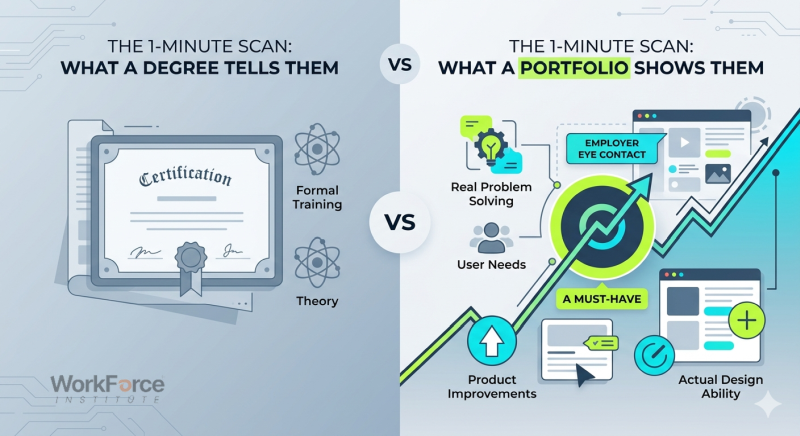
Hiring managers move fast. They may spend less than a minute on each applicant. In that first scan, your UX portfolio does far more work than your education section.
They are not starting with your college name. They are asking simple questions right away.
- Can this person solve problems like the ones on our team?
- Can this person explain their thinking clearly?
- Does this UX portfolio show real work or only polished images?
- The first thing they notice is ease of use. Is your UX portfolio clean and simple to scan?
- Can they tell what kind of work you do in seconds?
If the answer is yes, they keep reading. If the answer is no, they may leave fast.
Next, they look for relevance. They want to see projects that connect to real user needs. A strong UX portfolio helps them picture you doing the job. If your work looks clear, thoughtful, and grounded in real problems, that builds trust.
Then they look at your process. This is where many people lose the room. A weak UX portfolio jumps from problem to final screen with no clear steps between. A strong one shows how you got there. Hiring managers care about the path because the path proves your value.
"A Degree Tells Them You Studied.
A Portfolio Tells Them You Can Do the Job"
Explore the Generative AI Data Analysis Bootcamp
What Employers Want in the First 6 Seconds
The first 6 seconds are not about your resume summary INHERSIGHT. They are not about the date of your degree. They are about whether your UX portfolio looks useful, clear, and real.
Hiring managers often start with project titles and short summaries. They want to see if your UX portfolio includes actual product problems.
They look for signs that you understand users, flows, and product decisions.
They also check if you can explain your role. If you worked on a team, they want to know what you owned. A strong UX portfolio makes that obvious.
- Did you lead research?
- Build wireframes?
- Test flows?
- Refine the final UI?
Say it plainly. Writing matters too. Clear writing makes your work easier to trust. If your UX portfolio is packed with vague claims and buzzwords, it feels weak. If the writing is direct and simple, your thinking feels stronger.
Last, they want signs of impact. That does not mean every project must show huge growth numbers. A UX portfolio can still be strong if it shows what changed, what improved, and why your choices mattered.
Show the Work, Not Only the Final Screen
The best portfolios show the middle, not just the ending. A strong UX portfolio lets hiring managers see how you think through a problem. That means showing rough work. Include user flows, sketches, early wireframes, notes from research, and key design changes.
You do not need to post every draft. Your UX portfolio should still feel clean. But it should reveal enough of the process to feel real.
Why does this matter so much?
Because design teams work in the messy middle every day. They test ideas, change direction, weigh trade-offs, and revise based on feedback. A UX portfolio that shows this feels honest and ready for a job.
Case studies are the best place to do that. Each project in your UX portfolio should walk the reader through the problem, your role, your steps, and the result. Keep it simple. Keep it clear. Let the work speak. A strong UX portfolio does not act like the first idea was perfect. It shows a change. It shows thought. It shows that you can make better choices as you learn more.
Why Case Studies Matter More Than Galleries
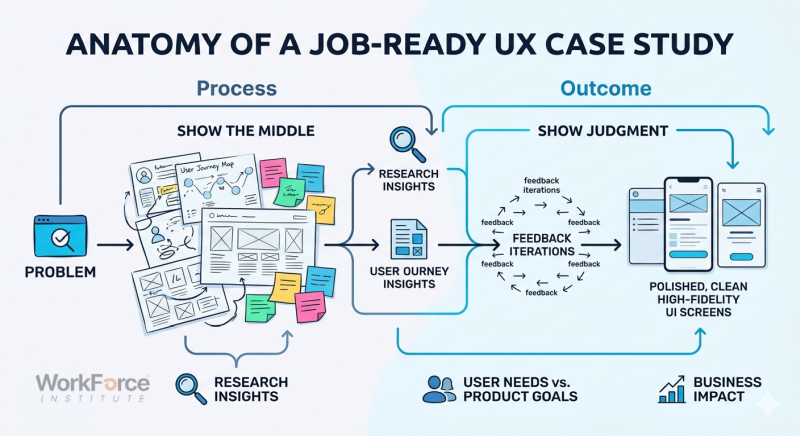
A gallery can show taste. A case study shows judgment. That is why the case study is the heart of a good UX portfolio. A case study gives context. It explains what was broken and why it mattered. It names the user problem. It explains what you did.
A UX portfolio without context leaves too much to guess. Good case studies also help with trust. Hiring managers want to know your role, your steps, and your choices. They want to see if you can connect user needs to product goals. A UX portfolio that does this well feels grounded and useful.
Every case study should answer a few basic questions.
- What problem were you solving?
- Who were the users?
- What did you learn from research?
- What ideas did you test?
- What changed after feedback?
- What did the final design improve?
A UX portfolio grows stronger when each project answers those questions.
This is also where your UX design skills become visible. Research, flow design, content structure, testing, and iteration all belong in your case studies. They matter more than a diploma line because they show your work in motion.
How to Turn Past Experience Into Strong UX Case Studies
The best-case studies often start with familiar pain points. That is why career switchers have an edge. You can build a UX portfolio around problems you have seen up close.
A former teacher might redesign a student portal or parent update tool. A retail manager might improve an employee scheduling app or in-store pickup flow. A marketer might rethink a lead form or email signup path. Each of these can become a strong UX portfolio project.
Start with a problem you know well. Then talk to real people if you can. Gather quick input, note patterns, and build around those needs. Your UX portfolio gets stronger when your choices are tied to real user pain.
Then show your process clearly. Explain the problem, the users, the gaps, and your design steps. Include wireframes, rough flows, and feedback notes. A UX portfolio built this way feels practical and strong.
For anyone making a career change, this is the bridge. You are not leaving your old skills behind. You are using them to build better case studies and stronger proof.
Common Portfolio Mistakes That Hurt Career Switchers
The first mitake is hiding your past work. A career change can feel awkward. So people try to erase their old jobs. That is a loss. Your past experience can make your UX portfolio stronger.
The second mistake is making everything look too perfect. A UX portfolio should feel polished but not staged. If you skip the process and only show final screens, trust drops.
The third mistake is using too much vague language. Claims like “passionate designer” do not help. Your UX portfolio should prove your value through clear examples, not labels.
The fourth mistake is weak role detail. If you worked on a group project, say what you did. A UX portfolio needs that clarity or hiring teams cannot judge your real skill.
Stop Waiting for Permission
A lot of people put off UX because they think they need the right degree first. That delay costs time and confidence. The truth is simple: A UX portfolio carries more weight in hiring than a formal credential.
That does not mean learning does not matter, it does. You need strong basics, useful feedback, and solid practice. But the goal of that learning is to build a UX portfolio that proves your skills.
If you are making a career change, you do not need permission from a diploma. You need structure, support, and projects that show what you can do. That is how you move from “interested” to “hirable.”
At WorkForce Institute, that is the focus. You build real projects. You sharpen your UX design skills. You learn how to create a UI/UX portfolio that hiring teams can trust. Most of all, you stop waiting and start showing proof.