
Machine learning sits behind a lot of the AI people already use. It powers recommendations, spam filters, fraud checks, and systems that have to notice a pattern and make a call. The computer is not following a rule for every case. It is learning those patterns from data.
You do not need to be a mathematician or a programmer to understand the basics. If you are curious about artificial intelligence, data science, or software, this is a useful place to start.
This guide covers what machine learning is, how a model is trained, the main types, everyday examples, common algorithms, and a practical way for beginners to begin.
What Is Machine Learning?
Machine learning (ML) is a branch of artificial intelligence and machine learning. A computer looks at examples, finds patterns, and uses those patterns to predict or decide something new. Nobody writes a separate instruction for every possible case.
Developers give the model examples instead. It studies the data, notices relationships, and then applies what it learned to information it has not seen before.
A traditional spam filter might block messages that contain a short list of words someone typed in by hand. A machine learning filter can study thousands of emails already marked as spam or as real mail, then recognize the patterns that tend to show up in unwanted messages.
Machine learning is one part of artificial intelligence, not the whole field. AI is the wider effort to build systems that do tasks people associate with intelligence. Machine learning is the part that learns from data.
How Does Machine Learning Work?
A model is trained on data so it can spot patterns and use them later. The details change with the problem, but most projects move through the same steps.
1. Collect Data
Start with information that actually relates to the question. That might be numbers, text, images, purchases, sensor readings, or something else.
A team building a house-price model might gather size, location, bedrooms, age, and what similar homes sold for.
2. Prepare and Clean the Data
Raw data is usually messy. Values are missing, records are duplicated, and formats do not match. Someone has to clean it before a model can learn from it.
That work can mean filling or removing missing values, dropping duplicates, fixing obvious errors, and putting the data into a shape the model can read.
3. Choose a Machine Learning Algorithm
An algorithm is the method the model uses to find patterns. The right one depends on the task, how much data you have, and what you want back.
A decision tree is often a fit for sorting things into categories. Linear regression is a common choice when you need to predict a number.
4. Train the Model
During training, the model studies the examples and adjusts itself so its answers get better. In supervised learning, it compares each guess with the known answer and learns from the gap. You can read more about how AI model training works.
The aim is a pattern that still works on new data, not a model that has only memorized the examples it was shown.
5. Evaluate the Model
After training, the model is tested on data it has not seen. That is how you find out whether it can make useful predictions outside the practice set.
The score depends on the job. Classification models are often judged with accuracy, precision, recall, or F1 score. Regression models are often judged with mean absolute error or root mean squared error.
6. Make Predictions and Monitor Performance
When the model is good enough for the job, it can be put to work on new data.
That is not the end of the project. Patterns in the real world shift. A model usually needs to be watched, updated, or trained again if you want it to stay useful.
Types of Machine Learning
People usually talk about four types: supervised, unsupervised, semi-supervised, and reinforcement learning. They do not use data in the same way, and they fit different problems.
1. Supervised Learning
In supervised learning, every training example comes with an answer. The model sees the input and the correct output, then learns the connection between them.
Once it has learned that connection, it can guess the answer for a new example.
Common supervised learning tasks include:
- Classification: Predicting a category, such as whether an email is spam or legitimate.
- Regression: Predicting a number, such as a house price or a monthly sales total.
Examples of supervised learning:
- Email spam detection
- Credit-risk assessment
- House-price prediction
- Customer churn prediction
2. Unsupervised Learning
Unsupervised learning starts without labels. Nobody tells the model what the right group or answer is. It looks through the data for structure on its own.
Clustering is a common version of this. Similar records get grouped together. A business might use it to find customer groups based on what people buy.
Examples of unsupervised learning:
- Customer segmentation
- Grouping similar documents
- Finding unusual patterns in data
- Discovering relationships between products
3. Semi-Supervised Learning
Semi-supervised learning uses a little labeled data and a lot of unlabeled data. It helps when labeling is expensive, slow, or needs an expert.
A company might have thousands of product photos and only a few that someone has sorted into categories. The model can learn from both the labeled photos and the unlabeled ones.
Examples of semi-supervised learning:
- Image classification with limited labeled images
- Speech recognition
- Text classification
- Medical image analysis
4. Reinforcement Learning
In reinforcement learning, an agent learns by trying things. It takes an action, then gets a reward or a penalty based on what happened.
Over time it builds a strategy, called a policy, that aims for the better reward.
A game-playing agent might get a reward for winning and a penalty for losing. By trying different moves, it finds strategies that work more often.
Examples of reinforcement learning:
- Game-playing systems
- Robotics and control systems
- Resource allocation
- Some autonomous decision-making applications
Machine Learning Types at a Glance
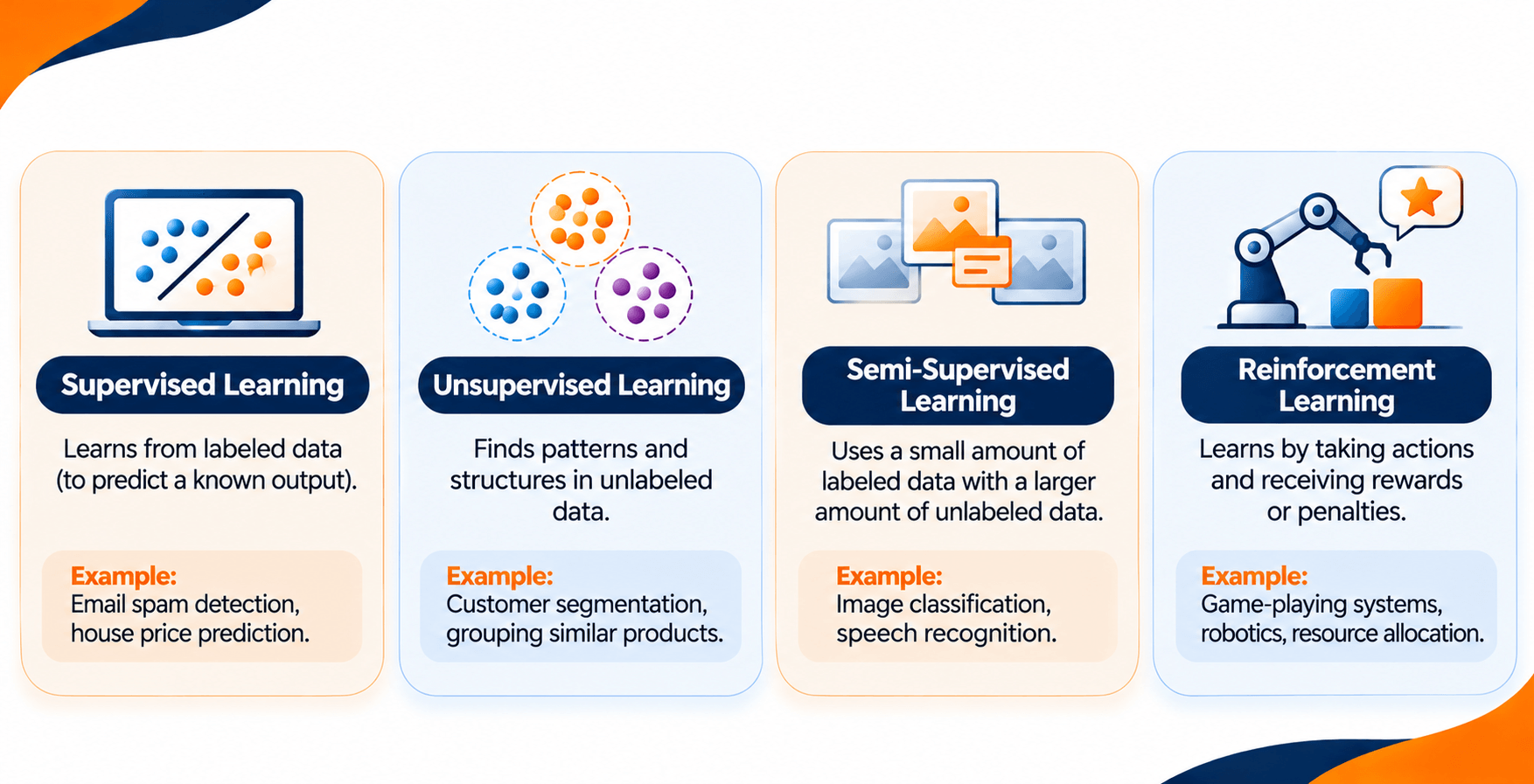
| Type | How It Learns | Example |
|---|---|---|
| Supervised Learning | Uses labeled data with known answers | Predicting house prices |
| Unsupervised Learning | Finds patterns in unlabeled data | Customer segmentation |
| Semi-Supervised Learning | Combines labeled and unlabeled data | Classifying product images |
| Reinforcement Learning | Learns through actions and rewards | Training a game-playing agent |
Real-World Examples of Machine Learning
Machine learning shows up in many industries. Some of it is obvious, like a recommendation on a streaming app. Some of it stays in the background and supports a business decision.
1. Recommendation Systems
Streaming services, online stores, and content sites use machine learning to suggest products, films, music, or articles based on what people have already done.
A system might look at what you watched, then compare that with patterns from other viewers, and suggest something you are likely to want next.
2. Fraud Detection
Banks and payment companies use machine learning to spot transactions that do not look normal. A model can weigh the amount, the place, the time, and how that person usually spends.
The point is not to decide every case alone. It is to pull the transactions that deserve a closer look to the top of the list.
3. Healthcare
Machine learning can help clinicians read medical images, notice patterns in patient data, and support some decisions. It does not replace the clinician.
A model trained on medical images might flag patterns linked to a condition. Those systems need careful testing, and a qualified professional still has to oversee how they are used.
4. Natural Language Processing
Machine learning is what lets software work with human language: chatbots, translation, sentiment analysis, and sorting text into categories.
A business might run customer reviews through a model to see whether the feedback is positive, negative, or neutral.
5. Predictive Maintenance
Factories and other industrial teams use machine learning on equipment data to notice signs that a machine may fail soon.
Catching those signs earlier makes it easier to schedule maintenance and avoid a surprise shutdown.
6. Marketing and Customer Analytics
Marketing teams use machine learning to understand how customers behave, estimate who might respond to a campaign, and tailor recommendations.
Those estimates can inform who to reach, how to engage them, and how to plan the next campaign. They are still estimates, not guarantees.
Machine Learning vs. Artificial Intelligence vs. Deep Learning
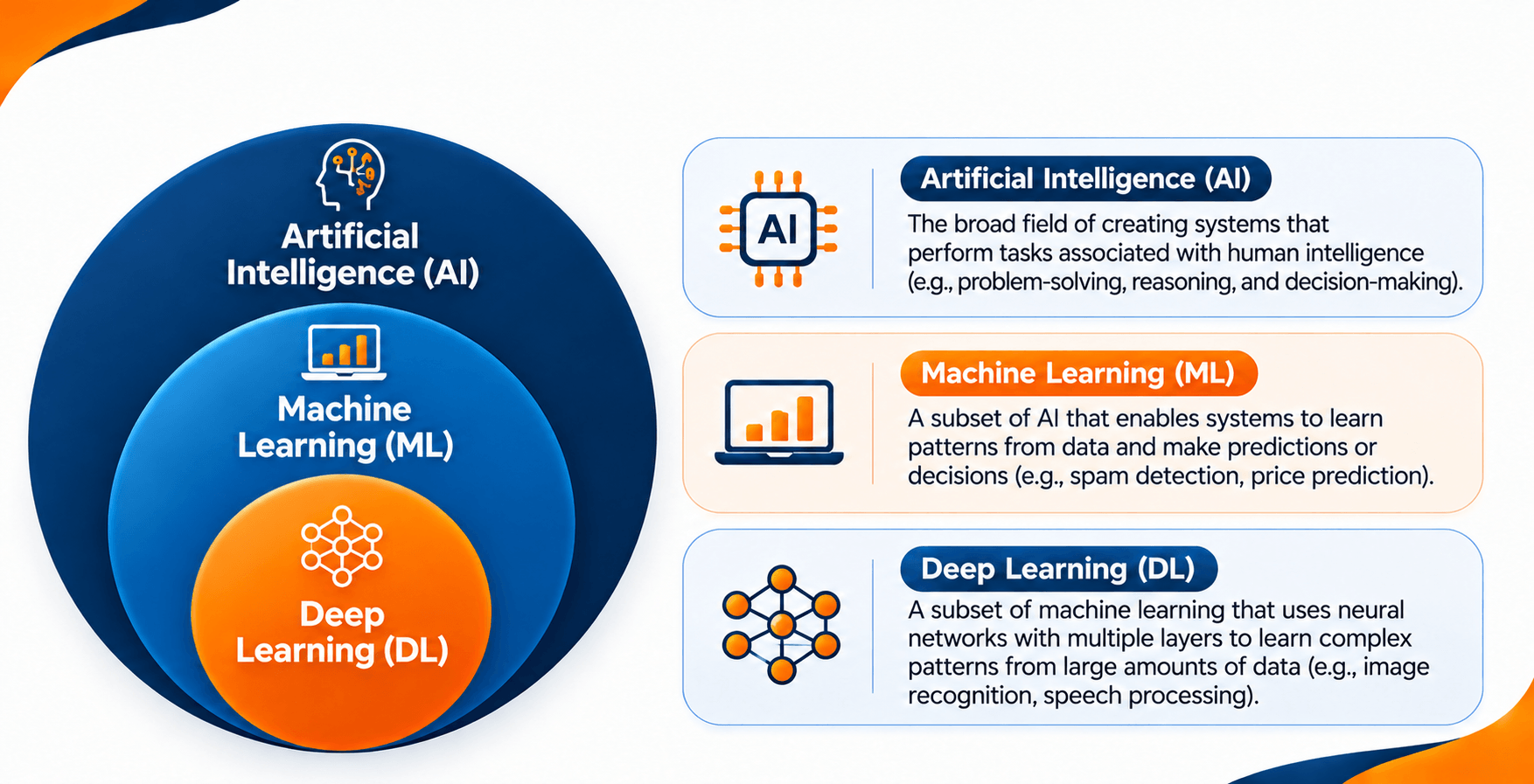
Artificial intelligence, machine learning, and deep learning are related, but they are not interchangeable.
- Artificial Intelligence (AI): The broad field of building systems that do tasks associated with human intelligence.
- Machine Learning (ML): A part of AI in which systems learn patterns from data.
- Deep Learning (DL): A part of machine learning that uses neural networks with many layers to learn harder patterns.
A rule-based expert system can be AI without any machine learning. A machine learning model might be a decision tree or a regression formula. A deep learning model uses a neural network with more than one layer.
Common Machine Learning Algorithms
Algorithms are different ways of learning from data. Some are easier to explain. Others can capture relationships that are harder to see.
| Algorithm | Common Use | How It Works |
|---|---|---|
| Linear Regression | Predicting numerical values | Models a relationship between variables using a linear equation. |
| Logistic Regression | Classification | Estimates the probability of an example belonging to a class. |
| Decision Tree | Classification and regression | Uses a sequence of decision rules to make predictions. |
| Random Forest | Classification and regression | Combines predictions from multiple decision trees. |
| K-Means | Clustering | Groups data points into a selected number of clusters. |
| Support Vector Machine (SVM) | Classification and regression | Finds a decision boundary that separates data points. |
| Neural Networks | Complex pattern recognition | Use interconnected layers of computational units to learn patterns. |
Benefits of Machine Learning
Machine learning pays off when the problem is a good fit and the data is reliable.
- Automation: Helps automate repetitive prediction and classification tasks.
- Pattern recognition: Finds relationships that are hard to spot by hand.
- Data-driven decisions: Gives teams evidence they can use in business and operational choices.
- Personalization: Supports recommendations and experiences that fit the person.
- Adaptability: Models can be trained again when new data arrives.
- Scalability: Can work through large amounts of data when the infrastructure can support it.
Limitations of Machine Learning
Machine learning is useful, and it also fails in predictable ways. Those limits matter when you decide whether a model is the right tool.
- Data quality: Poor or incomplete data leads to unreliable results.
- Bias: A model can repeat or amplify bias that was already in the training data.
- Overfitting: A model can look strong on the training set and then fall apart on new examples.
- Interpretability: Some complex models are hard to explain.
- Computational requirements: Training and running certain models takes serious computing power.
- Privacy concerns: Personal or sensitive data needs real safeguards and has to follow the rules that apply.
- Ongoing maintenance: Models need watching, and often retraining, as the data changes.
How to Get Started with Machine Learning
If you are new to this, start with the basics and add skills as you go. You do not need every algorithm memorized before you build something small.
1. Learn the Fundamentals of Python
Python is the language most people use for machine learning because so many libraries are built for it. Start with variables, data types, functions, loops, lists, dictionaries, and reading a file.
2. Understand Basic Mathematics and Statistics
You need enough statistics, probability, and algebra to see how a model learns and how a score is calculated.
Later, vectors, matrices, derivatives, and optimization become useful, especially if you want to understand neural networks.
3. Learn Data Analysis
Practice on real datasets with Pandas and NumPy. Learn to clean data, look for patterns, deal with missing values, and make a simple chart. Those same skills support roles such as a Generative AI Data Analyst.
4. Explore Machine Learning Libraries
When the basics feel familiar, try Scikit-learn for traditional algorithms. For deep learning, TensorFlow and PyTorch are the tools people use most often.
5. Build a Beginner Project
A small project is how the steps start to make sense. Pick a dataset you can finish, and pay attention to each stage instead of rushing to a score.
Beginner project ideas include:
- Predicting house prices using regression
- Classifying emails as spam or legitimate
- Grouping customers using clustering
- Predicting whether a customer may leave a service
- Analyzing sentiment in product reviews
Machine Learning Career Opportunities
Machine learning skills show up in several technology and data jobs. The day-to-day work changes with the role, the company, and how much experience you have.
- Machine Learning Engineer: Develops, trains, evaluates, and deploys machine learning models.
- Data Scientist: Uses statistics, programming, and analysis to solve business problems and explain what the data shows.
- Data Analyst: Analyzes data, builds reports, and helps a team see trends and performance.
- AI Engineer: Builds applications and systems that use AI, including machine learning models.
- Research Scientist: Studies or develops new methods in machine learning and AI.
For a beginner, Python, statistics, data analysis, and the core ideas in this guide are enough to keep going. Explore WFI’s AI and machine learning training if you want a structured way to build those skills.
Frequently Asked Questions About Machine Learning Basics
Is machine learning difficult to learn?
It can be, because it mixes programming, math, statistics, and problem-solving. Beginners can still learn it by starting with simple ideas and building small projects as they go.
Can I learn machine learning without coding?
You can learn the ideas with no-code and low-code tools. Programming, especially Python, still matters if you want to build, adjust, test, and deploy a model yourself.
What is the difference between AI and machine learning?
Artificial intelligence is the wider field of systems that do tasks associated with human intelligence. Machine learning is the part of AI that learns patterns from data.
What are the four main types of machine learning?
The four types people usually mean are supervised learning, unsupervised learning, semi-supervised learning, and reinforcement learning. They differ in how the model uses data and feedback.
What is an example of machine learning?
An email spam filter is the classic example. It learns from emails that were already labeled, then uses those patterns to sort new messages into spam or real mail.
What is the difference between machine learning and deep learning?
Deep learning is a type of machine learning that uses neural networks with many layers. It is especially useful for images, speech, text, and other data with a lot of detail.
Conclusion
Machine learning is how a computer learns patterns from data and then uses them to predict or decide. If you understand training, the main types of learning, a few common algorithms, and where these systems show up, you have a solid base for the rest of artificial intelligence.
That foundation helps whether you are heading toward data analysis, software, or AI engineering. It shows how these systems work and where they get used on real problems.
Start with the basics, practice on small datasets, and build projects that force you to use what you just learned. The more advanced ideas make more sense after you have done that a few times.