
Backend development is what keeps everyday apps, websites, and digital platforms working. It handles login requests, databases, payments, and APIs, so the product stays reliable even though users never see that work.
Companies keep investing in digital products, so developers who can build secure, scalable, and efficient server-side systems stay in demand. Learning backend development gives aspiring developers a solid technical base and a path into software engineering.
This guide covers what backend development is, how it works, the languages and frameworks developers use, the skills you need, and how to start a backend career.
What Is Backend Development?
Backend development is building and maintaining the server-side parts of a website or application. Users do not see this layer, but they depend on it every time they use the product.
Create an account, submit a form, search for a product, or pay online, and the backend takes the request. It talks to databases or other services, applies the business rules, and sends back the right response.
A backend system typically includes several components:
- Server: Receives and processes requests from the frontend or other applications.
- Application logic: Defines how the application behaves and processes information.
- Database: Stores and retrieves information such as user accounts, products, and transactions.
- APIs: Allow different applications and services to communicate.
- Authentication and authorization: Verify users and control access to protected resources.
When a customer places an order on an e-commerce website, the backend validates the order, checks product availability, calculates the total, processes the payment request, and stores the order details.
How Does Backend Development Work?
The backend connects what users see with the data, services, and business logic behind it. A simple screen can trigger several background processes with one action.
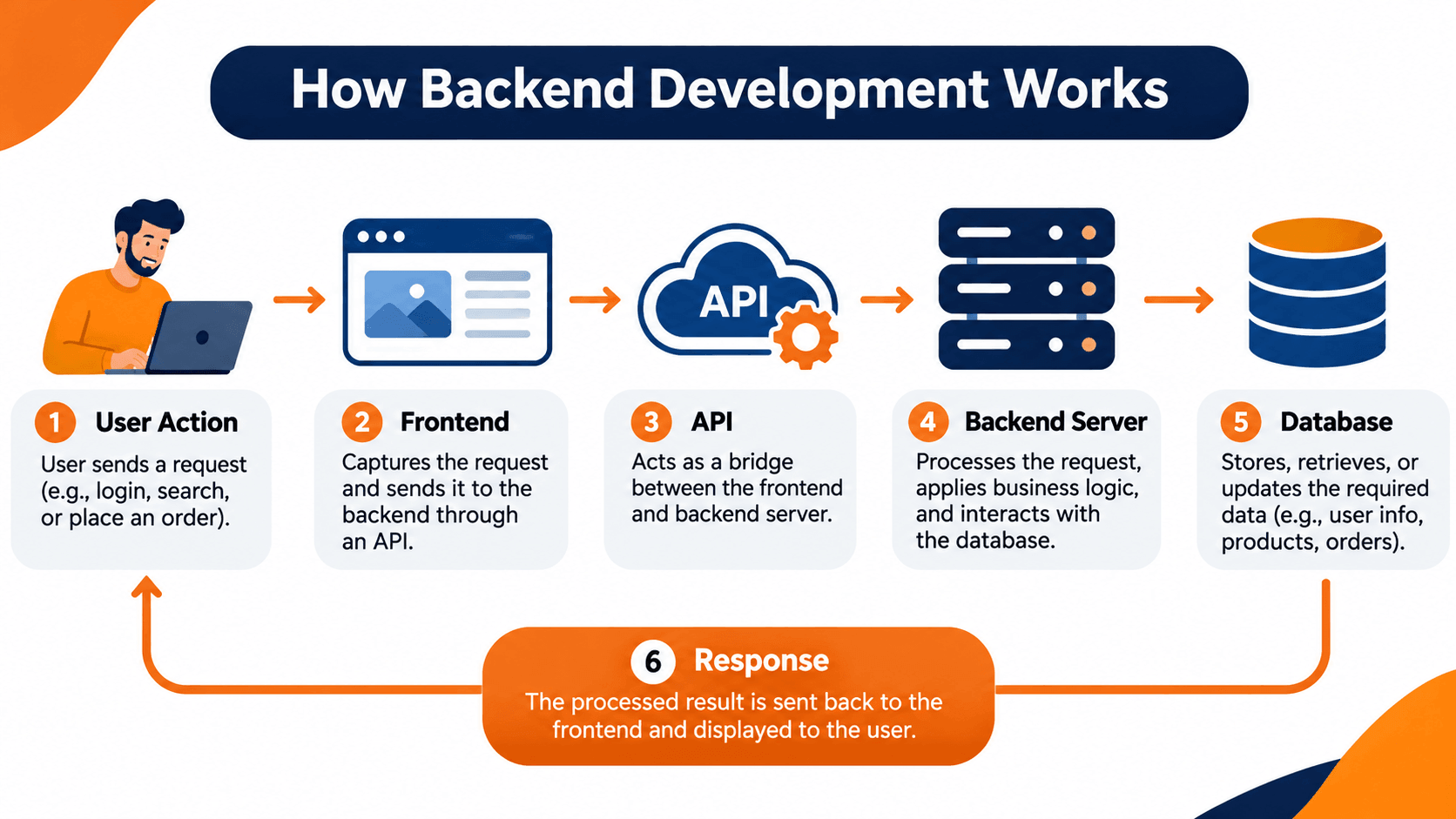
Consider what happens when a user logs into an application:
- User submits a request: The user enters their email address and password through the frontend.
- Frontend sends the request: The application sends the login information to the backend through an API.
- Backend validates the information: The server checks the submitted credentials and applies authentication rules.
- Database interaction: The backend retrieves the relevant user record from the database.
- Authentication response: If the credentials are valid, the backend creates or returns an appropriate authentication token or session.
- Frontend displays the result: The user is redirected to the application or receives an error message.
That flow shows how the backend manages data, application logic, and communication between components.
Backend Development vs. Frontend Development
Frontend and backend development both sit at the center of modern web work. They work together so an application is usable, and each side has its own job.
| Feature | Frontend Development | Backend Development |
|---|---|---|
| Main focus | User interface and user experience | Server-side functionality and application logic |
| Visibility | Visible to users | Works behind the scenes |
| Common technologies | HTML, CSS, JavaScript, React | Python, Java, PHP, Node.js |
| Primary responsibilities | Layouts, navigation, forms, and interactions | Data processing, authentication, APIs, and databases |
| Example | Displaying a shopping cart | Calculating the cart total and saving the order |
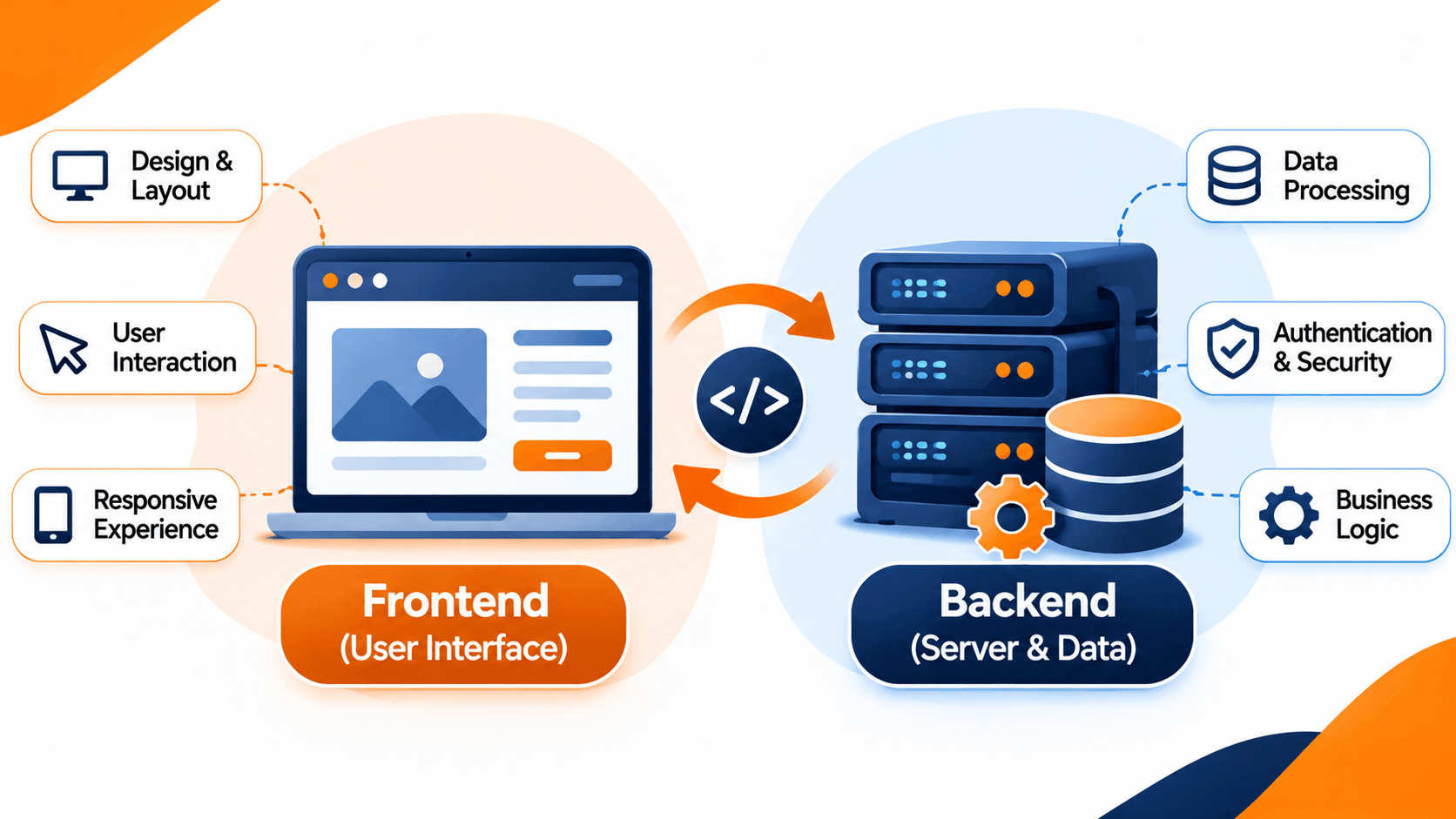
Full-stack development covers both the frontend and the backend, so one developer can work across the whole application. Many developers still specialize in one side.
Essential Backend Development Technologies
Backend developers use languages, frameworks, databases, and tools to build and maintain server-side applications. The right stack depends on the project's requirements, performance needs, existing infrastructure, and the team's experience.
1. Backend Programming Languages
Programming languages provide the instructions that control how a server-side application works. Some of the most commonly used languages in backend development include:
Python
Python is widely used because the syntax is readable and the ecosystem is large. Backend developers use it for APIs, web applications, automation systems, and data-driven services.
Popular Python frameworks include Django, Flask, and FastAPI.
Java
Java is a common choice for enterprise applications, large-scale platforms, and backend services. A mature ecosystem, an object-oriented structure, and extensive tooling make it a fit for complex business systems.
Spring Boot is one of the most popular frameworks used for Java backend development.
JavaScript and Node.js
JavaScript is used widely on the frontend, and Node.js lets it run on the server as well. Developers can then use JavaScript across different parts of a web application.
Node.js is a strong fit for APIs, real-time applications, and services that handle many concurrent connections.
PHP
PHP is a server-side scripting language used across web development and content management systems. It powers many websites and supports frameworks such as Laravel and Symfony.
C#
C# is commonly used with Microsoft's .NET ecosystem. Developers use it to create web APIs, enterprise applications, and backend services.
2. Backend Frameworks
Frameworks give developers reusable structure, libraries, and tools, so common features do not have to be written from scratch.
| Framework or Platform | Language or Ecosystem | Common Use |
|---|---|---|
| Django | Python | Full-featured web applications and data-driven platforms |
| Flask | Python | Lightweight web applications and APIs |
| FastAPI | Python | Modern APIs and high-performance backend services |
| Spring Boot | Java | Enterprise applications and microservices |
| Express.js | Node.js | Web servers and REST APIs |
| Laravel | PHP | Web applications and backend systems |
| ASP.NET Core | C# and .NET | Web applications and enterprise APIs |
The right framework depends on the application's requirements, the programming language in use, and the development team's experience.
3. Databases
Databases store the information an application needs to run. Backend developers create, retrieve, update, and delete records, and they keep that data consistent and secure.
There are two broad categories of databases:
Relational Databases
Relational databases organize information into tables with structured relationships between records. They commonly use SQL (Structured Query Language) to manage and query data.
Examples include:
- MySQL: A popular relational database used in websites and web applications.
- PostgreSQL: An advanced open-source relational database known for its features and extensibility.
- Microsoft SQL Server: A relational database management system used in many enterprise environments.
NoSQL Databases
NoSQL databases support different data models. They are useful when an application needs flexible data structures or a particular scaling pattern.
Examples include:
- MongoDB: A document-oriented database that stores data in flexible, JSON-like documents.
- Redis: An in-memory data store commonly used for caching, session management, and other low-latency workloads.
4. APIs and Backend Communication
Application Programming Interfaces (APIs) let different software systems exchange information and request services from one another.
A mobile application may use an API to retrieve a user's profile from a backend server. An e-commerce platform may also connect to payment gateways, shipping services, or inventory systems through APIs.
Backend developers commonly work with:
- REST APIs: APIs that commonly use HTTP methods such as GET, POST, PUT, PATCH, and DELETE.
- GraphQL: A query language and runtime that allows clients to request specific data through a defined schema.
- WebSockets: A communication protocol that supports ongoing, two-way communication between clients and servers.
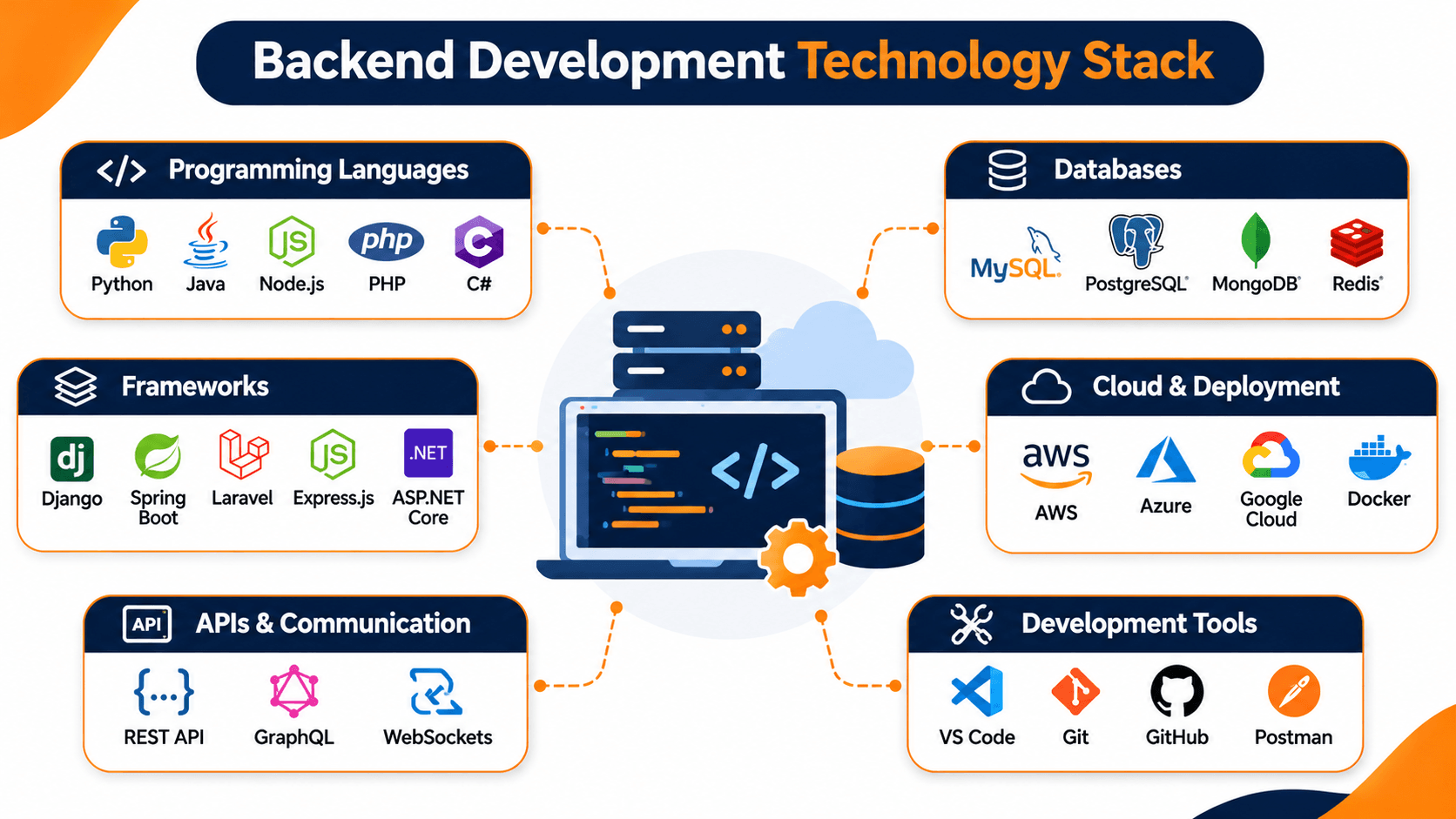
API design, request validation, error handling, and authentication are an important part of backend development.
Essential Backend Developer Skills
A strong backend developer needs more than a programming language. You also need to understand how applications run, how information moves between systems, and how to solve technical problems.
Here are some of the most important skills to develop.
1. Programming and Problem-Solving
Get comfortable writing, reading, debugging, and maintaining code. You also need problem-solving skills so you can break a complex requirement into smaller tasks and implement a reliable solution.
Data structures, algorithms, object-oriented programming, and common programming principles give you a strong foundation. Developers planning a longer-term software engineering career can also explore our guide on how to become an AI software engineer in 2026, which covers engineering foundations, technical skills, and practical learning steps.
2. Database Management
Learn how to design database structures, write queries, manage relationships, and retrieve information efficiently. Indexing, transactions, data validation, and database performance belong in that skill set too.
3. API Development and Integration
APIs connect applications with backend services and external platforms. You should know how to create endpoints, validate requests, return appropriate responses, document APIs, and handle errors.
4. Authentication and Security
Backend systems often handle sensitive information, so security is part of the job. Learn password hashing, access control, secure authentication, input validation, and common web application vulnerabilities.
Also learn how to protect applications against SQL injection, cross-site scripting, and unauthorized access.
5. Version Control with Git
Git tracks code changes, helps you collaborate with other team members, and manages different versions of a project. GitHub and GitLab make it easier to review code and coordinate development work.
6. Testing and Debugging
Testing catches errors before they reach users. Learn unit testing, integration testing, debugging techniques, and how to investigate application logs.
7. Cloud and Deployment Fundamentals
Many modern applications run on cloud infrastructure. It helps to understand hosting environments, deployment processes, environment variables, containers, and basic cloud services.
AWS, Microsoft Azure, or Google Cloud can also be useful, depending on the organization and the project.
8. Communication and Collaboration
Backend developers work with frontend developers, designers, testers, project managers, and other engineers. Clear communication, documentation, teamwork, and the ability to explain technical decisions are part of the job.
What Does a Backend Developer Do?
A backend developer builds and maintains the server-side functionality of websites, applications, and digital platforms. Daily work changes with the organization and the project, and commonly includes:
- Writing and maintaining server-side code.
- Designing, developing, and maintaining APIs.
- Creating and managing database structures.
- Implementing authentication and authorization systems.
- Integrating third-party services and external APIs.
- Testing and debugging application functionality.
- Improving application performance and reliability.
- Monitoring backend services and resolving production issues.
- Collaborating with frontend developers and other technical teams.
- Maintaining documentation and following coding standards.
On an online learning platform, a backend developer may build the systems responsible for student registration, course enrollment, lesson access, progress tracking, and payment processing.
The Backend Development Process: Step by Step
Building a backend takes more than writing code. Developers follow a structured process to understand requirements, design the architecture, implement functionality, test the application, and maintain it after deployment.
Step 1: Understand Project Requirements
Before development begins, the team identifies what the application needs to do. That includes user roles, required features, data requirements, integrations, performance expectations, and security considerations.
Step 2: Design the Backend Architecture
Developers decide how the system will be structured and how its components will communicate. This may involve choosing a programming language, framework, database, API approach, and hosting environment.
Step 3: Design the Database
Next, plan how application data will be stored. Developers define tables or collections, relationships, constraints, and other database structures based on the application's requirements.
Step 4: Develop Backend Functionality
Developers implement the business logic, API endpoints, authentication, database operations, and integrations the application requires.
Step 5: Test and Debug
The backend is tested for errors, security issues, performance problems, and unexpected behavior. Developers may use automated tests and manual testing to verify that the system works as intended.
Step 6: Deploy the Application
After testing, the backend is deployed to a server or cloud environment. Developers configure the production environment, database connections, security settings, and other required services.
Step 7: Monitor and Maintain
The work continues after launch. Developers monitor performance, fix bugs, apply security updates, improve existing functionality, and adapt the system as business requirements change.
Popular Tools Used in Backend Development
Backend developers use a range of tools throughout the development lifecycle. These tools support coding, testing, collaboration, database management, deployment, and application monitoring.
| Tool | Purpose |
|---|---|
| Visual Studio Code | Code editing and development |
| Postman | Testing and sending API requests |
| Git | Version control and code management |
| GitHub | Code hosting and team collaboration |
| Docker | Containerizing applications and managing consistent environments |
| MySQL Workbench | Working with MySQL databases |
| pgAdmin | Managing PostgreSQL databases |
| Jenkins | Automating build and deployment workflows |
You do not need to master every tool at the beginning. Start with the tools that support your programming language, framework, and project requirements.
Backend Development Best Practices
Working code is only one part of backend development. Professional developers also focus on making systems secure, maintainable, reliable, and efficient.
Some important best practices include:
- Write clean and maintainable code: Use meaningful names, consistent formatting, reusable functions, and clear project structures.
- Validate user input: Never assume that information received from a client is safe or correctly formatted.
- Protect sensitive information: Use secure password hashing and avoid exposing credentials or private data.
- Use efficient database queries: Review queries, indexes, and data access patterns to avoid unnecessary processing.
- Handle errors properly: Return appropriate responses without exposing sensitive internal details.
- Test important functionality: Use automated and manual testing to catch problems early.
- Document APIs and systems: Clear documentation helps other developers understand and use the backend.
- Monitor application performance: Review logs, errors, and performance metrics to identify problems.
How AI Is Changing Backend Development
Artificial intelligence is changing how software developers plan, write, test, and maintain applications. AI-powered tools can support routine tasks and improve a development workflow.
You still need strong technical knowledge to evaluate the results. Review generated code, tests, and documentation for correctness, security, and maintainability.
Some practical applications of AI in backend development include:
1. Code Assistance
AI coding assistants can suggest code, explain unfamiliar functions, generate boilerplate, and help developers explore possible solutions. Developers must still review generated code for correctness, security, and maintainability.
2. Debugging Support
AI tools can help interpret error messages, explain potential causes, and suggest debugging approaches. They can make troubleshooting faster, especially in an unfamiliar codebase.
3. Automated Testing Support
AI-assisted tools can help generate test cases, identify possible edge cases, and support test maintenance. Human review remains important so the tests accurately reflect application requirements.
4. Documentation
AI tools can assist with drafting technical documentation, explaining API behavior, and summarizing code. Developers should verify the output against the actual implementation. For more examples of how AI is changing everyday coding workflows, explore WFI's AI software engineering articles.
5. Building AI-Powered Backend Features
Backend developers can also integrate AI services into applications through APIs. Examples include intelligent search, recommendation features, chatbots, document processing, and automated content classification.
Developers who want to explore the intersection of software engineering and artificial intelligence can learn more about WFI's AI Software Engineers Bootcamp, which focuses on developing skills for modern AI-driven software development. You can also read our related guide to becoming an AI software engineer to understand the broader skills and learning path.
Backend Developer Career Opportunities
Backend skills can open doors to different roles across software engineering and technology. The options depend on your experience, technical strengths, and the types of systems you want to build.
1. Junior Backend Developer
Junior backend developers work on smaller development tasks with guidance from experienced engineers. They may build API endpoints, fix bugs, write database queries, and help maintain existing applications.
2. Backend Developer
Backend developers build and maintain server-side functionality, develop APIs, manage databases, and integrate external services. They are expected to work more independently and contribute to technical decisions.
3. Senior Backend Developer
Senior backend developers handle complex technical challenges, improve application architecture, review code, and mentor junior developers. They also help keep systems reliable as they grow.
4. API Developer
API developers specialize in designing, building, documenting, and maintaining interfaces that allow different applications and services to communicate.
5. Software Engineer
Software engineers work across different stages of the software development lifecycle. Depending on their specialization, they may focus on backend systems, application architecture, integrations, or broader software solutions. You can also read about AI software engineering career paths and related topics as the field continues to evolve.
6. DevOps or Cloud Engineer
Developers with additional experience in infrastructure, automation, cloud platforms, and deployment can explore DevOps or cloud engineering roles. These positions focus on the systems and processes used to build, deploy, and operate applications.
How to Become a Backend Developer
You do not need to learn every programming language or framework at once. Start with the fundamentals, then build the skills required to develop complete applications.
Step 1: Learn Programming Fundamentals
Choose one backend-friendly programming language, such as Python, Java, JavaScript, PHP, or C#. Learn variables, data types, conditions, loops, functions, error handling, and object-oriented programming.
Step 2: Understand Data Structures and Algorithms
Learn common data structures such as arrays, lists, stacks, queues, hash maps, and trees. Practice basic algorithms and problem-solving exercises so you can write more efficient code.
Step 3: Learn SQL and Database Fundamentals
Start with a relational database such as MySQL or PostgreSQL. Practice creating tables, writing SQL queries, joining records, and managing data relationships.
Step 4: Choose a Backend Framework
Once you understand the programming language, learn a framework that supports it. Python developers can explore Django or FastAPI. JavaScript developers can start with Node.js and Express.
Step 5: Build and Test APIs
Learn how HTTP requests and responses work. Build simple REST APIs, study request validation and status codes, and practice testing endpoints with tools such as Postman.
Step 6: Learn Git and Development Workflows
Use Git to track changes and manage your projects. Create repositories, write meaningful commit messages, and learn how branches and pull requests support team collaboration.
Step 7: Build Practical Projects
Practical projects turn theoretical knowledge into development experience. Start with small applications, then add more advanced functionality.
Some project ideas include:
- Task management API: Build endpoints for creating, updating, assigning, and completing tasks.
- Blog management system: Create user accounts, publish articles, manage comments, and control access.
- E-commerce backend: Develop product management, shopping cart, order processing, and inventory functionality.
- Student management system: Store student records, manage course enrollment, and track academic information.
- Authentication service: Implement registration, login, password hashing, and protected routes.
Step 8: Learn Deployment and Cloud Basics
Learn how to configure an application for production, manage environment variables, connect databases, and deploy backend services. Explore Docker and a cloud platform when you are comfortable with the fundamentals.
Step 9: Create a Technical Portfolio
Publish selected projects on GitHub with clear README files, setup instructions, API documentation, and screenshots where relevant. A well-organized portfolio helps show your practical abilities to potential employers. If you are considering how to build on these foundations with AI-focused engineering skills, read WFI's software engineering and AI learning resources.
Common Backend Development Challenges
Backend development comes with technical challenges that developers need to understand and address throughout a project's lifecycle.
Managing Complex Data
Applications can generate and process large amounts of information. Developers need to design appropriate database structures, optimize queries, and maintain data consistency.
Maintaining Application Security
Backend systems may store personal information, payment-related data, and business records. Weak security practices can expose this information to unauthorized users.
Handling Increased Traffic
As an application grows, more users may access it at the same time. Developers need to consider performance, caching, database optimization, and infrastructure capacity.
Integrating External Services
Applications often depend on third-party services such as payment providers, email platforms, analytics systems, and identity providers. Developers must handle API errors, authentication, timeouts, and changes in external services.
Maintaining Existing Systems
Backend developers often work with applications that already contain years of code and data. Understanding the existing system, reducing technical debt, and introducing changes without breaking functionality are important parts of the job.
Future Trends in Backend Development
Backend development continues to evolve as businesses adopt new technologies and application architectures. Build strong fundamentals, and stay aware of changes in the industry.
- Cloud-native development: More applications are designed to use cloud infrastructure, managed services, and scalable deployment environments.
- Microservices architecture: Some organizations divide large applications into smaller services that can be developed and deployed independently.
- Serverless computing: Serverless platforms allow teams to run application code without directly managing the underlying server infrastructure.
- AI integration: Backend systems increasingly connect with AI services to provide features such as intelligent search, recommendations, and automation.
- Improved application security: Secure development practices, identity management, and continuous monitoring remain essential as systems become more interconnected.
- Automation and DevOps: Automated testing, deployment pipelines, and infrastructure management help teams deliver and maintain software more efficiently.
These trends still depend on core backend skills. Programming, databases, APIs, security, and problem-solving remain important foundations for developers working with modern technologies.
Frequently Asked Questions About Backend Development
1. What is backend development in simple terms?
Backend development is the process of building the server-side functionality of a website or application. It manages data, business logic, authentication, databases, and communication between different systems.
2. Which programming language is best for backend development?
There is no single best language for every project. Python, Java, JavaScript, PHP, and C# are all used in backend development. The right choice depends on project requirements, the development environment, and your career goals.
3. Is backend development difficult to learn?
Backend development can be challenging because it involves programming, databases, APIs, security, and application architecture. Learning these topics step by step, and building practical projects, makes the process more manageable.
4. Do backend developers need to know frontend development?
Backend developers do not need to specialize in frontend development. Understanding basic HTML, CSS, JavaScript, and how frontend applications communicate with APIs can make collaboration easier.
5. Which database should a beginner learn first?
A relational database such as MySQL or PostgreSQL is a good starting point. Learning SQL provides a foundation for how applications store, retrieve, and manage structured data.
6. What is the difference between backend development and full-stack development?
Backend development focuses on server-side functionality, databases, and APIs. Full-stack development combines backend skills with frontend development, so developers can work on both the user-facing and server-side parts of an application.
7. Can I become a backend developer without a computer science degree?
Yes. A computer science degree can provide a useful foundation, and people also enter the field through programming knowledge, practical projects, problem-solving skills, and the ability to demonstrate technical experience.
8. What projects should beginners build for a backend development portfolio?
Beginners can start with a task management API, blog management system, authentication service, student management system, or e-commerce backend. These projects demonstrate skills in programming, database management, API development, and application logic.
9. Is backend development a good career choice?
Backend development can be a strong career path for people interested in programming, databases, system architecture, and solving technical problems. It offers opportunities across industries that build and maintain digital products and services.
10. How is AI used in backend development?
AI can assist developers with code suggestions, debugging, documentation, and test generation. Backend developers can also integrate AI services into applications through APIs to support features such as recommendations, intelligent search, and chatbots.
Final Thoughts
Backend development is an essential part of modern software engineering. It powers the systems that process information, manage databases, connect services, and keep digital applications working reliably.
To become a backend developer, start with programming fundamentals, databases, APIs, and a suitable backend framework. Then strengthen those skills through practical projects, testing, version control, and deployment experience.
As software development continues to change, developers who combine strong engineering fundamentals with an understanding of modern technologies are better prepared to work on complex digital products.
If you want to build broader software engineering skills and explore how artificial intelligence is changing modern development workflows, explore the AI Software Engineers Bootcamp at WorkForce Institute.