How to Become an AI Software Engineer in 2026: The Complete Career Roadmap for Tech Graduates
Artificial Intelligence is no longer experimental. It powers search engines, recommendation systems, fraud detection, generative AI tools, medical diagnostics, robotics, and enterprise automation. As AI adoption accelerates across industries, companies are competing for professionals who can design, build, deploy, and maintain intelligent systems.
If you're researching how to become an AI software engineer, you are exploring one of the most strategic and high-growth career paths in technology today.
But here's what most online articles don't tell you: becoming an AI engineer isn't just about learning Python or completing a few machine learning tutorials. It requires structured learning, mathematical foundations, system design thinking, real-world projects, and production deployment experience.
In this complete guide, you'll learn:
- What an AI software engineer really does
- The exact AI engineer roadmap to follow
- Technical and soft skills required in 2026
- Salary expectations and job outlook
- The difference between degrees, self-study, and bootcamps
- Common mistakes that delay your career
- What employers actually look for
- How a structured AI bootcamp can accelerate your path
If you're a tech graduate or early-career developer, this guide will give you clarity, structure, and direction.
What Is an AI Software Engineer?
An AI software engineer is a professional who builds intelligent systems capable of learning from data, making predictions, recognizing patterns, and improving over time.
Unlike traditional software engineers who focus mainly on application features and backend logic, AI engineers work on systems that:
- Train on large datasets
- Learn patterns automatically
- Generate predictions or classifications
- Adapt based on new information
- Scale in production environments
AI engineers sit at the intersection of:
- Software engineering
- Machine learning
- Data engineering
- Cloud infrastructure
Their role is highly practical. They don't just research models they deploy them into real-world systems.
What Does an AI Software Engineer Do on a Daily Basis?
Understanding daily responsibilities is critical when learning how to become an AI software engineer.
A typical week may include:
- Cleaning and preprocessing raw datasets
- Engineering features for machine learning models
- Training and tuning algorithms
- Evaluating model performance
- Writing production-level Python code
- Building APIs for model access
- Deploying models to cloud infrastructure
- Monitoring performance and retraining models
- Collaborating with product and engineering teams
AI engineers often work closely with:
- Data scientists
- Backend developers
- DevOps engineers
- Product managers
- Business stakeholders
The key distinction is that AI engineers focus heavily on production systems, not just experiments.
Why AI Engineering Is One of the Fastest Growing Careers
Artificial Intelligence is expanding due to:
- Generative AI and large language models
- Business automation
- Data-driven decision-making
- Advances in cloud computing
- Increased data availability
Industries hiring AI engineers include:
- Healthcare (medical diagnostics, predictive systems)
- Finance (fraud detection, risk modeling)
- E-commerce (recommendation engines)
- SaaS platforms
- Cybersecurity
- Government and defense
- Manufacturing and robotics
For tech graduates, this means long-term career security and strong upward mobility.
AI Software Engineer Salary in 2026
Compensation is one of the biggest motivations behind searching for how to become an AI software engineer.
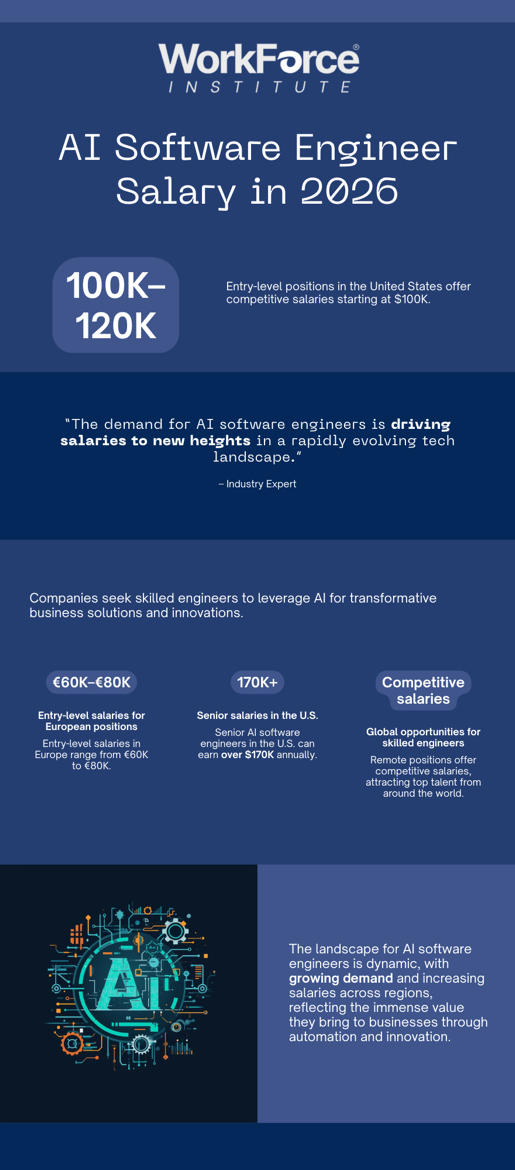
| Region | Level | Range |
|---|---|---|
| United States | Entry-level | $100,000 – $120,000 |
| Mid-level | $130,000 – $160,000 | |
| Senior-level | $170,000+ | |
| Europe | Entry-level | €60,000 – €80,000 |
| Mid-level | €80,000 – €120,000 | |
| Remote Global Roles | Remote AI roles often offer competitive compensation, especially for candidates with strong portfolios and deployment experience. | |
Why Salaries Are High
AI engineers deliver measurable business impact:
- Revenue optimization
- Cost reduction
- Automation
- Product intelligence
The demand-supply gap keeps compensation strong.
Do You Need a Degree to Become an AI Software Engineer?
Short answer: No — but strong foundations are required.
There are three primary paths.
1. Traditional Computer Science Degree
Pros:
- Strong theoretical base
- Structured progression
- Academic recognition
Cons:
- 3–4 years minimum
- High cost
- Limited focus on production AI deployment
Degrees are valuable, but not the only option.
2. Self-Study Path
Pros:
- Flexible
- Affordable
- Custom pace
Cons:
- Information overload
- No structured AI engineer roadmap
- No mentorship
- No job placement support
Many learners start strong but lose direction.
3. Structured AI Bootcamp
AI bootcamps focus on:
- Applied machine learning
- Real-world projects
- Production deployment
- Industry tools
- Career transition preparation
For tech graduates, this path significantly reduces time-to-employment.
Essential Technical Skills to Become an AI Software Engineer
To successfully follow an AI engineer roadmap, you must master multiple skill categories.
1. Programming & Software Engineering
Python is the primary AI language.
You must understand:
- Object-oriented programming
- Clean code principles
- Git and version control
- API development
- Debugging and testing
Without strong engineering fundamentals, scaling AI systems becomes difficult.
2. Mathematics for Machine Learning
Mathematics powers AI systems.
Core concepts include:
- Linear algebra (vectors, matrices)
- Probability distributions
- Statistics
- Optimization techniques
You don't need advanced research-level knowledge, but conceptual clarity is essential.
3. Machine Learning Fundamentals
Every aspiring AI engineer must understand:
- Supervised learning
- Unsupervised learning
- Regression models
- Classification models
- Clustering
- Feature engineering
- Model evaluation metrics
Projects you should build:
- Customer churn prediction
- Sales forecasting
- Fraud detection
- Recommendation systems
4. Deep Learning & Modern AI Systems
Deep learning drives today's AI revolution.
Important topics:
- Neural networks
- Convolutional Neural Networks (CNNs)
- Recurrent Neural Networks (RNNs)
- Transformers
- Transfer learning
- Fine-tuning large language models
Portfolio ideas:
- Image recognition system
- Sentiment analysis tool
- Chatbot powered by NLP
- AI resume analyzer
5. Tools & Frameworks
Industry-standard tools include:
- TensorFlow
- PyTorch
- Scikit-learn
- Pandas
- NumPy
For deployment and scaling:
- Docker
- Kubernetes (basic knowledge)
- FastAPI or Flask
- AWS, Azure, or GCP
Production knowledge differentiates job-ready candidates.
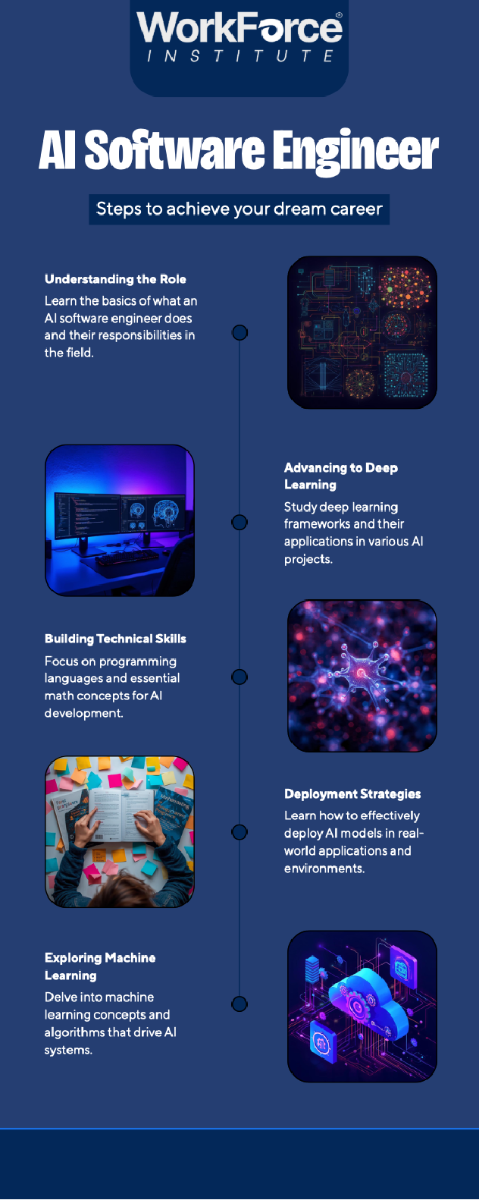
The Complete AI Engineer Roadmap (Step-by-Step)
If you're serious about learning how to become an AI software engineer, follow this structured roadmap.
Phase 1: Programming Foundations (Months 1–2)
Focus on:
- Python mastery
- Data structures
- Basic algorithms
- Git workflows
Build small automation scripts.
Phase 2: Mathematics & ML Basics (Months 2–4)
Study:
- Linear algebra
- Probability
- Statistics
Implement basic ML models using Scikit-learn.
Phase 3: Intermediate Machine Learning (Months 4–6)
Learn:
- Model tuning
- Cross-validation
- Feature engineering
- Data pipelines
Build end-to-end ML projects.
Phase 4: Deep Learning & AI Applications (Months 6–8)
Build:
- Computer vision system
- NLP application
- Recommendation engine
Understand neural network architecture deeply.
Phase 5: Deployment & MLOps (Months 8–10)
Learn to:
- Containerize models
- Deploy APIs
- Monitor model performance
- Use cloud infrastructure
This step is critical for employability.
Phase 6: Portfolio & Interview Preparation (Months 10–12)
Prepare:
- 3–5 complete AI projects
- Public GitHub repositories
- Clear documentation
- Resume optimized for AI roles
Practice:
- Coding challenges
- ML system design
- Behavioral interviews
With structured learning, this roadmap can be completed in under 12 months.
Real-World AI Software Engineer Career Paths
When learning how to become an AI software engineer, it's important to understand that this role is not one-size-fits-all. There are multiple specialization paths within AI engineering, and your roadmap may vary slightly depending on the direction you choose.
Here are some common AI career tracks:
1. Machine Learning Engineer
Focus:
- Building predictive models
- Training algorithms
- Optimizing performance
- Working with structured datasets
Industries:
- Finance
- SaaS
- E-commerce
This path emphasizes strong machine learning fundamentals and scalable model training pipelines.
2. Deep Learning Engineer
Focus:
- Neural networks
- Computer vision systems
- Natural language processing
- Generative AI systems
Industries:
- Healthcare imaging
- Autonomous vehicles
- AI research labs
This track requires deeper knowledge of neural network architectures and high-performance computing.
3. NLP Engineer
Focus:
- Text classification
- Chatbots
- Language models
- Sentiment analysis
- Large language models
With the rise of generative AI tools, NLP specialization is becoming extremely valuable.
4. MLOps Engineer
Focus:
- Model deployment
- CI/CD for AI systems
- Monitoring model drift
- Infrastructure automation
This role blends AI knowledge with DevOps and cloud engineering.
Understanding these career paths helps you choose a more focused AI engineer roadmap aligned with your interests.
Portfolio Projects That Get You Hired
If you're serious about how to become an AI software engineer, you must build projects that demonstrate real business value.
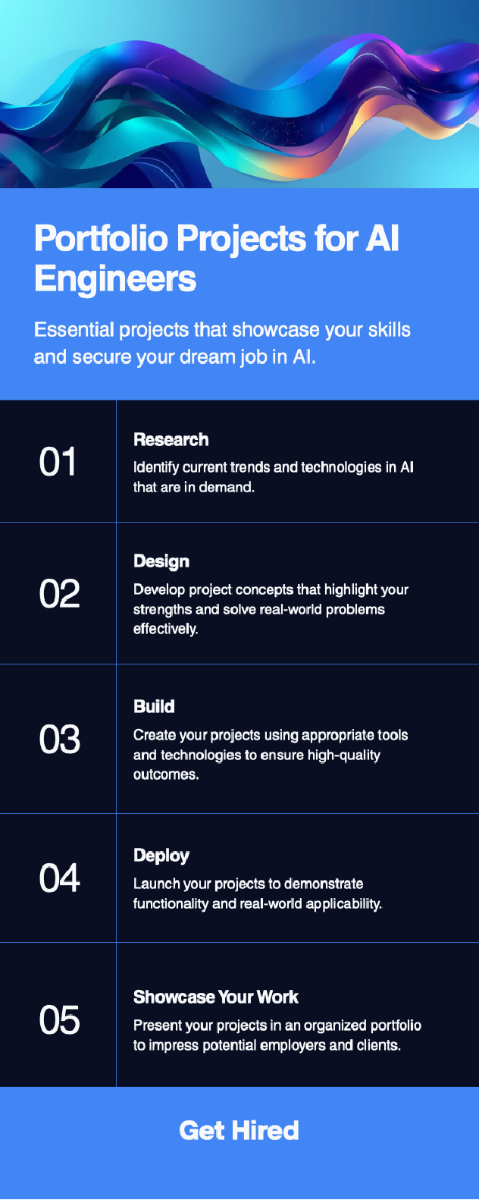
Employers are not impressed by basic tutorial notebooks.
They
want:
- End-to-end projects
- Clean GitHub repositories
- Clear documentation
- Deployment experience
Here are examples of strong portfolio projects:
Project Idea 1: AI Resume Screening System
- Build a resume classifier
- Rank candidates based on job description
- Deploy via web API
This demonstrates NLP + deployment.
Project Idea 2: E-commerce Recommendation Engine
- Use collaborative filtering
- Train recommendation models
- Deploy with a simple frontend
Shows understanding of business impact.
Project Idea 3: Fraud Detection Model
- Use classification algorithms
- Address class imbalance
- Evaluate precision and recall
- Deploy model
Demonstrates applied machine learning in finance.
Project Idea 4: AI-Powered Chatbot
- Use NLP
- Integrate API
- Deploy via cloud service
- Add monitoring
Shows modern AI integration.
Building 3–5 serious projects dramatically increases employability.
Technical Interview Preparation for AI Roles
Another critical component of learning how to become an AI software engineer is preparing for technical interviews.
AI interviews often include:
1. Coding Assessments
- Data structures
- Algorithms
- Python problem-solving
2. Machine Learning Theory
- Explain bias vs variance
- How does gradient descent work?
- Difference between supervised and unsupervised learning
3. System Design for AI
- How would you deploy a model at scale?
- How do you monitor performance?
- How do you handle data drift?
4. Behavioral Questions
- Explain a project you built
- Describe a technical challenge
- How do you handle failure?
Preparing for these areas should be part of your AI engineer roadmap.
Freelancing and Remote Opportunities in AI
One overlooked benefit when researching how to become an AI software engineer is flexibility.
AI engineers can:
- Work remotely
- Freelance
- Consult
- Build SaaS tools
- Launch AI startups
Freelance AI services may include:
- Building chatbots for businesses
- Creating custom ML models
- Data analysis automation
- AI system integration
With a strong portfolio, you can monetize your skills even before landing a full-time job.
The Importance of Mentorship in AI Learning
AI is complex.
Many learners quit because:
- They get stuck debugging models
- They misunderstand math concepts
- They feel overwhelmed by information
Mentorship accelerates progress by:
- Providing feedback
- Correcting mistakes early
- Offering career guidance
- Sharing industry insights
This is one major reason structured programs often produce faster results compared to self-study.
How to Transition from Another Tech Role into AI
If you are already a:
- Software developer
- Data analyst
- Backend engineer
- Cloud engineer
Your transition timeline may be shorter.
You likely already have:
- Programming knowledge
- Git experience
- Problem-solving ability
You mainly need:
- Machine learning depth
- Deep learning experience
- Deployment of AI models
With focused training, transitioning can take 4–6 months.
Advanced AI Topics to Learn in 2026
If you want to stay competitive beyond entry-level roles, consider learning:
- Generative AI systems
- Fine-tuning large language models
- Retrieval-augmented generation (RAG)
- AI agents
- Reinforcement learning
- Model compression and optimization
- Edge AI deployment
Advanced knowledge increases long-term earning potential.
Long-Term Career Growth in AI Engineering
The career ladder often looks like:
AI Engineer → Senior AI Engineer → Lead AI Engineer → AI Architect → Head of AI
With experience, professionals move into:
- Technical leadership
- AI product strategy
- Startup founding
- Research leadership
AI engineering offers both technical and managerial growth paths.
Final Strategic Advice
If you truly want to understand how to become an AI software engineer, focus on three pillars:
- Depth over surface-level tutorials
- Real projects over passive learning
- Structured roadmap over random resources
The biggest difference between those who break into AI and those who quit is clarity and consistency.
AI is not just a career trend. It is becoming foundational infrastructure for modern businesses.
The sooner you start building real systems, the sooner you position yourself for long-term opportunity.
What Employers Actually Look For
Companies hiring AI engineers evaluate:
- Strong Python skills
- Understanding of ML concepts
- Ability to deploy models
- Code quality
- Portfolio projects
- Problem-solving ability
- Communication skills
Candidates who can explain how their model creates business value stand out significantly.
Common Mistakes That Delay Your Progress
When learning how to become an AI software engineer, avoid these pitfalls:
- Jumping into deep learning without basics
- Ignoring math foundations
- Only watching tutorials
- Not building real projects
- Avoiding deployment
- Neglecting Git and collaboration tools
Consistent building is more important than endless theory.
How Long Does It Take to Become an AI Software Engineer?
Your timeline depends on your starting point.
- Complete beginner: 12–18 months
- Tech graduate: 6–9 months
- Software engineer transitioning: 4–6 months
Structured programs significantly reduce wasted time.
How a Structured AI Software Engineering Bootcamp Accelerates the Process
Many learners struggle with:
- Lack of direction
- Inconsistent progress
- Information overload
- No feedback
- No career preparation
A structured AI Software Engineers Bootcamp addresses these challenges by:
- Providing a clear AI engineer roadmap
- Offering hands-on, real-world projects
- Teaching production deployment
- Providing mentorship
- Supporting resume and interview preparation
Instead of guessing what to learn next, students follow a guided, industry-aligned curriculum focused on employability.
Is Becoming an AI Software Engineer Worth It in 2026?
Yes — for several reasons:
- Strong salary growth
- High demand
- Industry-wide applicability
- Long-term career stability
- Continuous innovation
AI engineering is not a short-term trend. It is becoming foundational to modern software systems.
Final Thoughts: Your Next Step
Now you understand how to become an AI software engineer and the structured roadmap required to succeed. Your journey includes:
- Programming mastery
- Mathematical foundations
- Machine learning expertise
- Deployment skills
- Real-world portfolio development
The difference between aspiring and achieving is execution.
If you want a faster, structured path into AI engineering, consider the AI Software Engineers Bootcamp at WorkForce Institute. This program provides hands-on mentorship, real projects, and career preparation to help you transition confidently into the field.
AI is shaping the future of technology. The question is whether you will build the systems driving that future — or simply use them. Your journey starts with a roadmap, consistent action, and the right guidance.
Take action today and start building the AI skills that employers are actively seeking.