
Artificial intelligence is changing the way businesses work. Companies now use it to handle customer support, study data for predictions, and create new products, with generative AI helping them work more efficiently and compete more effectively.
However, AI adoption comes with obligations. Businesses need clear answers about how they protect data, secure their systems, check for unfair outcomes, explain automated decisions, and assign responsibility when those decisions cause harm. Without firm policies and oversight, AI can expose customers, employees, and the organization to serious risks.
AI governance addresses that gap. It sets the rules, processes, and ownership needed to build, deploy, and manage AI systems responsibly. This guide explains AI governance, why it matters, the frameworks businesses can draw on, and practical ways to build an effective strategy.
What Is AI Governance?
AI governance consists of the policies, processes, standards, and oversight that shape how artificial intelligence systems are developed, deployed, monitored, and managed. Its purpose is to keep AI systems aligned with the organization’s goals, ethical standards, legal duties, and acceptable level of risk.
AI governance extends well beyond technical departments. Business leaders, developers, data scientists, lawyers, security experts, and other stakeholders all shape how an organization uses AI.
A sound governance process should make several responsibilities clear:
- Who owns the AI system and remains accountable for its decisions?
- Which data trains the system or supports its operation?
- How will the organization detect and reduce bias?
- Who will check AI’s output, and how will they verify it?
- If the system produces something inaccurate or harmful, what happens next?
- The organization also needs a way to track performance over time.
Clear answers to these questions make adoption more dependable and keep responsibility visible.
Why Is AI Governance Important for Businesses?
AI governance gives organizations a practical way to pursue new technology without losing control of its consequences. As AI becomes embedded in routine business operations, clear oversight can improve decisions and limit the harm caused by poorly managed systems.
1. Reduces Business and Operational Risks
AI can make faulty predictions, produce biased recommendations, or generate unexpected results. Without proper oversight, those failures may cause financial losses, disrupt operations, or damage the organization’s reputation.
Governance sets out how organizations spot risks, test systems, examine their results, and handle incidents before they grow.
2. Supports Data Privacy and Security
AI systems often depend on vast amounts of data, some of which may include personal information or confidential and commercially sensitive material. AI governance sets clear rules for handling data—from collection through protection—and asks teams to confirm that its use fits the purpose.
3. Improves Transparency and Accountability
Organizations need a clear view of how their AI systems operate and who answers for the results. Governance supports proper documentation, assigns ownership, and requires suitable explanations when AI helps make decisions.
Clear responsibilities make it easier to investigate failures and show stakeholders how a system works.
4. Builds Customer and Employee Trust
Trust grows when people understand how an AI system is used and can see that sensible safeguards protect them. Open AI practices also show that an organization takes fairness, privacy, security, and accountability seriously.
5. Helps Organizations Prepare for Regulatory Requirements
AI laws and regulations continue to change, and the rules may vary by industry, location, application, and the risk level of a given system. A clear governance process helps organizations determine which obligations apply, keep the necessary records, and respond to regulatory changes.
Businesses should review those requirements with qualified legal and compliance professionals.
Core Principles of AI Governance
Organizations may govern AI in different ways, but a few shared principles can guide responsible adoption.
Transparency
People should receive clear, appropriate information about an AI system’s purpose, how it works, and its limitations. Transparency does not mean releasing technical specifications or proprietary material. The people who need relevant information should be able to find and understand it.
Accountability
Each AI system needs a clearly assigned owner and proper oversight. Organizations must establish who handles its development, deployment, monitoring, and continued maintenance.
Accountability also requires clear procedures for reviewing decisions, responding to complaints, and dealing with incidents.
Fairness
Organizations need to test AI systems for bias and unequal results. A model’s behavior can be shaped by its training data, design, and the conditions in which people use it. They should check whether the system puts certain individuals or groups at an unfair disadvantage, then take reasonable steps to reduce that risk.
Privacy and Security
AI governance must protect personal and confidential information. That can mean limiting access, collecting only what is needed, storing data securely, encrypting it, and deleting it according to defined retention rules.
Security reviews should account for unauthorized access, data leaks, and efforts to manipulate AI systems.
Reliability and Safety
Testing should show whether an AI system behaves consistently and suits its intended purpose. Organizations need clear performance standards, a record of the system’s limits, and procedures for handling failures or unreliable results.
Human Oversight
People must supervise AI when its decisions could have serious effects on others. Depending on the application, an organization may need a person to review the result, a clear escalation process, or a way to reject an AI recommendation.
AI Governance Frameworks Businesses Should Know
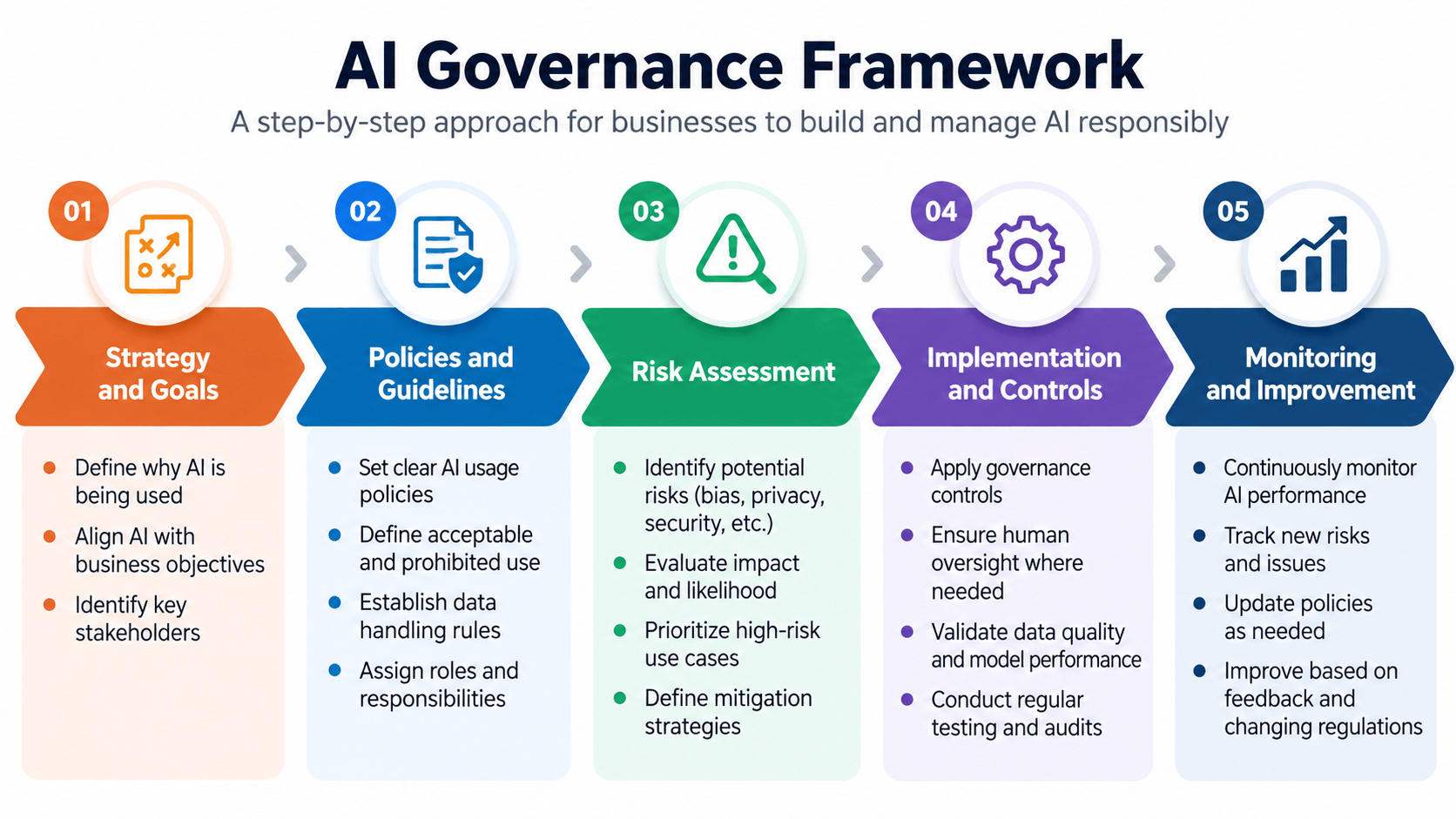
AI governance frameworks give businesses a practical structure for spotting risks, setting controls, and managing AI systems from development through retirement. Companies can start with one framework, then adjust it to fit their own needs.
1. NIST AI Risk Management Framework (AI RMF)
The National Institute of Standards and Technology (NIST) created the AI Risk Management Framework to help organizations identify and manage risks connected to AI systems. It rests on four core functions:
- Govern: Set policies, assign responsibility, shape organizational culture, and oversee AI risk management.
- Map: Define how an AI system will be used by examining its purpose, stakeholders, and possible effects.
- Measure: Examine AI risks through testing, assessment, and ongoing monitoring.
- Manage: Decide which risks matter most, then address, reduce, or respond to them.
The NIST AI RMF gives organizations a repeatable way to handle AI risk instead of treating every project as a separate exercise.
2. ISO/IEC 42001
ISO/IEC 42001 is an international standard that sets requirements for creating, implementing, maintaining, and continually improving an AI management system. It gives organizations a structured way to assign AI responsibilities and handle related risks and processes.
Businesses can also fold AI governance into the management practices they already use. Organizations can use ISO/IEC 42001 to organize an AI management system and decide whether certification fits their goals and requirements.
3. The EU Artificial Intelligence Act
The European Union’s Artificial Intelligence Act regulates AI according to the harm its use could cause. It sets different rules for different kinds of systems and applications.
Under the Act, some AI practices are banned outright. High-risk systems must meet specific requirements, while lower-risk categories face other obligations.
Businesses that develop, supply, or use AI systems linked to the European Union should first establish whether the Act covers their work, then identify the requirements that apply.
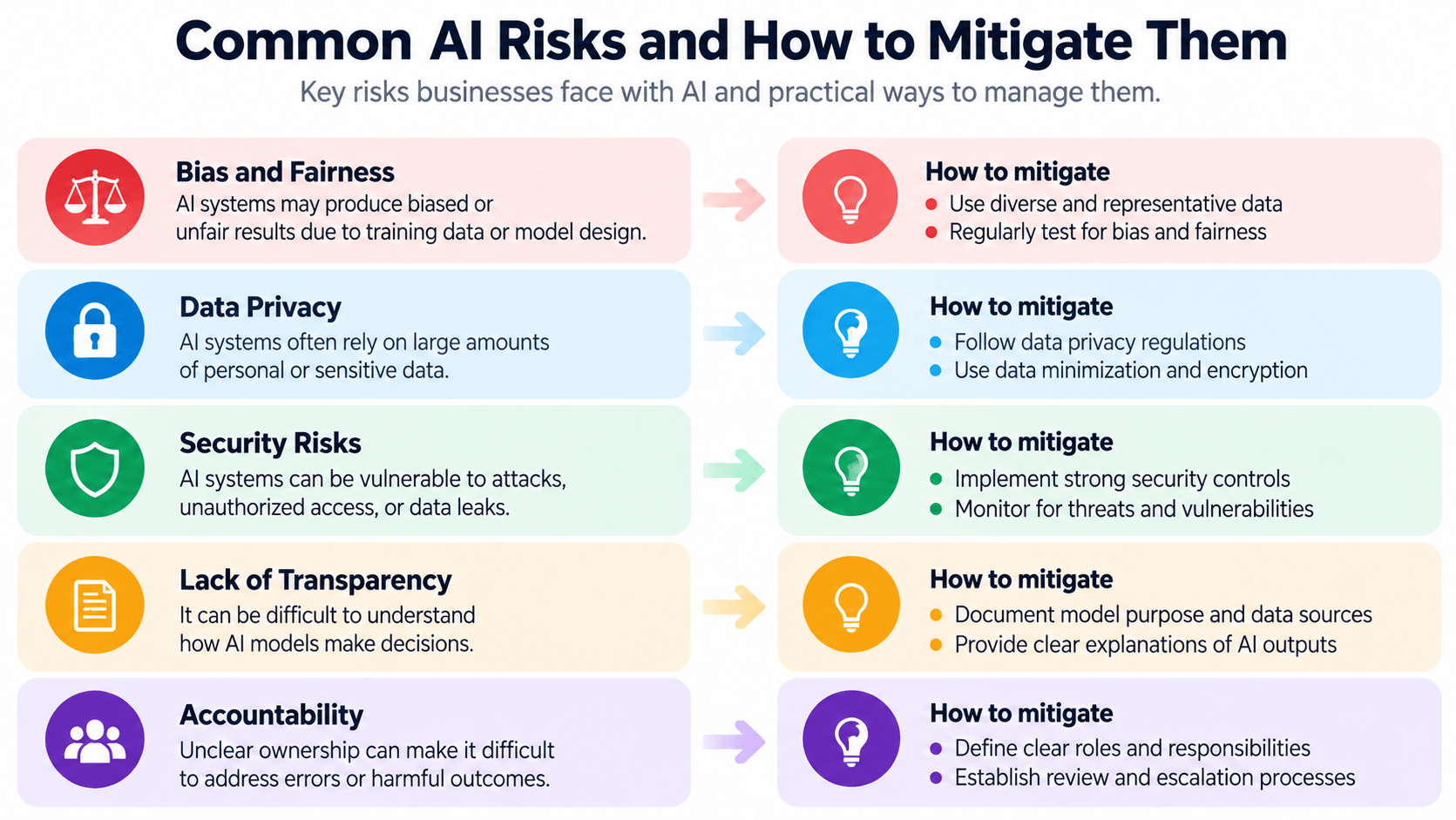
AI Governance Best Practices for Businesses
Knowing the relevant governance principles and frameworks is only a starting point. Organizations also need workable procedures for managing AI projects day to day.
1. Create an AI Governance Policy
Write a clear internal policy that sets the boundaries for AI use. It should cover permitted uses, banned activities, expectations for handling data, required reviews, and who is responsible for each decision.
For instance, staff might use approved AI tools to draft documents or conduct research, but they must not enter confidential customer information into systems that have not been approved.
2. Establish Clear Roles and Responsibilities
AI governance spans several departments, so each organization needs to assign duties clearly. Business owners, technical teams, security professionals, legal teams, and other stakeholders should know exactly what they are responsible for.
The right setup depends on the organization’s size and how far it has progressed with AI. Some organizations may create a dedicated AI governance committee; others may give an existing risk or compliance team responsibility for supervising AI-related work.
3. Maintain an AI Inventory
Keep a record of every AI system the organization develops, buys, or uses. That record may include:
- System name and business owner
- Intended purpose and use case
- Data sources and processing activities
- Model or vendor details
- Risk category
- Testing and approval status
- Monitoring and review schedule
This inventory shows where AI is in use and identifies systems that may need closer oversight.
4. Conduct AI Risk Assessments
Assess an AI system’s risks and likely effects before deployment. Review its intended purpose, the quality of its data, security, fairness, reliability, and what could happen if it produces an incorrect result.
The review should match the potential harm. An internal productivity tool with limited impact may need fewer safeguards than a system that informs decisions about employment, finance, healthcare, or access to essential services.
5. Validate Data Quality and Model Performance
AI systems rely on the data behind them. Organizations should check that those datasets fit the intended use, reflect the relevant population well enough, and remain accurate.
Model testing needs to reflect real conditions rather than ideal ones. Depending on the system, evaluators may check accuracy and consistency, look for bias, test how well the model handles disruption, and measure its tendency to produce unreliable answers.
Organizations developing AI also need a clear grasp of how AI model training works. The data selected and the choices made during development can shape the system’s behavior.
6. Keep Humans Involved Where Necessary
Human oversight should be proportionate to the potential impact of an AI system. An AI tool that summarizes internal documents may need only a light review. But when the system informs a consequential business decision, a qualified person should assess its recommendation before anyone finalizes the outcome.
Organizations need clear rules for human involvement. Reviewers must have enough information—and the authority—to question or reject what the system produces.
7. Monitor AI Systems Continuously
AI governance continues after deployment. Over time, model performance and data quality may shift, while users and business needs change.
Organizations need monitoring processes that catch declining performance, unexpected results, security problems, and new risks. They also need clear steps for investigating incidents, revising systems, and recording corrective action.
8. Train Employees on Responsible AI Use
Employees must know how to use AI tools responsibly. Training should cover which tools are approved, how to protect private data, where AI commonly falls short, and why generated information must be checked.
Organizations can also offer role-specific training for staff engaged in AI development, deployment, governance, and oversight.
Professionals comparing AI approaches can turn to our guide, Generative AI vs. Traditional AI, for a clear explanation of how the two differ and where each is commonly used.
Practical Example: Applying AI Governance to a Customer Support Chatbot
Imagine a business preparing to launch a chatbot that answers customer questions. Without governance, it could give customers wrong information, reveal sensitive data, or promise something the business cannot deliver.
An AI governance plan might begin by setting a clear boundary for the chatbot: it should handle routine customer questions and pass harder cases to human support staff. Next, review the data it can reach. Remove anything unnecessary, especially personal or confidential information. Then test its replies for accuracy and consistency, while checking for inappropriate content and possible data exposure.
Be clear with customers when AI is handling the interaction, and give them an obvious way to contact a human representative if needed. Someone should regularly review the chatbot’s replies alongside customer feedback and reported problems. Assign a team to maintain and improve the system.
These measures show how governance can support practical AI adoption while still allowing organizations to improve customer experiences with AI.
Common AI Governance Challenges
AI governance can help organizations, but putting it into practice often creates its own difficulties.
Rapidly Changing Technology
AI capabilities change fast. A policy that fits current tools may soon need revision as new technologies and uses appear. Organizations should review their policies, risk assessments, and technical controls on a regular basis.
Limited AI Expertise
Some businesses lack enough staff with the technical and governance knowledge to assess AI systems properly. Training, collaboration across teams, and clear ownership can help build the skills needed for responsible AI adoption.
Balancing Innovation and Oversight
Too many approval steps can choke off experimentation. Too little oversight, though, leaves organizations exposed to avoidable risks. A risk-based approach matches the level of control to the potential harm: routine, low-risk work can proceed with less friction, while applications with greater impact receive closer review.
Managing Third-Party AI Tools
Many organizations depend on AI products built by outside vendors, which can leave them with little insight into how those systems are trained, updated, or run. Before adopting one, a business should assess the vendor and read the available documentation. It also needs a clear understanding of how the vendor handles data, along with suitable contractual terms and security requirements.
The Future of AI Governance
As organizations adopt AI more broadly, oversight will likely move deeper into business planning, technology management, and risk decisions. A few changes may define how that oversight develops.
- Companies are likely to formalize their review processes as AI spreads across daily operations.
- They may also keep closer watch on these systems throughout their entire operational lifecycle, rather than checking them only at launch.
- Employee training may increasingly include responsible AI use as a regular part of professional development.
- Organizations may also take a harder look at outside AI tools and vendors before adopting them.
- As laws, standards, and guidance change, businesses will need to keep track of the rules that apply to them.
AI governance is not a one-time exercise. Building it into an AI strategy can help organizations manage risks while they continue exploring new opportunities.
Conclusion
Businesses need AI governance if they want to use artificial intelligence safely, responsibly, and well. Clear internal rules, assigned accountability, risk reviews, and ongoing checks of AI systems give adoption a firmer base.
The NIST AI Risk Management Framework, ISO/IEC 42001, and the EU AI Act offer useful reference points. They help organizations understand what governance requires and put workable procedures in place.
Good AI governance goes beyond risk control. It also builds trust, develops staff skills, and establishes the internal habits needed to connect AI use with long-term business goals.
As AI changes how work gets done, both employees and organizations will need enough practical knowledge to use it well. The AI for Software Engineers Bootcamp and the AI-Powered Project Manager Bootcamp offer ways to build those skills.
Frequently Asked Questions About AI Governance
What does AI governance mean in plain language?
It refers to the rules, procedures, and assigned responsibilities that shape how an organization builds, uses, and oversees artificial intelligence responsibly.
Why does AI governance matter?
It helps organizations address privacy, security, fairness, transparency, and accountability risks while adopting AI responsibly.
Which AI governance frameworks are most widely used?
Organizations often turn to the NIST AI Risk Management Framework, ISO/IEC 42001, or the EU Artificial Intelligence Act. These resources address different needs, so each organization must determine which ones apply to its obligations and operations.
Who is responsible for AI governance?
No single department owns AI governance. Responsibility may sit with business leaders alongside technical staff, legal and compliance professionals, security specialists, and the people who own individual systems.
How can a business start implementing AI governance?
A business can start with an inventory of its AI systems and a clear policy for their use. It should also assign accountability, assess risks, test and monitor those systems, and train employees to use AI responsibly.
Does AI governance prevent businesses from using AI?
No. Its purpose is to support responsible adoption, not block it. A risk-based approach lets organizations put suitable safeguards in place while moving ahead with appropriate AI applications.