Running a large project with several Agile teams is hard. Each team may own a different feature, follow different priorities, and still depend on the others to finish one product. When that coordination is missing, work slips, messages get lost, and the result is uneven.
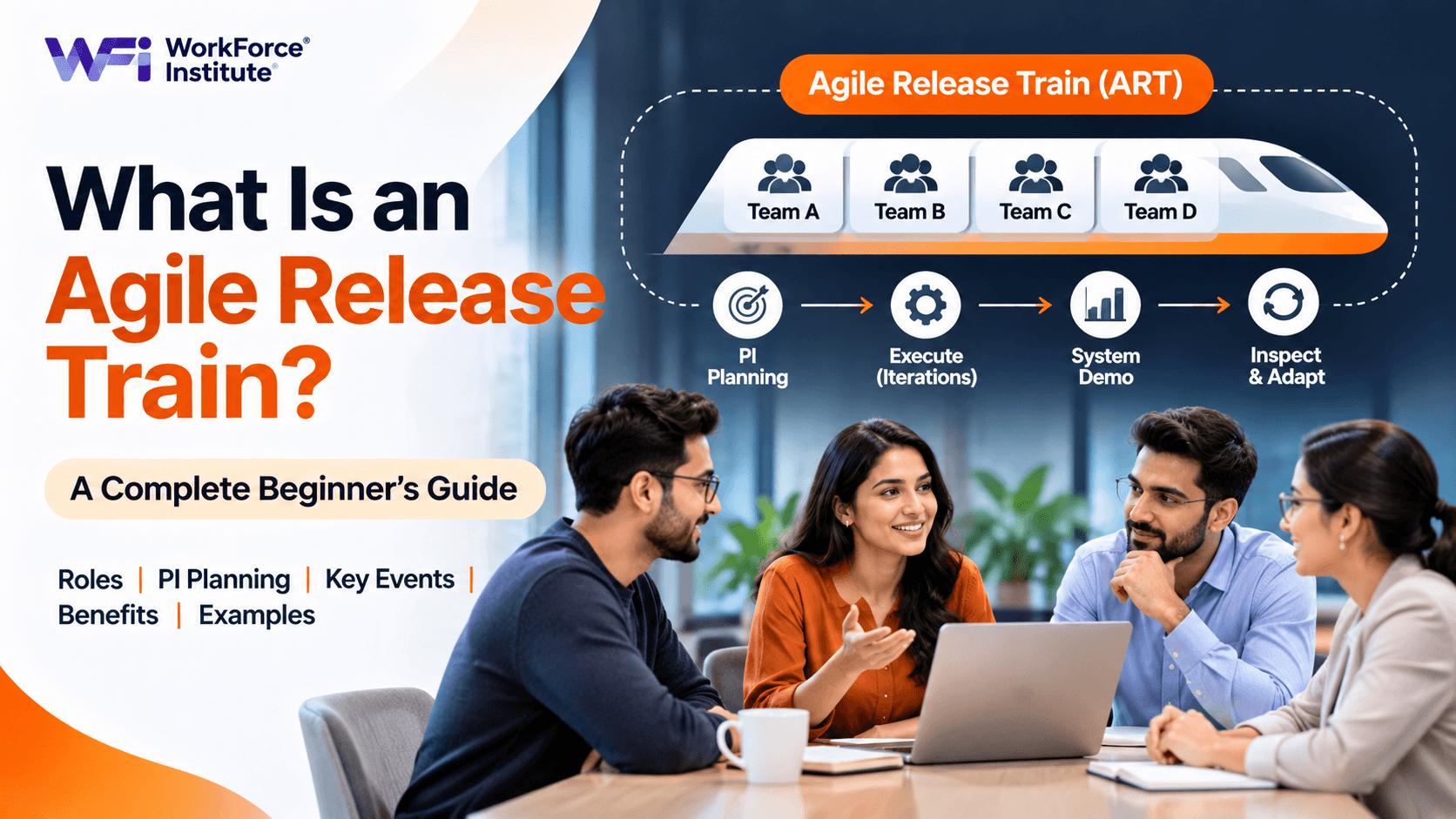
An Agile Release Train (ART) brings those teams together around one business mission and one delivery schedule. It is a core idea in the Scaled Agile Framework (SAFe), which is how organizations apply Agile across larger projects and more than one team.
This guide covers what an Agile Release Train is, how it runs, who does what, how PI Planning keeps teams aligned, and how organizations use an ART to collaborate and deliver value.
1. What Is an Agile Release Train (ART)?
An Agile Release Train (ART) is a group of Agile teams that plan, build, test, and deliver together around one business objective. It is for products or solutions that are too large for one Agile team to finish on its own.
In the Scaled Agile Framework (SAFe), an ART is the structure for coordinating teams, lining up priorities, managing dependencies, and releasing an integrated solution on a regular schedule.
Teams still own their own work. They also coordinate with the rest of the train, so everyone is moving toward the same goals.
A company building a large e-commerce platform might have separate teams for customer accounts, payments, product search, inventory, and order management. Those teams can sit on one Agile Release Train so the customer experience stays connected.
In simple terms: An Agile Release Train is a coordinated group of Agile teams working together to deliver a shared product or solution.
2. How Does an Agile Release Train Work?
An Agile Release Train organizes several Agile teams around one mission, shared priorities, and a regular planning and delivery rhythm. Each team contributes to a larger product and still runs its own day-to-day work.
The process generally involves the following activities:
Step 1: Establish a Shared Vision
Teams start by understanding the product vision, the business goals, what customers need, and the outcomes they are expected to produce. That shared direction shows how each team's work fits the whole solution.
Step 2: Organize Work into a Shared Backlog
Product Management defines and prioritizes the features the ART needs to deliver. The ART backlog shows upcoming work and which features need more than one function.
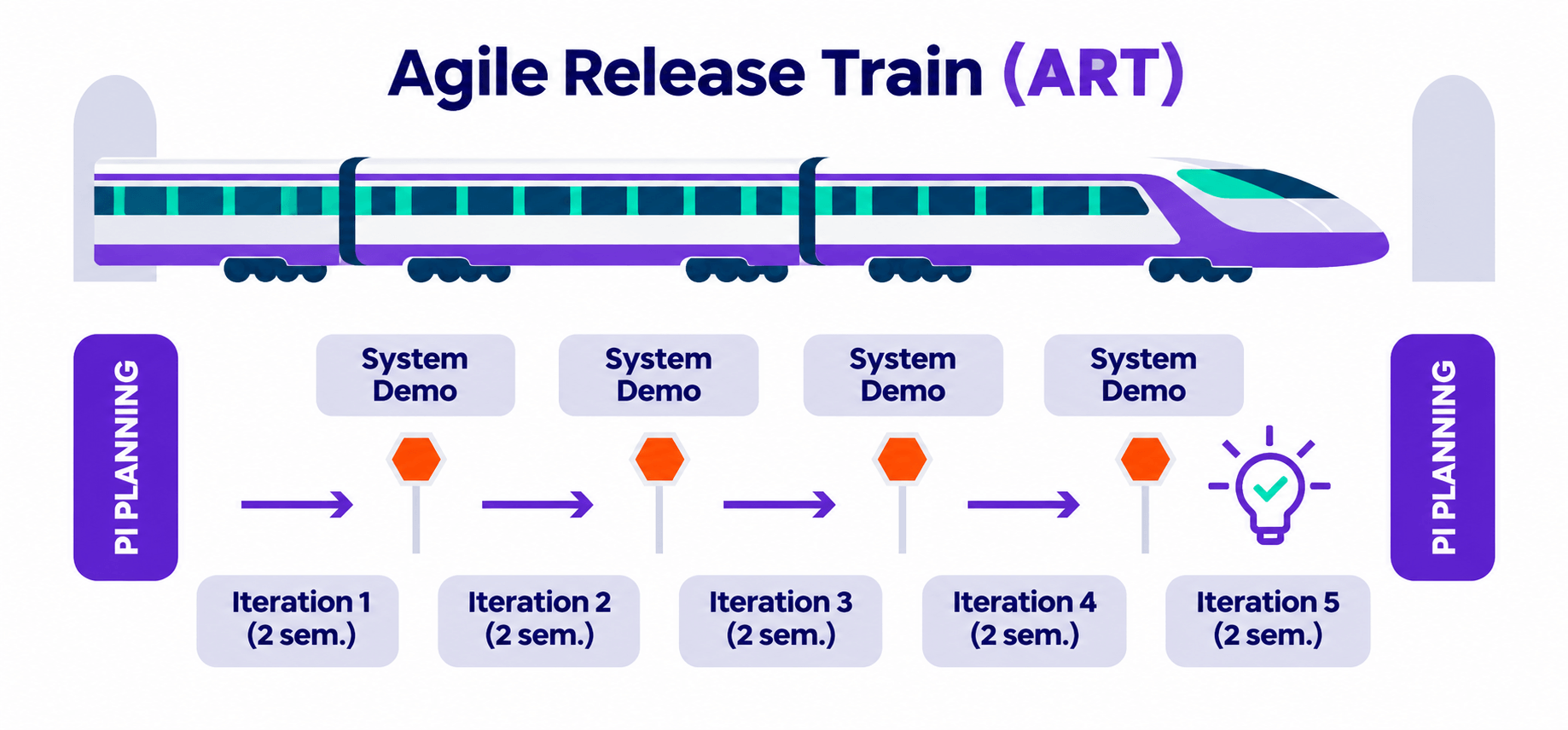
Step 3: Conduct PI Planning
Teams and stakeholders meet during Program Increment (PI) Planning to talk through priorities, plan the next stretch of work, find dependencies, and agree on objectives for that interval.
Step 4: Execute Work Through Agile Iterations
After planning, each team works through its iterations. They build features, test them, fix issues, and coordinate with other teams when the work is connected.
Step 5: Demonstrate Integrated Progress
System Demos let stakeholders see how work from different teams fits together. They review an integrated view of the solution, not a list of separate tasks.
Step 6: Review Results and Improve
At the end of a Program Increment, teams look at what they delivered, name the problems, and talk about what to improve. Those lessons feed the next cycle of planning and delivery.
3. Key Components of an Agile Release Train
An Agile Release Train depends on a few connected pieces to coordinate teams and manage delivery.
Agile Teams
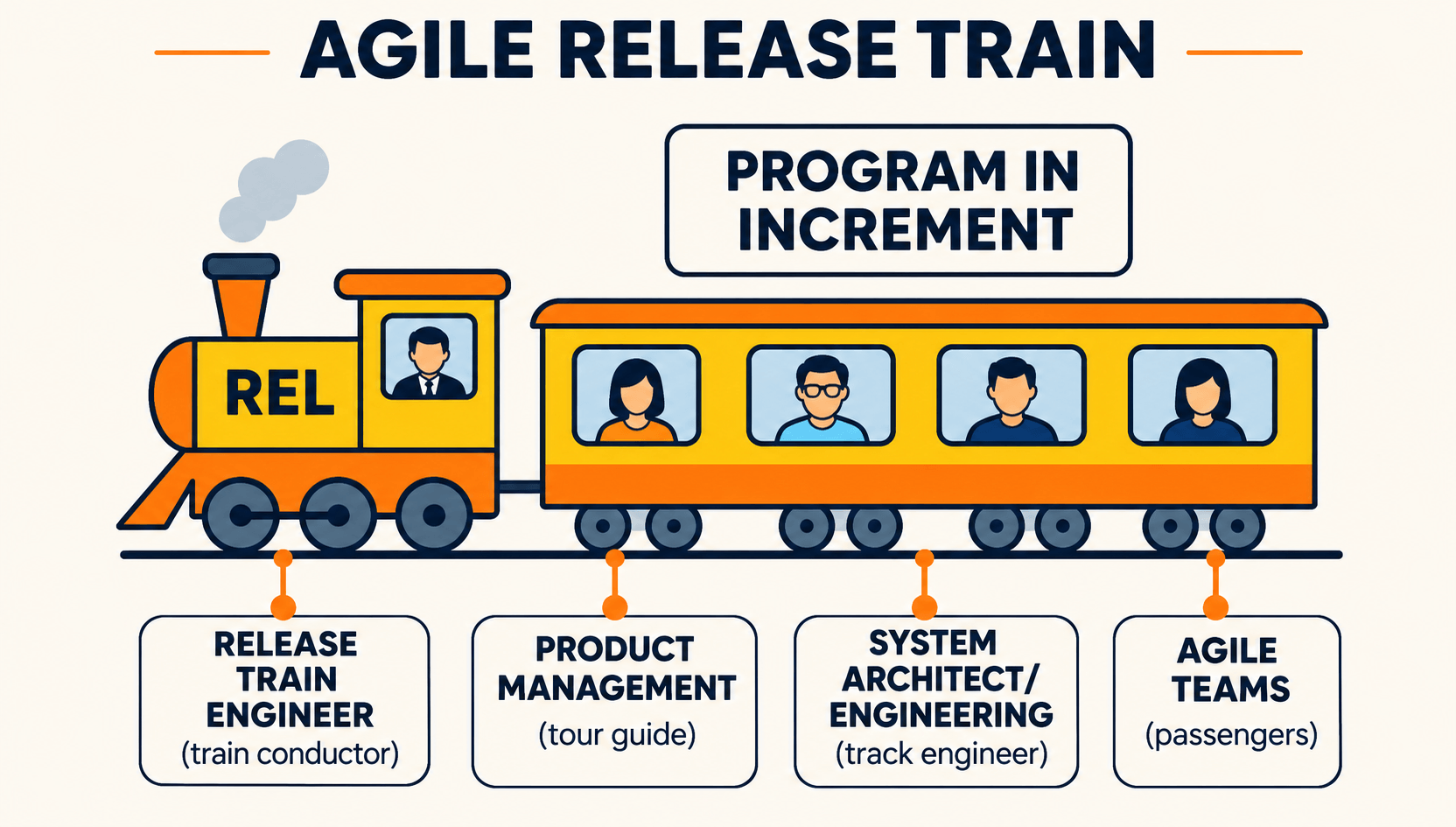
Agile teams are the people who build and deliver specific parts of a product or solution. A team usually includes the skills it needs to finish its work, such as development, testing, design, and analysis.
Shared Mission and Vision
Every team on an ART works toward the same business and technology mission. That shared direction helps them prioritize and make decisions that support the whole product or solution.
ART Backlog
The ART backlog holds the features and enablers the train needs to deliver. Product Management and the teams use it to see upcoming priorities and organize work at the train level.
Program Increment (PI)
A Program Increment is a fixed planning and execution period in which an ART delivers a set of planned objectives. That cadence gives teams a shared rhythm for planning, coordinating, reviewing, and delivering work.
Continuous Delivery Pipeline
The Continuous Delivery Pipeline supports exploring, integrating, deploying, and releasing solutions. It helps work move through development and delivery while quality stays in place and the organization can respond to customer needs.
4. Key Agile Release Train Roles and Responsibilities
A working Agile Release Train needs clear responsibilities and collaboration between team-level and train-level roles. Each role supports planning, coordination, technical direction, or business alignment.
Release Train Engineer (RTE)
The Release Train Engineer is a servant leader and coach for the Agile Release Train. The RTE facilitates ART events, helps teams communicate, works through impediments, manages risks, and encourages continuous improvement.
The RTE is there to help teams collaborate and to keep the ART's processes pointed at delivering value. The role is not a way to hand tasks out to teams.
Product Management
Product Management understands customer and business needs, sets product direction, and prioritizes features in the ART backlog. This role keeps teams focused on work that delivers real business value.
System Architect
The System Architect gives technical direction across the ART. This role helps teams make architectural decisions, deal with technical dependencies, and keep a solution design that can handle current and future requirements.
Business Owners
Business Owners are key stakeholders who make sure the ART's work supports business objectives. They bring business context, join planning and reviews, and help judge the value the solution delivers.
Scrum Master or Team Coach
The Scrum Master or Team Coach supports one Agile team. They facilitate team events, help remove obstacles, encourage collaboration, and coach the team in Agile practices.
Product Owner
The Product Owner represents customer and stakeholder needs for one team. They manage and prioritize the team backlog, clarify requirements, and help the team see what should be done first.
5. What Is PI Planning in an Agile Release Train?
Program Increment (PI) Planning is one of the most important events on an Agile Release Train. It brings teams, stakeholders, and ART leadership together to align on a shared mission and build a coordinated plan for the next Program Increment.
PI Planning is typically a two-day event that takes place every 8 to 12 weeks. Organizations should use the cadence that fits their own implementation.
During PI Planning, participants work together to:
- Review business context, product vision, and priorities.
- Understand upcoming features and requirements.
- Identify dependencies between Agile teams.
- Discuss risks, constraints, and potential blockers.
- Plan team iterations and coordinate delivery activities.
- Define and agree on team and ART PI objectives.
The event shows teams what they need to deliver and how their work connects with the other teams.
What Are the Outputs of PI Planning?
PI Planning produces several important outputs, including:
- PI Objectives: A set of planned business and technical outcomes that teams aim to achieve during the Program Increment.
- ART Planning Board: A visual representation of planned feature delivery, milestones, and dependencies.
- Identified Risks: A shared understanding of potential issues that could affect delivery.
- Team Plans: Coordinated plans that help teams understand their responsibilities and delivery commitments.
For more details, see the official Scaled Agile Framework guide to PI Planning.
6. Important Agile Release Train Events
ART events are regular chances to plan, communicate, review progress, and improve. They keep teams aligned through a Program Increment.
PI Planning
PI Planning sets the shared direction and the coordinated plan for the next Program Increment. Teams agree on objectives and find dependencies before the work starts.
ART Sync
ART Sync is a regular check-in for representatives and stakeholders to talk about progress, dependencies, risks, and impediments. It keeps the whole Agile Release Train visible.
System Demo
A System Demo presents an integrated view of the latest work the ART has finished. Stakeholders can judge progress, give feedback, and see how each team's contribution fits together.
Inspect and Adapt
The Inspect and Adapt event happens near the end of a Program Increment. Teams and stakeholders review results, name the challenges, and discuss changes that can make the next delivery more effective.
7. Benefits of Using an Agile Release Train
Organizations use Agile Release Trains when several teams contribute to one product or solution. Some of the key benefits include:
Better Team Alignment
An ART puts teams on shared priorities and business objectives. That reduces conflicting priorities and shows each team how its work supports the whole solution.
Improved Cross-Team Collaboration
Regular planning and coordination help teams find dependencies early. They can talk through integration problems while they plan and build, before those problems show up at the end of development.
Greater Delivery Visibility
Shared planning, PI objectives, and System Demos give stakeholders a clearer view of progress, upcoming work, and delivery risks.
More Predictable Planning
A consistent planning cadence helps organizations coordinate work across teams and set expectations. It also gives them a chance to review capacity and adjust priorities when they need to.
Continuous Improvement
Regular feedback and Inspect and Adapt activities push teams to name problems and improve the process over time.
Stronger Business Alignment
When business stakeholders join planning and reviews, the ART connects technical delivery with customer needs and organizational priorities.
8. Agile Release Train Example: A Practical Scenario
Imagine a financial technology company building a new digital banking application. The project includes user registration, account management, money transfers, payment processing, and security verification.
One Agile team may not have the skills or the capacity to build the whole application. The organization can coordinate several Agile teams through an Agile Release Train.
For example, the ART could include:
- Team 1 – Customer Experience: Develops registration, login, and user profile features.
- Team 2 – Account Management: Builds account information, balances, and transaction history.
- Team 3 – Payments: Develops money transfers and payment functionality.
- Team 4 – Security: Works on authentication, authorization, and security requirements.
- Team 5 – Integration and Testing: Supports integration and validates how the different components work together.
During PI Planning, the teams discuss planned work, find dependencies, and agree on objectives. The Payments team may depend on the Account Management team for account information. The Security team needs to coordinate authentication requirements across the application.
Through the Program Increment, teams work on their features and join the coordination activities. System Demos let stakeholders review the integrated application. Inspect and Adapt helps the ART decide what to improve in the next cycle.
This is how an Agile Release Train lets several teams coordinate while they contribute to one larger product.
9. Agile Release Train vs. Scrum: What's the Difference?
Agile Release Train and Scrum are related, and they do different jobs. Scrum is an Agile framework that individual teams commonly use. An ART coordinates several Agile teams working toward one product or solution.
| Comparison | Scrum | Agile Release Train |
|---|---|---|
| Primary focus | Managing work within an Agile team | Coordinating multiple Agile teams |
| Team structure | One cross-functional Scrum Team | Multiple Agile teams working together |
| Planning | Sprint Planning | PI Planning and team-level iteration planning |
| Coordination | Primarily within the team | Across teams, stakeholders, and ART leadership |
| Key roles | Scrum Master, Product Owner, Developers | RTE, Product Management, System Architect, Business Owners, and team-level roles |
| Typical scope | A team's product or service responsibilities | A larger product, solution, or value stream |
Scrum and an Agile Release Train can work together. Teams on an ART can use Scrum, while the ART coordinates those teams.
10. Common Challenges When Implementing an Agile Release Train
An ART can improve coordination, and putting one in place still takes planning, organizational support, and a real commitment to collaboration. Organizations often run into a few problems.
Unclear Roles and Responsibilities
When people do not know who decides, who plans, or who resolves a dependency, work stalls. Clear responsibilities make collaboration easier.
Poor Communication Between Teams
Teams that stay isolated miss important dependencies or make decisions that affect other parts of the solution. Regular coordination and open communication reduce that risk.
Unrealistic Planning
Planning more work than teams can actually deliver leads to missed objectives and extra pressure. Plans should account for capacity, technical complexity, dependencies, and risk.
Resistance to Organizational Change
Moving from independent teams to coordinated delivery can change responsibilities, processes, and how leaders work. Organizations should support teams with coaching, communication, and practical training.
Insufficient Technical Coordination
Teams working on connected systems have to think about architecture, integration, testing, and quality. Technical guidance and early collaboration reduce integration problems.
11. Skills Project Managers Need to Work in Agile Environments
Agile project management is more than tracking deadlines and assigning tasks. You need to understand how teams collaborate, how priorities change, how dependencies get coordinated, and how value gets delivered continuously.
Some important skills include:
- Agile and Scrum Knowledge: Understanding Agile principles, Scrum practices, iterations, and continuous improvement.
- Planning and Prioritization: Organizing work based on business value, available capacity, and project objectives.
- Stakeholder Communication: Keeping teams, business stakeholders, and leadership aligned.
- Risk and Dependency Management: Identifying issues that could affect delivery and coordinating solutions across teams.
- Facilitation and Leadership: Helping teams resolve blockers, make decisions, and work toward shared outcomes.
- Technology and AI Awareness: Understanding how modern project management tools and AI-enabled workflows can support planning, reporting, and decision-making.
Project managers who want to build these skills can explore the AI-Powered Project Manager Bootcamp at WorkForce Institute. The program covers project management approaches, including Agile, predictive, adaptive, and hybrid methodologies, alongside AI-related project management skills.
You can also read What an Agile PM Using GenAI Actually Does to see how AI can support project management and Agile workflows.
12. Frequently Asked Questions About Agile Release Trains
What does ART stand for in Agile?
ART stands for Agile Release Train. It is a group of Agile teams that coordinate their work to deliver value around a shared business and technology mission.
Is Agile Release Train part of SAFe?
Yes. The Agile Release Train is a central part of the Scaled Agile Framework (SAFe). It coordinates several Agile teams working on larger products and solutions.
What is the role of a Release Train Engineer?
A Release Train Engineer (RTE) is a servant leader and coach who facilitates ART events and processes. The RTE supports communication, helps resolve impediments, manages risks, and encourages continuous improvement.
What is PI Planning in SAFe?
PI Planning is a regular planning event that brings Agile teams and stakeholders together to align on a shared mission and plan the work for the next Program Increment.
How long is a Program Increment?
In SAFe, a Program Increment commonly runs on an 8-to-12-week cadence. The exact length depends on how the organization implements it.
What is the difference between an Agile Release Train and Scrum?
Scrum is a framework for managing work inside one Agile team. An Agile Release Train coordinates several Agile teams working toward one product or solution. Teams on an ART can still use Scrum.
What are the main benefits of an Agile Release Train?
The main benefits are stronger collaboration across teams, closer alignment with business objectives, clearer delivery visibility, coordinated planning, and continuous improvement.
Conclusion
An Agile Release Train is a structured way for several Agile teams to work toward one goal. Coordinated planning, clear responsibilities, regular communication, and continuous feedback help organizations manage complex products and solutions.
Project managers, Scrum Masters, Product Owners, and anyone involved in large-scale Agile delivery benefit from understanding how an ART works. As more organizations adopt Agile, coordinating teams and connecting daily work to broader business objectives matters more.
If you are building project management skills, or preparing to work in a scaled Agile environment, learning how an ART operates will help you contribute more effectively on a modern project team.