AI is no longer only writing answers and making content. Some systems can now plan a task, use tools, make a decision, and work through several steps. That shift is why people talk about two related ideas: generative AI and agentic AI.
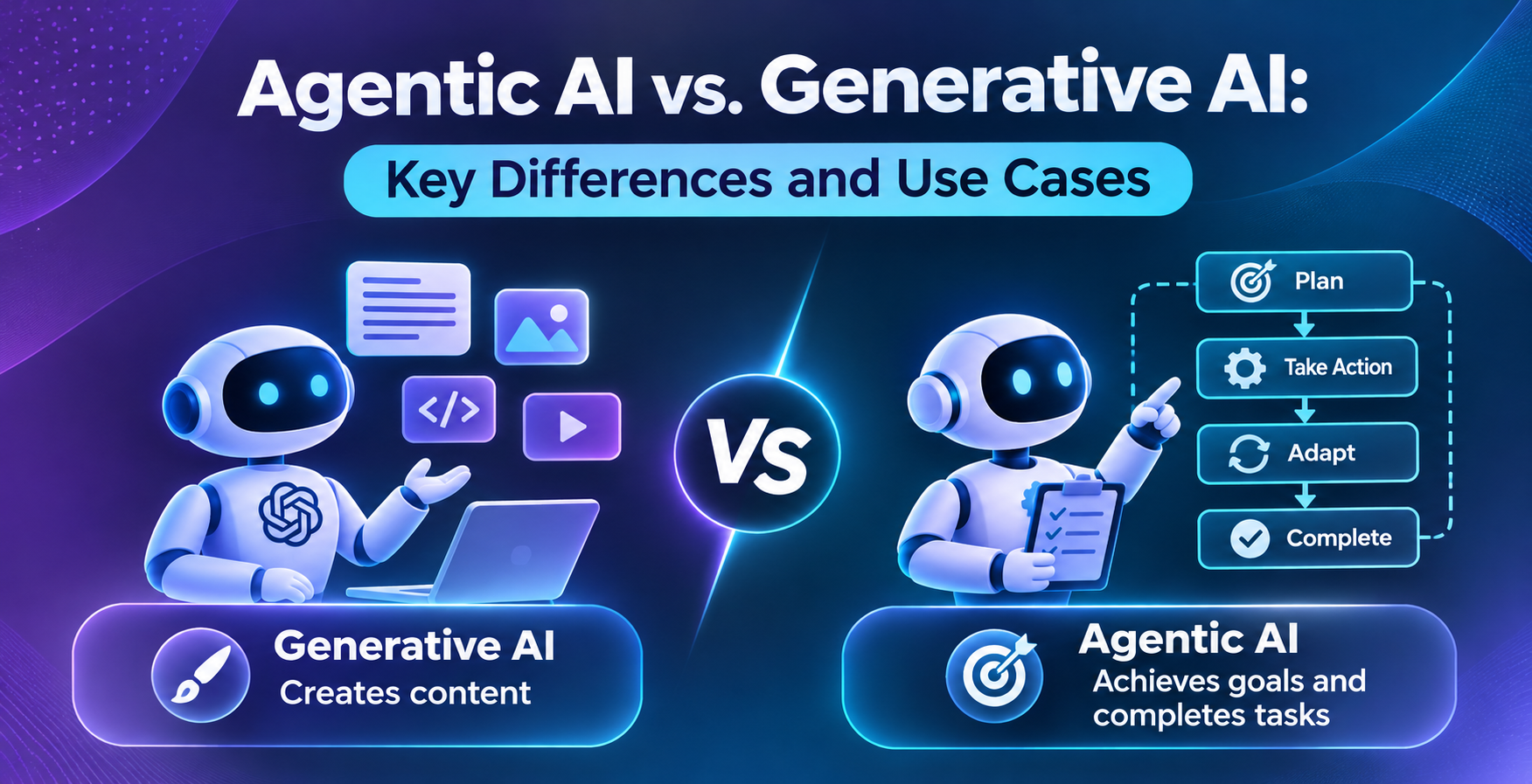
They sit close together, but they do different jobs. Generative AI makes something: text, an image, code, or a summary, usually because you asked for it. Agentic AI tries to reach a goal. It plans, takes actions, and often needs less hand-holding at every step.
Knowing the difference in agentic AI vs. generative AI helps a business pick the tool that fits the work, and it helps people see how their own jobs are changing. This guide covers how each one works, where they differ, where they show up, and how they can be used together.
What Is Generative AI?
Generative AI creates new content from patterns it learned in training data. Give it a prompt, and it can write text, make an image, produce audio or video, write code, or create something else in that family.
You might ask it for a product description, a shorter version of a report, an image, or a plain explanation of a programming idea. It reads the request and comes back with something that fits the instructions and the context you gave it.
A lot of these tools run on large language models (LLMs) or other deep learning models. They learned patterns from huge datasets and use those patterns to answer. The answer can still be wrong or misleading, so a person should check it when the facts matter.
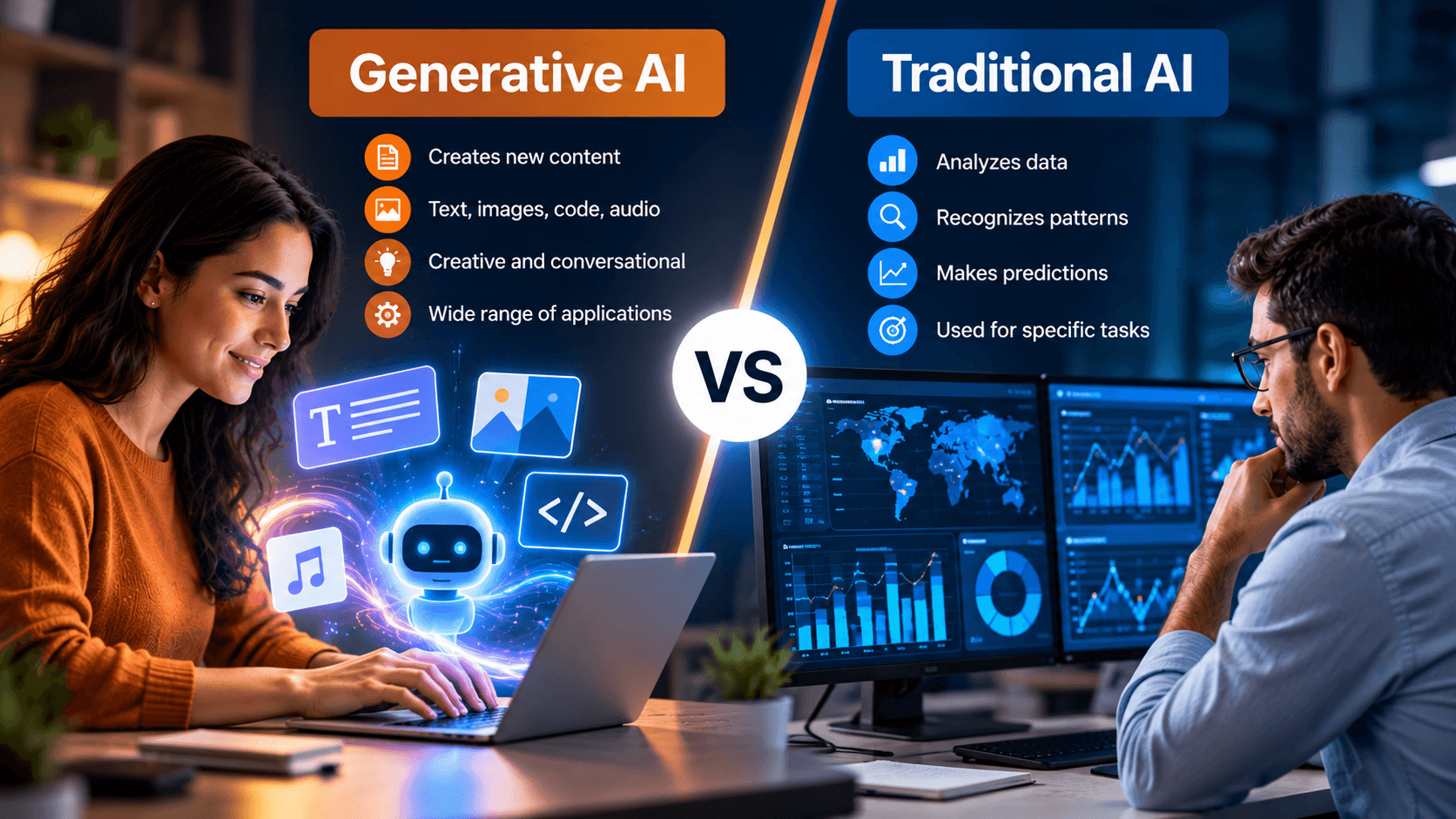
To see how these systems learn, read WFI’s guide to Generative AI vs. Traditional AI: Key Differences, Uses, and Examples.
Common Uses of Generative AI
- Content creation: Drafting articles, emails, product descriptions, and marketing copy.
- Software development: Generating code, explaining functions, and suggesting debugging approaches.
- Research and summarization: Summarizing reports, documents, and large amounts of information.
- Design and creativity: Generating images, concepts, and creative ideas.
- Customer support: Drafting responses and answering common questions.
- Learning and training: Explaining concepts, creating practice questions, and supporting personalized learning.
Generative AI is the better fit when you want a piece of content, an explanation, or a suggestion that a person will still read and decide what to do with.
What Is Agentic AI?
Agentic AI is built to chase a goal. It plans, decides, uses tools, and takes action across more than one step. It is not only answering the prompt in front of it. It can keep working toward a larger outcome and change course when a step does not go as expected.
A generative tool can draft an email asking for a meeting. An agentic system could look for open times, check the calendar, draft the invite, and put the meeting on the calendar, if it has permission and if a person still has to approve it.
An agentic system often has a generative model inside it. The model reads the instructions or writes the content. The agent is the part that lines up the steps and tries to finish the job.
IBM explains the distinction in its overview of agentic AI, including how agents use outside tools to move from writing information to finishing a task.
Common Characteristics of Agentic AI
- Goal-oriented behavior: Works toward a defined outcome rather than only producing a response.
- Planning: Breaks a larger task into smaller steps.
- Tool use: Interacts with approved APIs, databases, applications, or other tools.
- Decision-making: Selects actions based on available information and the task objective.
- Feedback and adaptation: Evaluates results and may adjust its next steps.
- Context management: Maintains relevant information throughout a task or workflow.
- Human oversight: Can request approval or escalate decisions that require human judgment.
Agentic AI is not automatically a system that runs on its own. How independent it is depends on the design, the permissions, how risky the task is, and the safeguards around it.
Agentic AI vs. Generative AI: Key Differences
The main difference is the job each one is built to do. Generative AI makes content. Agentic AI finishes tasks and works toward a goal. They overlap, because an agent often uses generative AI to write something in the middle of a workflow.
| Comparison | Generative AI | Agentic AI |
|---|---|---|
| Primary purpose | Creates content or responses | Achieves goals and completes tasks |
| Typical input | A prompt, question, or data input | A goal or desired outcome |
| Typical output | Text, images, code, audio, or other content | Completed workflows, decisions, or actions |
| Operating approach | Usually responds to a user request | Plans and acts across multiple steps |
| Autonomy | Usually requires direction for each new task | Can operate with varying levels of independence |
| Tool interaction | May use tools when connected or configured | Often designed to use tools as part of task execution |
| Human involvement | People typically review or use the generated output | People may set goals, approve actions, and monitor outcomes |
| Example | Drafting a customer email | Drafting, scheduling, and tracking a customer follow-up workflow |
Generative AI can sit inside an agent. Agentic AI is what adds the planning and the ability to act in pursuit of a goal.
How Generative AI Works
These systems learn patterns and relationships from large datasets. You send a prompt, the model reads it, and it writes a response from those patterns and whatever context it has.
A simplified generative AI workflow looks like this:
- Input: The user provides a prompt, question, or source material.
- Processing: The model interprets the input and considers the context.
- Generation: The model produces content based on its learned patterns.
- Review: The user evaluates the result and may request revisions.
A marketer can paste a product brief and ask for three campaign headlines. The tool writes the options. The marketer picks one, or rewrites it, so it actually fits the campaign.
This can speed up content work. It does not guarantee the facts are right, the voice matches the brand, or the result fits the business goal.
How Agentic AI Works
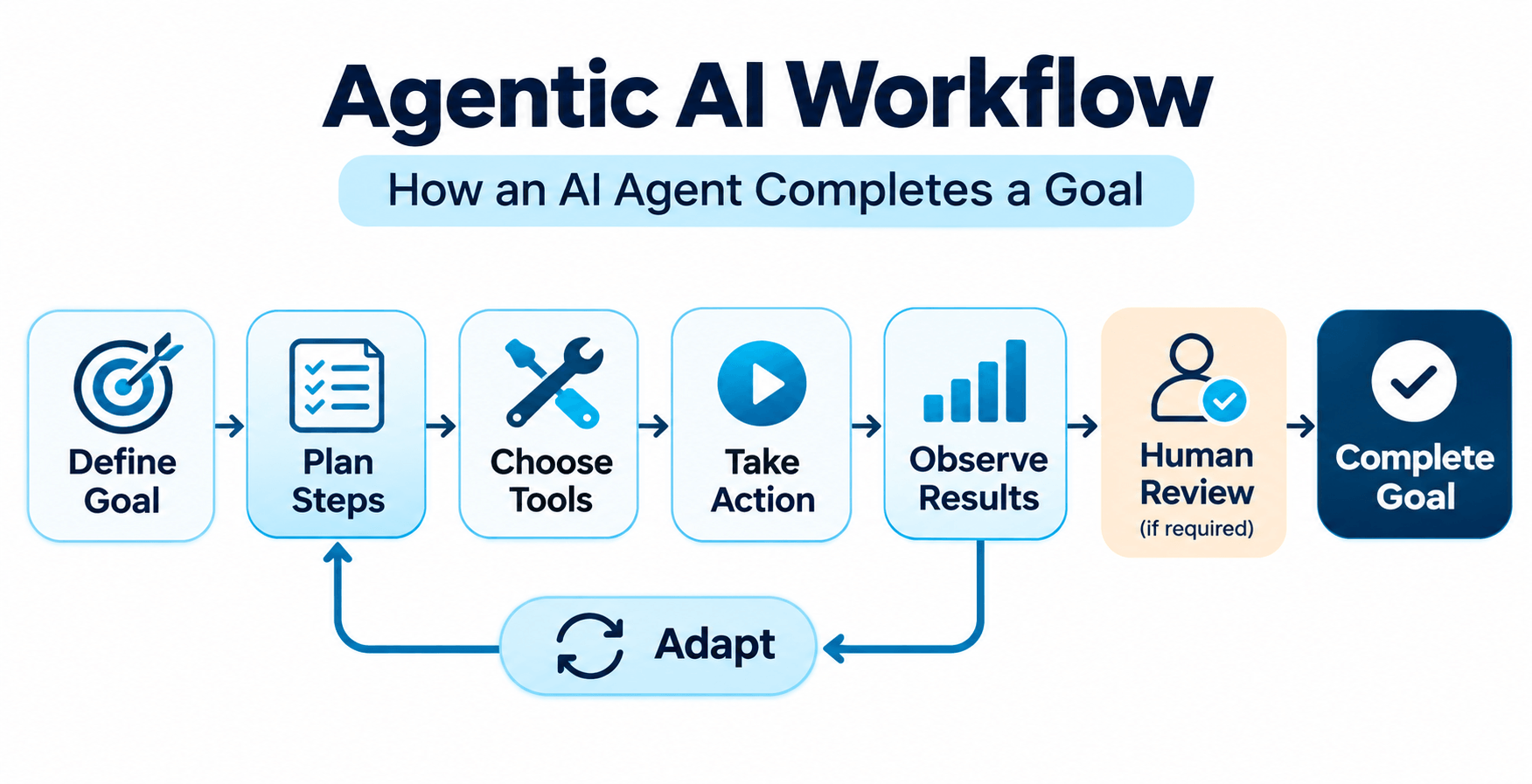
An agent usually loops: understand the goal, make a plan, take an action, look at what happened, then decide the next move. It may go around that loop until the job is done or it needs a person.
A simplified agentic AI workflow includes:
- Goal definition: The user or system defines the desired outcome.
- Planning: The agent breaks the objective into smaller tasks.
- Action: The agent uses approved tools or systems to complete a step.
- Observation: The agent evaluates the result of that action.
- Adjustment: The agent changes its plan, continues, or requests assistance.
- Completion: The agent reports the outcome or completes the authorized workflow.
Picture an agent asked to prepare a weekly project status report. It could pull the approved updates, notice what is missing, summarize progress, draft the report, and tell the project manager the draft is ready. If it has permission, it might also update the project tool.
For a practical look at how agents are changing software work, read WFI’s article, The Rise of the Agentic Engineer: Moving from Coder to Orchestrator.
Generative AI Use Cases
Generative AI helps when the work is creating, rewriting, or explaining something. That shows up in marketing, software, education, customer service, and plenty of other jobs.
1. Content Creation and Marketing
Marketing teams use it to draft blog posts, social captions, emails, product descriptions, and ad ideas. It can also reshape a piece of content for a different audience or channel.
Someone still needs to read it. The facts, the usefulness, the brand voice, and the fit for that audience are not things to leave to the draft.
2. Software Development
Developers use it to write code, explain a function they have not seen, draft documentation, and suggest tests. It can also point at possible causes of a bug and offer a fix to try.
For more on AI-assisted coding and the skills developers need, read WFI’s article, The Future of Coding: Mastering AI-Powered Development.
3. Research and Summarization
It can shorten a long report, pull out the main points, and help you sort a pile of information. That is useful for research. Important findings still need to be checked against a source you trust.
4. Customer Support
It can draft answers to questions customers ask often, summarize a support thread, and help a representative reply faster. Connected to an approved knowledge base, it can also help someone find the right information.
5. Learning and Professional Development
It can explain a hard idea, make practice questions, and let someone move through a topic at their own pace. People also use it to review a concept, prepare for an interview, or pick up a new skill.
Agentic AI Use Cases
Agentic AI matters when a job needs several connected actions, someone watching the process, or more than one system. These examples show how that can look in different kinds of work.
1. Customer Service Workflows
A customer-service agent might pull an order, check the return policy, start a return that qualifies, and send an update. Messy or sensitive cases can go to a person.
What it is allowed to do depends on the connections, the permissions, and the company’s rules.
2. Software Engineering
In software work, an agent can read a requirement, sketch a plan, write code, run tests, look at the errors, and try again. A developer still watches the process and approves changes before they are merged or shipped.
That changes the job. Less of it is typing every line. More of it is setting the requirement, judging the result, and coordinating the workflow. WFI looks at that shift in The Rise of the Agentic Engineer: Moving from Coder to Orchestrator.
3. Sales and Lead Management
A sales workflow could score a new lead against approved rules, pull the account details, draft a personal follow-up, and update the CRM. Depending on the setup, it might also schedule the next task or wait for approval before anything is sent.
4. Supply Chain and Inventory Management
It can watch inventory, spot a possible shortage, compare suppliers, and recommend what to reorder. With tight permissions, it may also start a purchase that the company has already approved as a type of action.
5. Project Management
It can collect status updates, find overdue tasks, flag risks, and draft a report. If it is allowed to, it can also send reminders or update the project record.
Generative AI is the part that drafts the documents. Agentic AI is the part that keeps the workflow moving. WFI writes about generative AI in project management in its blog collection.
How Agentic AI and Generative AI Work Together
These are not rival technologies. In a lot of real work, they are used together.
Generative AI reads the instructions, writes the content, and summarizes. The agent uses that as one step in a larger process that also plans, uses tools, and takes action.
For example, imagine a business team preparing a customer event:
- Generative AI drafts the event agenda and invitation email.
- Agentic AI checks approved calendar and venue systems for availability.
- Generative AI helps create event descriptions and attendee communications.
- Agentic AI coordinates approved scheduling tasks and tracks responses.
- A human organizer reviews important decisions and approves actions when needed.
Software work can follow the same pattern. Generative AI helps write the code and the docs. An agentic workflow lines up the build, the tests, and the review.
IBM’s explanation of agentic AI vs. generative AI also shows how generative tools can sit inside systems that plan and carry out several steps.
Benefits and Limitations of Generative AI
Benefits
- Faster content creation: Helps generate drafts, summaries, and creative material.
- Support for knowledge work: Helps users organize and interpret information.
- Creative assistance: Provides ideas and alternative approaches.
- Flexible applications: Can support writing, coding, design, learning, and research.
Limitations
- Potential inaccuracies: Generated information may be incorrect or misleading.
- Prompt dependence: Results can vary depending on the instructions and context.
- Limited action by default: Generating an answer does not necessarily complete a real-world task.
- Need for review: Important outputs should be evaluated before use.
Benefits and Limitations of Agentic AI
Benefits
- Workflow coordination: Can manage multiple connected steps toward a goal.
- Reduced repetitive work: Can handle approved actions that would otherwise require manual effort.
- Tool integration: Can interact with connected applications and data sources.
- Adaptive execution: Can evaluate results and adjust its approach during a task.
Limitations
- Operational risk: Incorrect actions can affect connected systems or business processes.
- Integration complexity: Reliable workflows may require careful configuration and testing.
- Governance requirements: Permissions, monitoring, and auditability are important.
- Human oversight: High-impact or irreversible actions may require human approval.
Because an agent can touch other systems and take action, a company needs clear limits, someone watching what it does, and a way to hand off anything uncertain or high risk. IBM also covers the risks and the need for safeguards in its overview of agentic AI.
Career Opportunities in Generative AI and Agentic AI
As companies add AI tools and workflows, people need a mix of technical, analytical, and communication skills. What that mix looks like depends on the role and how far the company has gone with AI.
Generative AI-Related Skills
- Prompt design and evaluation
- AI-assisted writing and content creation
- Understanding model capabilities and limitations
- Data interpretation and information verification
- AI-assisted software development
Agentic AI-Related Skills
- Workflow design and process analysis
- Task decomposition and planning
- API and tool integration
- Testing, monitoring, and evaluation
- AI governance and human oversight
- System design and orchestration
Software engineers, project managers, data people, and business analysts are all likely to run into these workflows. Knowing what AI can do, and when a person still has to decide, makes it easier to keep up.
If you work in software and want to build those skills, WFI’s article on the agentic engineer looks at how the job is moving toward planning, orchestration, and oversight.
When Should You Use Generative AI vs. Agentic AI?
The better choice depends on the task, the result you want, and how much you are willing to let the system do on its own.
Use generative AI when:
- You need to create or revise content.
- You want to summarize or explain information.
- You need ideas, drafts, or code suggestions.
- A person will review the output and decide what to do next.
Consider agentic AI when:
- A task involves several connected steps.
- The system needs to interact with approved tools or applications.
- The workflow requires monitoring or adapting to new information.
- You want to automate actions within clearly defined permissions.
Some jobs only need generative AI. Others are worth an agent. A lot of business processes work better with both.
The Future of Agentic AI and Generative AI
Generative AI made it easier to create content, try ideas, and work through information. Agentic AI takes that further by helping a system plan and finish work that takes more than one step.
As this develops, companies have to decide not only what AI may write, but what it may do. Clear goals, the right permissions, a person in the loop, and a real way to check the result still matter.
For people in the work, the useful skill is knowing how to work with AI. That might mean using a generative tool on everyday tasks, or understanding how an agent coordinates a longer workflow.
Conclusion
The key difference in agentic AI vs. generative AI is purpose. Generative AI makes content because you asked. Agentic AI works toward a goal by planning, using tools, and acting across several steps.
Generative AI is useful for writing, coding, summarizing, and creating. Agentic AI can carry those skills into workflows such as customer service, software development, sales, and project coordination.
Neither one is the right answer for every task. Choose based on the goal, the workflow, the risk, and how much a person needs to stay involved. Often the better result is using them together.
For people doing the work, understanding both is a practical step toward working confidently with AI.
Frequently Asked Questions
1. What is the main difference between agentic AI and generative AI?
Generative AI makes content such as text, images, code, or summaries when you prompt it. Agentic AI tries to reach a goal by planning and acting across several steps. An agent may use generative AI as one of its tools.
2. Is agentic AI a type of generative AI?
Not exactly. They describe different abilities. An agent may use a generative model, but agentic AI also includes planning, tool use, and workflows that take action.
3. Can generative AI take actions?
A generative app can be connected to tools that let it act. Writing content is still different from running a workflow aimed at a goal. Agentic AI is the name for systems built around that wider process.
4. Is agentic AI more advanced than generative AI?
Not necessarily. They are built for different jobs. Generative AI is often the better fit for making content. Agentic AI is often the better fit for a workflow with several steps. The task decides which one you need.
5. What are examples of generative AI?
Tools that turn a prompt into text, images, audio, video, or code. Everyday uses include writing help, image generation, summaries, and coding support.
6. What are examples of agentic AI?
Systems that run a customer-service workflow, handle scheduling you have already approved, help with software testing, or watch a business process and take actions they are allowed to take.
7. Can agentic AI and generative AI work together?
Yes. An agent can use generative AI to read instructions, write content, or summarize, while it coordinates the steps of a larger task.
8. What are the risks of agentic AI?
The risks include a wrong action, behavior you did not intend, permissions that are too broad, and failures in the systems it is connected to. Use safeguards, monitoring, testing, and a person’s approval for actions that are hard to undo.
9. Which industries can benefit from agentic AI?
Software development, customer service, sales, finance, healthcare administration, and supply chain work can all use agentic workflows. Whether a specific use is a good idea depends on the requirements, the data, the integrations, and the risk.
10. What skills are useful for working with agentic AI?
Useful skills include reading a workflow, planning tasks, designing the system, connecting tools and APIs, testing, monitoring, and knowing where AI fails. You also need the judgment to check what the system produced.