
A good digital product starts with the people who have to use it. Before anyone designs a website, an app, or another product, the team needs to know who those people are, what they are trying to do, and where they get stuck. That is the work of a UX researcher.
UX researchers watch how people behave, ask them what is going on, and turn that into findings a product team can actually use. The result is a product that is more useful, easier to use, and more accessible.
If you like user experience, psychology, figuring out problems, or how products get built, UX research is worth a look. This guide covers the job, the skills, the methods and tools, and how people get into the field.
What Is a UX Researcher?
A UX researcher, also called a user experience researcher, studies how people actually use a digital product or service. The job is to understand what people need, what they expect, what motivates them, and where they struggle, so the product team is not guessing.
UX means user experience. It is the whole experience of using something, whether that is a website, an app, or an online service.
UX researchers usually start with questions like these:
- Who are the users of this product?
- What are users trying to accomplish?
- Where do users experience confusion or difficulty?
- Which features are useful to users?
- How can the product experience be improved?
Those findings give designers, product managers, developers, and other stakeholders a clearer picture of users before they make a big product decision.
What Does a UX Researcher Do?
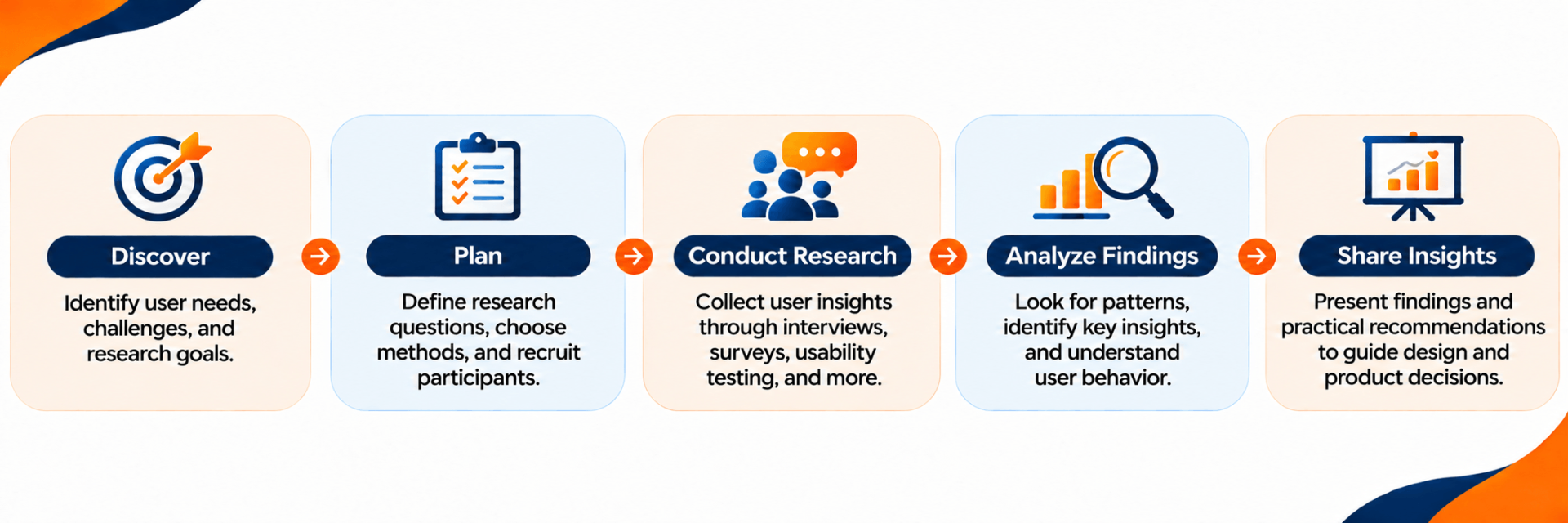
The day-to-day work changes with the company, the product, and the size of the research team. Most researchers still move through the same loop: plan the study, collect information, make sense of it, and tell the team what to do with it.
1. Plan User Research
The work starts with the questions that still need answers. Researchers sit with product and design teams, agree on the goal, pick a method, and decide who should take part.
A research plan usually covers the goal, who to recruit, the questions, the timeline, and how the information will be collected.
2. Conduct User Interviews and Surveys
Researchers talk with users about what they experienced, what they expected, and what got in the way. An interview gives you the detail. A survey helps you hear from more people.
The questions need to be clear and not steer the answer, or people will tell you what they think you want to hear.
3. Perform Usability Testing
Usability testing shows how easily someone can get something done. You might ask a person to create an account, find a piece of information, or finish a purchase.
You watch where they hesitate, make a mistake, or get lost. Those moments often reveal problems the team never noticed while building the product.
4. Analyze Research Findings
Once the information is in, the researcher looks for patterns. That can mean sorting interview notes, grouping problems that keep coming up, reading survey answers, or comparing what happened in several usability tests.
The point is not to repeat every quote. It is to say what the evidence actually means.
5. Communicate Insights and Recommendations
Researchers then share what they found with designers, product managers, developers, and anyone else who needs it. That might be a report, a presentation, a journey map, or a short list of usability problems.
If the story is clear, the team can see what users need and decide which fixes should come first.
Essential UX Researcher Skills
A strong UX researcher knows how to run a study, think through the results, and explain them. Technical skill helps. So does the ability to understand people and read what their experience actually means.
| UX Researcher Skill | Why It Matters |
|---|---|
| Research methods | Helps researchers choose suitable methods such as interviews, surveys, and usability testing. |
| Analytical thinking | Helps identify patterns, interpret findings, and distinguish meaningful insights from individual opinions. |
| Empathy | Helps researchers understand users' perspectives, needs, and frustrations. |
| Active listening | Helps researchers understand participants without interrupting or influencing their responses. |
| Communication | Helps explain research findings and recommendations to different teams. |
| Collaboration | Supports effective work with designers, developers, product managers, and stakeholders. |
| Research ethics | Ensures participants are treated respectfully and their information is handled responsibly. |
UX Research Methods and Tools
The method depends on the question, where the project is, and what time or budget you have. Some methods are about why people do something. Others measure behavior or test whether a product is usable.
Common UX Research Methods
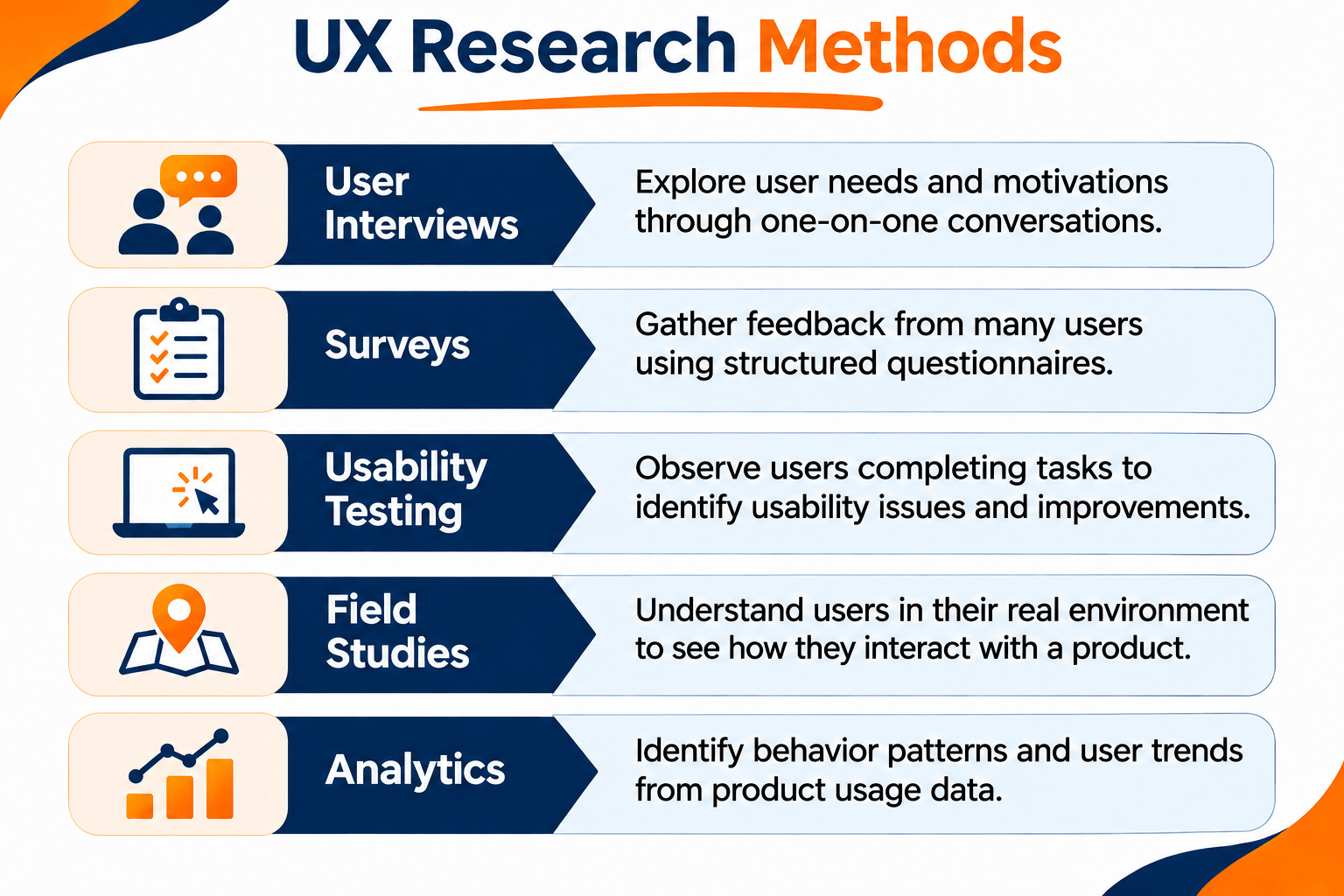
- User interviews: One-on-one conversations that explore users' experiences, needs, and motivations.
- Surveys: Questionnaires used to collect feedback and identify trends across a group of users.
- Usability testing: Observing users as they complete tasks with a product or prototype.
- Card sorting: Asking participants to organize information into categories to help inform information architecture.
- Contextual inquiry: Observing users in their real environment while learning about their workflows.
- Diary studies: Asking participants to record experiences over a period of time.
Qualitative vs. Quantitative UX Research
Most useful research mixes qualitative and quantitative methods. They answer different kinds of questions.
| Research Type | What It Helps Answer | Examples |
|---|---|---|
| Qualitative research | Why are users behaving this way? | User interviews, observations, usability testing |
| Quantitative research | How many users experience this issue, or how often does it happen? | Surveys, analytics, task completion rates |
Analytics might show that a lot of people leave during checkout. A usability test or an interview can tell you why they leave.
Common UX Research Tools
Researchers use tools to plan a study, collect feedback, look at behavior, and share what they found. The right tool depends on the method and the project.
- Figma: Often used to review prototypes and collaborate with design teams during usability testing.
- Google Forms: Can be used to create surveys and collect participant responses.
- Google Sheets or Excel: Useful for organizing research notes, survey results, and observations.
- FigJam or Miro: Can help teams organize research findings, group themes, and collaborate on affinity mapping.
- Usability testing platforms: Help researchers conduct remote studies and observe user interactions.
- Analytics tools: Help teams understand behavior patterns, such as navigation paths and task completion.
Knowing a tool is useful. Knowing how to choose the right method matters more than sticking to one platform.
UX Researcher vs. UX Designer
Researchers and designers work side by side, but they do not do the same job. Researchers find out what users need and gather the evidence. Designers use that evidence to shape and improve the experience.
| Aspect | UX Researcher | UX Designer |
|---|---|---|
| Primary focus | Understanding users and their needs | Designing useful and usable experiences |
| Typical activities | Interviews, surveys, usability studies, analysis | Wireframes, prototypes, user flows, interface design |
| Key deliverables | Research reports, insights, recommendations | Wireframes, prototypes, design specifications |
| Core skills | Research, analysis, empathy, communication | Interaction design, visual design, prototyping, problem-solving |
The line between the roles is not always sharp. On a small team, a designer may run the research, and a researcher may sit in on design and product decisions.
If you want the wider design picture, read more about UI/UX Design and how user research fits into that work.
How to Become a UX Researcher
You get into this work by learning how to research, paying attention to how people use products, and practicing. There is no single path. People arrive from different degrees and different jobs.
1. Build a Foundation in User Experience
Start with the basics of user experience: usability, accessibility, user-centered design, and how a product actually gets built.
If you understand that process, it is much easier to work with designers and product teams.
2. Learn UX Research Methods
Learn interviews, surveys, usability testing, and observation. Practice writing research questions, finding participants, and asking questions that do not lead the answer.
Then practice reading the results and explaining what the product team should do with them.
3. Practice With Real or Sample Projects
You learn this by doing it. Pick a website or an app that is awkward to use and treat it as a small study.
For example, you could:
- Identify a problem users may experience.
- Develop a research question.
- Conduct a small number of user interviews.
- Observe users completing a task.
- Identify patterns in the findings.
- Recommend improvements based on the evidence.
Tell people why you are doing the research and get a clear yes before they take part. Do not collect personal information you do not need.
4. Create a UX Research Portfolio
A portfolio shows how you frame a problem, run the research, read the results, and explain them. A clear case study lets an employer see your process, not just a finished screen.
A strong case study may include:
- The research problem and project context
- Research objectives and questions
- Methods and participant criteria
- Key findings and supporting evidence
- Recommendations and their rationale
- Limitations and what you would improve next time
Spend the space on your reasoning. Show how the research changed a decision, not only what the design looked like at the end.
5. Apply for Entry-Level UX Research Jobs
When you have the basics and a portfolio, look at roles such as UX Research Intern, Junior UX Researcher, Research Assistant, or UX Research Associate.
Jobs that mix research with design, product management, or customer experience can also get you useful experience while you specialize.
UX Researcher Career Path
There is more than one way to grow. Some people move into senior research. Others move into research leadership, product strategy, or a narrower research specialty.
| Career Level | Typical Responsibilities |
|---|---|
| Junior UX Researcher | Supports research planning, participant recruitment, interviews, usability testing, and documentation. |
| UX Researcher | Plans and conducts studies, analyzes findings, and communicates recommendations to product teams. |
| Senior UX Researcher | Leads complex studies, advises teams, and helps connect research insights with product strategy. |
| Lead or Principal UX Researcher | Guides research direction, develops research practices, and influences decisions across teams or products. |
| UX Research Manager or Head of Research | Manages researchers, supports team development, and establishes research priorities and processes. |
How fast you move depends on your experience, how strong your research is, the size of the company, and what the role actually covers. Job titles are not the same everywhere.
Is UX Research a Good Career?
UX research fits people who like understanding behavior, asking questions, solving problems, and using evidence to make a product better.
The satisfying part is that the findings can change how a product is designed and built. You also work with designers, developers, product managers, and people on the business side.
The hard parts are real. Time and budget are often tight. Finding the right participants takes work. Feedback can conflict. And you still have to explain the findings to teams that do not all want the same thing.
If you like both analysis and people, this is a way to improve products in a way users can feel.
Frequently Asked Questions About UX Researchers
What qualifications do you need to become a UX researcher?
There is no one qualification every employer asks for. People come from psychology, human-computer interaction, design, sociology, and other fields that study people. Practical research skill and a strong portfolio matter just as much.
Can you become a UX researcher without a degree?
Some people get in without a traditional degree. It depends on the employer and the role. Learning the methods, doing real projects, and showing them in a portfolio can prove you can do the work. Some employers will still ask for a degree or a specific qualification.
Is UX research different from UX design?
Yes. Research is about understanding users, what they need, and how they behave. Design is about creating and improving the experience. The two work closely, and on some teams the jobs overlap.
What skills are most important for a UX researcher?
The skills that matter most are research methods, analytical thinking, empathy, active listening, communication, collaboration, and research ethics. Being able to turn findings into a recommendation the team can use is the skill that ties the rest together.
How do you build a UX research portfolio?
Start with one project and one clear user problem. Walk through your goal, your method, who took part, what you found, and what you recommended. A strong case study shows how you thought, not just how the screens looked.
What does a UX researcher do every day?
A typical day might be planning a study, interviewing users, running a usability test, reading the results, working with designers and product managers, or presenting what you recommend. It depends on the project and the company.
Conclusion
A UX researcher helps a team understand users and make product decisions from evidence. Interviews, surveys, usability tests, and analysis show what people need and where the experience can get better.
The career takes research skill, clear thinking, communication, and practice. Learn the basics, try the methods, and put the work in a portfolio. That is how you start.
If you want to design better digital experiences, look at the UI/UX Design program at WorkForce Institute to learn user-centered design and the skills behind products people can actually use.