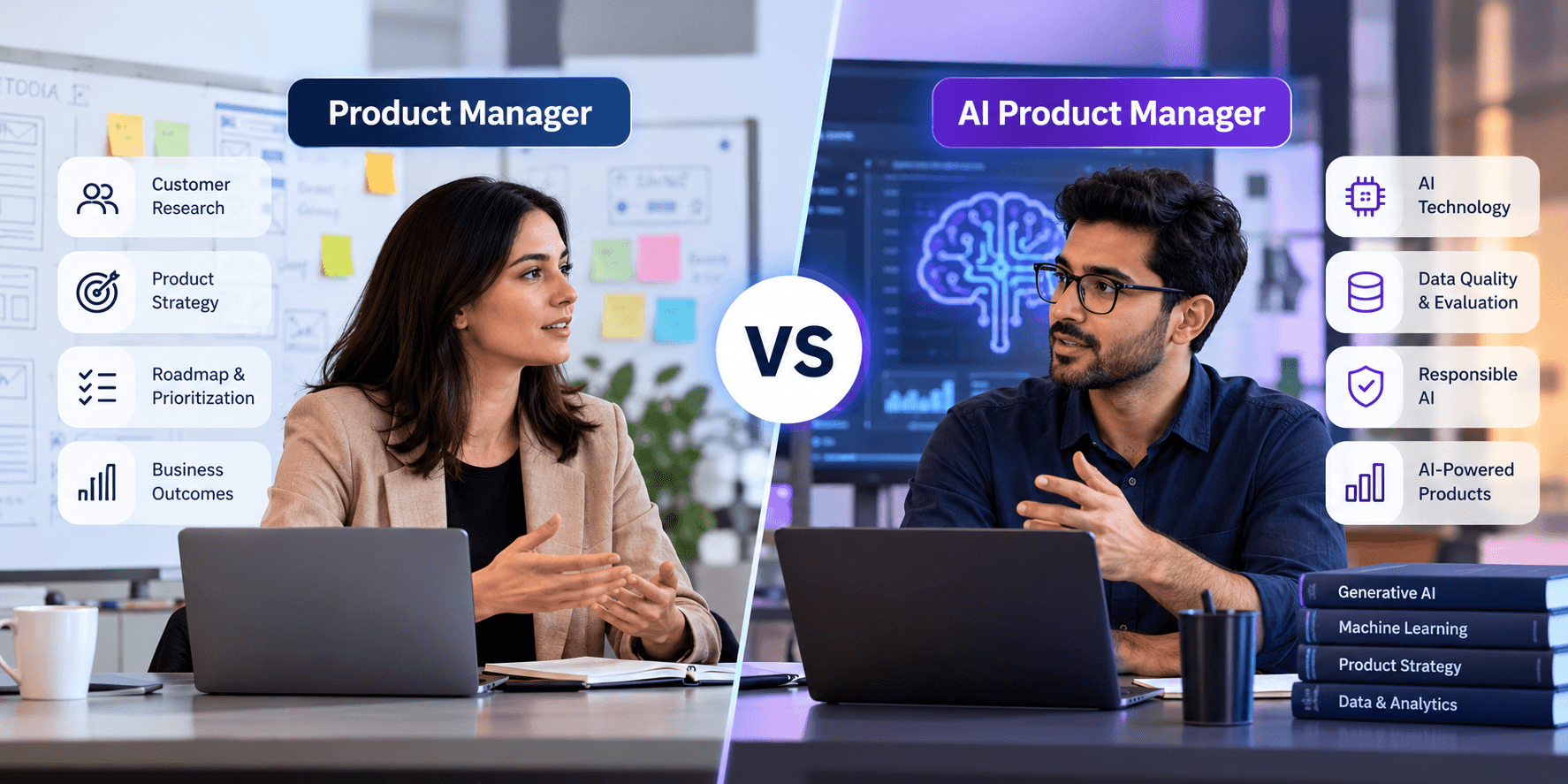
Artificial intelligence is changing how businesses develop products, understand customers, and make decisions. As companies introduce AI-powered features, product managers need to understand how AI can support customer needs and business goals.
This has increased interest in AI product management. But how is an AI product manager different from a traditional product manager? Both roles involve product strategy, customer research, prioritization, and collaboration. AI product managers must also consider AI capabilities, data quality, model performance, and responsible AI use.
In this guide, we compare AI product managers and product managers, explore their skills and responsibilities, and explain the career opportunities available in both fields.
What Is a Product Manager?
A product manager guides a product's development and improvement by connecting customer needs with business objectives. They help determine what a team should build, why it matters, and how success will be measured.
Product managers work with designers, developers, marketers, analysts, and other stakeholders. Their responsibilities often include customer research, product strategy, roadmap planning, feature prioritization, and performance measurement.
To understand the foundational skills required for this career, read WFI's guide on the skills and qualities product managers need.
Key Responsibilities of a Product Manager
- Research customer needs and market opportunities.
- Define product strategy, goals, and roadmaps.
- Prioritize features based on customer value and business impact.
- Collaborate with design, engineering, marketing, and business teams.
- Monitor product adoption, engagement, and other performance metrics.
- Use customer feedback and product data to guide improvements.
What Is an AI Product Manager?
An AI product manager guides the development and improvement of products or features that use artificial intelligence. These may include machine learning applications, generative AI assistants, recommendation systems, and natural language processing tools.
Like other product managers, AI product managers focus on solving customer problems. However, they also need to understand whether AI is appropriate for a particular use case and how to evaluate the reliability, usefulness, and risks of AI-powered features.
For example, an AI product manager developing a customer-support assistant may define which questions it should answer, how response quality will be assessed, and what safeguards are needed when the assistant produces incorrect information.
For a practical example of AI in project workflows, explore WFI's article What an Agile PM Using GenAI Actually Does.
Key Responsibilities of an AI Product Manager
- Identify customer problems that AI could help solve.
- Evaluate AI solutions against simpler alternatives.
- Collaborate with AI engineers, data scientists, designers, and business stakeholders.
- Define requirements for AI-powered features.
- Establish evaluation criteria for quality, reliability, and business impact.
- Consider data privacy, security, bias, and other AI-related risks.
- Monitor performance after launch and identify opportunities for improvement.
AI Product Manager vs. Product Manager: Key Differences
The primary difference is the product context. Both roles rely on product management fundamentals, but AI product managers also address challenges associated with AI technology, data, and model outputs.
| Comparison Area | Product Manager | AI Product Manager |
|---|---|---|
| Primary focus | Customer problems, product strategy, and business outcomes | Customer and business outcomes for AI-powered products |
| Technology | May involve websites, mobile applications, software platforms, or other products | May involve machine learning, generative AI, recommendation systems, or language models |
| Data requirements | Uses customer research, analytics, and product performance data | Also considers data quality, evaluation datasets, and AI output quality |
| Team collaboration | Works with design, engineering, marketing, and business teams | May also work closely with AI engineers and data scientists |
| Testing | Focuses on functionality, usability, adoption, and product performance | Also evaluates output quality, reliability, and AI failure cases |
| Risk management | Considers customer, product, commercial, and security risks | May additionally address hallucinations, model bias, and AI-specific privacy risks |
| Success metrics | May include adoption, retention, customer satisfaction, and revenue | May include these metrics plus AI quality, latency, and operating costs |
These differences are not absolute. Traditional product managers can use AI tools in their work, and AI product managers still rely on core product management practices. WFI explores this changing relationship in its article How Much Will Product Managers Rely on AI?.
Essential Skills for Product Managers
Product managers need a combination of customer understanding, strategic thinking, communication, and analytical skills. The exact requirements depend on the product and organization.
1. Customer and Market Research
Customer interviews, surveys, usability testing, and market research help product managers understand user needs and identify opportunities.
2. Product Strategy and Prioritization
Product managers must decide which features deserve attention based on customer value, business impact, technical feasibility, and available resources. WFI's article on which product features to prioritize provides additional guidance on this important responsibility.
3. Communication and Collaboration
Product managers align stakeholders, communicate requirements, resolve competing priorities, and help teams work toward shared goals.
4. Analytical Thinking
Understanding product analytics, customer feedback, experiments, and performance metrics helps product managers evaluate outcomes and make evidence-based decisions.
5. Technical and Business Understanding
Product managers benefit from understanding how their products work, what resources they require, and how they contribute to business objectives. For a broader overview, read WFI's article on the skills the next generation of product managers will need.
Essential Skills for AI Product Managers
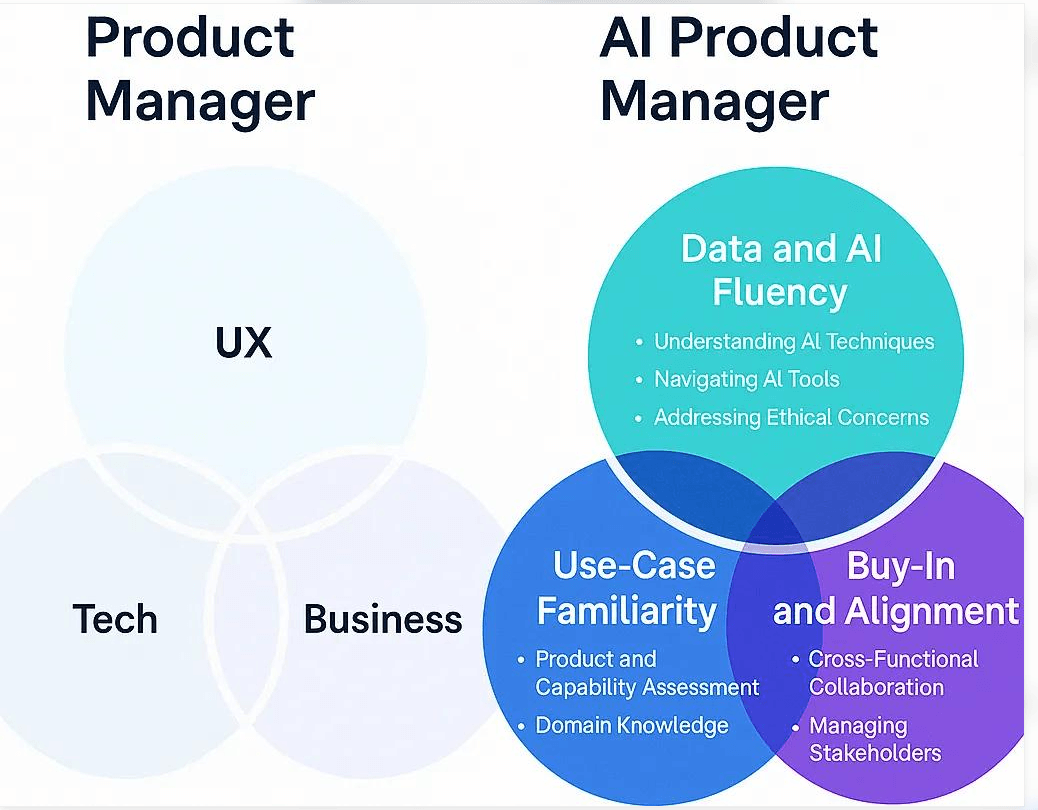
AI product managers need the core skills of product management along with additional knowledge of AI technologies, data, evaluation, and responsible implementation.
1. AI Literacy
They should understand relevant AI capabilities and limitations, including when generative AI or machine learning may be suitable for a product problem.
2. Data Literacy
AI product managers need to discuss data quality, availability, privacy, and evaluation requirements with technical specialists.
3. AI Evaluation and Experimentation
AI systems may produce different outputs for similar inputs. Product teams need appropriate test cases, output evaluation, user feedback, and monitoring to understand how well an AI feature performs.
4. Responsible AI and Risk Awareness
AI product managers should consider privacy, fairness, security, transparency, and the consequences of incorrect outputs.
5. Cost and Performance Management
AI features can introduce costs related to model usage, infrastructure, latency, and ongoing evaluation. Product decisions should balance quality, customer value, and operating costs.
How AI Tools Support Product Management
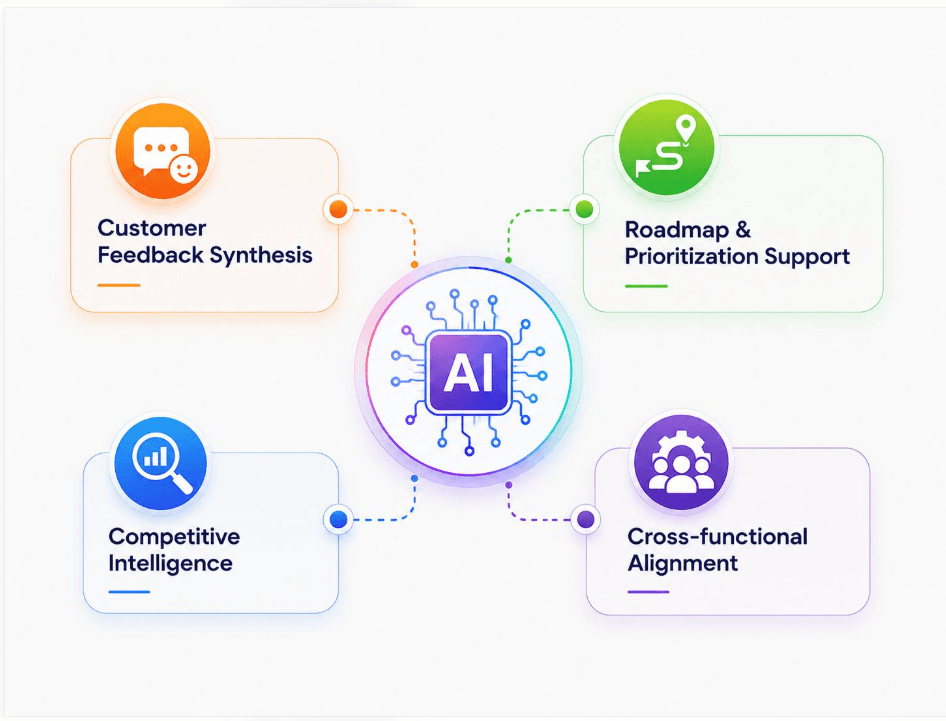
AI tools can assist with research, documentation, planning, and analysis. However, product managers still need to validate outputs and make decisions based on customer needs and reliable evidence.
Customer Research and Feedback
AI can help summarize interviews, organize feedback, and identify recurring themes. Product managers should verify these summaries against the original information.
Product Planning and Documentation
Generative AI can help draft product briefs, user stories, meeting summaries, and requirements documents. These drafts should be reviewed for accuracy and alignment with product goals.
Prioritization and Workflow Support
AI can help teams explore ideas and organize information, but feature decisions still require judgment about customer value, feasibility, risk, and business priorities. See WFI's practical article, What an Agile PM Using GenAI Actually Does, for examples of AI-assisted project work.
Career Opportunities in Product Management
Traditional and AI product management both offer career paths across industries. Opportunities depend on experience, skills, the product domain, and employer requirements.
Traditional Product Management Roles
- Associate Product Manager: Supports product research, requirements, and delivery.
- Product Manager: Manages a product area, roadmap, and performance goals.
- Senior Product Manager: Leads complex initiatives and coordinates across teams.
- Group Product Manager or Director: Guides multiple product areas, teams, or broader strategy.
- Head of Product or Chief Product Officer: Oversees product direction and its alignment with company goals.
AI Product Management Roles
- AI Product Manager: Leads AI-powered product features.
- Generative AI Product Manager: Focuses on generative AI applications and experiences.
- AI Platform Product Manager: Manages AI services and capabilities used across products.
- Senior AI Product Manager: Leads complex AI product initiatives.
- AI Product Lead or Director: Guides AI product portfolios, teams, or strategy.
AI Product Manager Salary: What Influences Pay?
Compensation varies according to location, experience, industry, company size, technical requirements, and the scope of responsibility. Compare roles at similar experience levels and in the same location, and distinguish base salary from total compensation.
AI expertise may be valuable for some positions, but it does not guarantee a higher salary. Product outcomes, communication, strategic thinking, and relevant experience remain important.
How to Become an AI Product Manager
- Learn product management fundamentals. Study customer discovery, strategy, roadmaps, prioritization, and product metrics.
- Develop AI literacy. Understand relevant AI technologies, their capabilities, and their limitations.
- Explore existing AI products. Examine how they solve customer problems and where they may fail.
- Practice defining an AI use case. Document the customer problem, proposed solution, alternatives, success metrics, and risks.
- Learn AI evaluation. Explore test cases, output-quality assessment, user feedback, and monitoring.
- Create a portfolio project. Document your product decisions, prototype, evaluation plan, and lessons learned.
- Gain practical experience. Look for opportunities to contribute to AI features or collaborate with technical teams.
If you want to develop practical skills in AI-supported project workflows, explore WFI's AI-Powered Project Manager Bootcamp. Review the program curriculum to decide whether it matches your learning goals.
Which Career Path Is Right for You?
- Traditional product management: A good fit if you want to develop broad skills in customer research, strategy, prioritization, and product delivery.
- AI product management: Worth exploring if you are interested in AI-powered products and willing to learn about data, model limitations, evaluation, and responsible AI.
- A combination of both: Useful if you want to manage a range of products while understanding when AI can provide meaningful value.
You do not need to choose one path permanently. Core product management skills can transfer across industries, while AI knowledge can complement an existing career.
Frequently Asked Questions
Is an AI product manager different from a product manager?
Yes. Both roles focus on customer needs, product strategy, and business outcomes. AI product managers also address AI capabilities, data, model output quality, evaluation, and responsible implementation.
Does an AI product manager need coding skills?
Not every role requires coding. However, understanding relevant technical concepts and AI limitations helps product managers collaborate with engineers and data scientists.
Can a traditional product manager become an AI product manager?
Yes. Product strategy, customer research, prioritization, and communication provide a useful foundation. Learning AI concepts and gaining practical experience with AI-powered features can help prepare professionals for specialized roles.
Is AI product management suitable for beginners?
It can be, but beginners should develop product management fundamentals and AI literacy. Practical projects can help demonstrate their ability to define problems and evaluate solutions.
Will AI replace product managers?
AI can assist with tasks such as summarizing feedback, drafting documents, and exploring data. Customer understanding, strategic judgment, prioritization, and accountability remain important, although the impact of AI will vary by organization.
Final Thoughts
The difference between an AI product manager and a product manager is not simply that one uses AI and the other does not. Both roles require customer understanding, strategic thinking, collaboration, and measurable outcomes. AI product management adds specialized considerations involving data, AI capabilities, evaluation, and responsible deployment.
Building strong product management fundamentals alongside AI literacy can help professionals prepare for evolving product roles. Explore WFI's related product management articles to continue learning, and review relevant training options to find a path that matches your career goals.
```

