Introduction
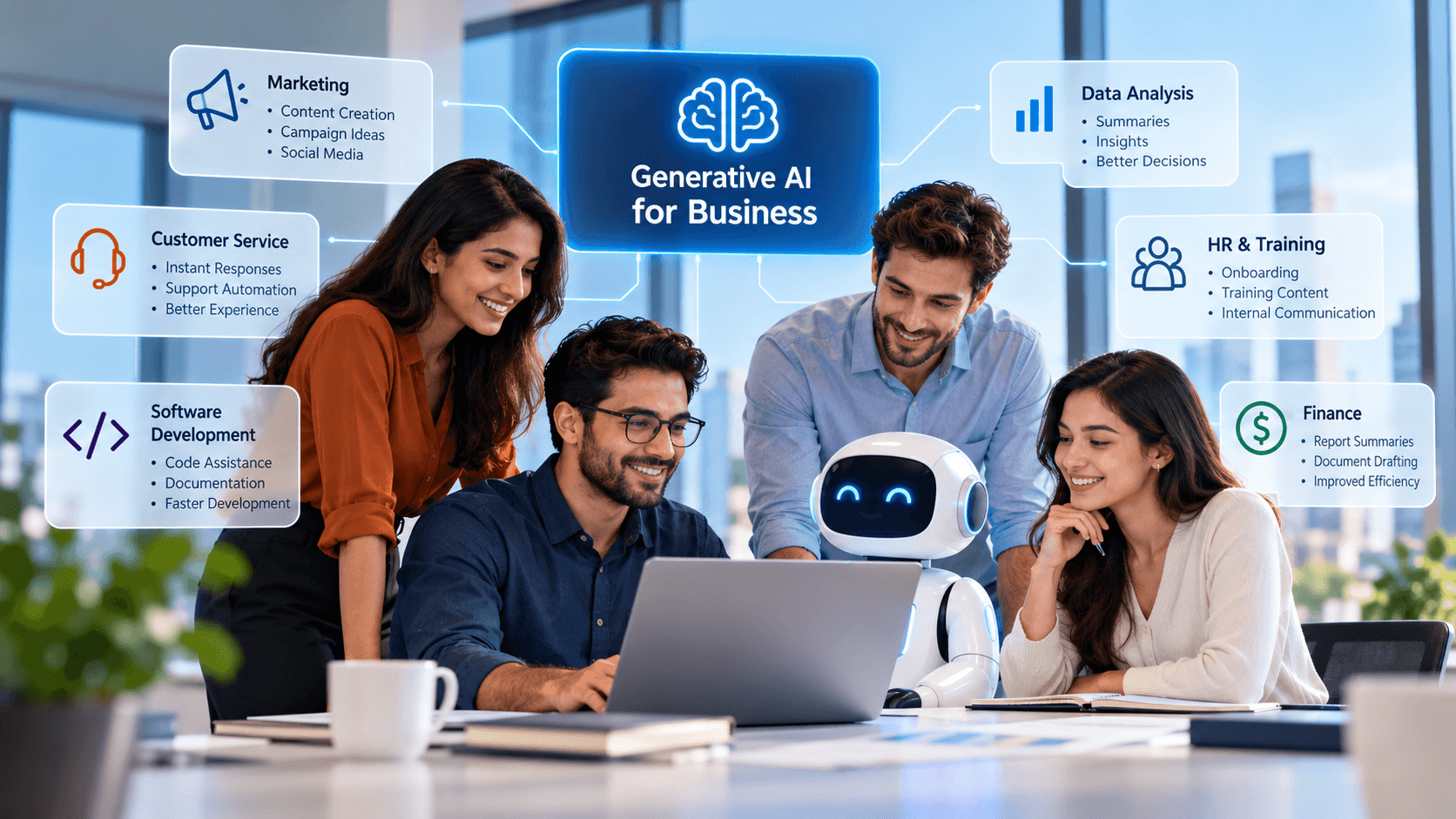
Generative AI is changing how businesses create content, serve customers, analyze information, and develop products. From drafting marketing campaigns to assisting software developers, generative AI tools are helping teams streamline everyday tasks and explore new ways to work.
For businesses, the opportunity goes beyond automation. Generative AI can support employees, improve customer experiences, accelerate content production, and help organizations discover new business opportunities. However, successful adoption requires choosing the right use cases, protecting sensitive information, and measuring results.
In this guide, we explore how generative AI for business works, its key benefits, practical applications across industries, real-world examples, and how organizations can measure its value.
What Is Generative AI for Business?
Generative AI is a type of artificial intelligence that creates new content based on patterns learned from training data. Depending on the model, it can generate text, images, code, summaries, audio, and other types of content.
Businesses can use generative AI to draft emails, summarize documents, brainstorm ideas, create product descriptions, support customer service, and assist with software development. These tools can help employees complete certain tasks more efficiently, although their outputs still require appropriate review.
Generative AI differs from traditional AI in its primary purpose. Traditional AI is often used to classify information, identify patterns, detect anomalies, or predict outcomes. Generative AI focuses on producing new content or responses based on instructions and available context.
For example, a traditional AI system might predict which customers are likely to cancel a subscription, while a generative AI tool could help a customer service representative draft a suitable response. Businesses can combine both approaches to support different stages of a workflow.
Organizations looking to build a stronger understanding of this technology can also explore WFI's article, Understanding AI Model Training: A Beginner's Guide, which introduces the concepts behind AI models.
Key Benefits of Generative AI for Business
1. Improved Productivity and Efficiency
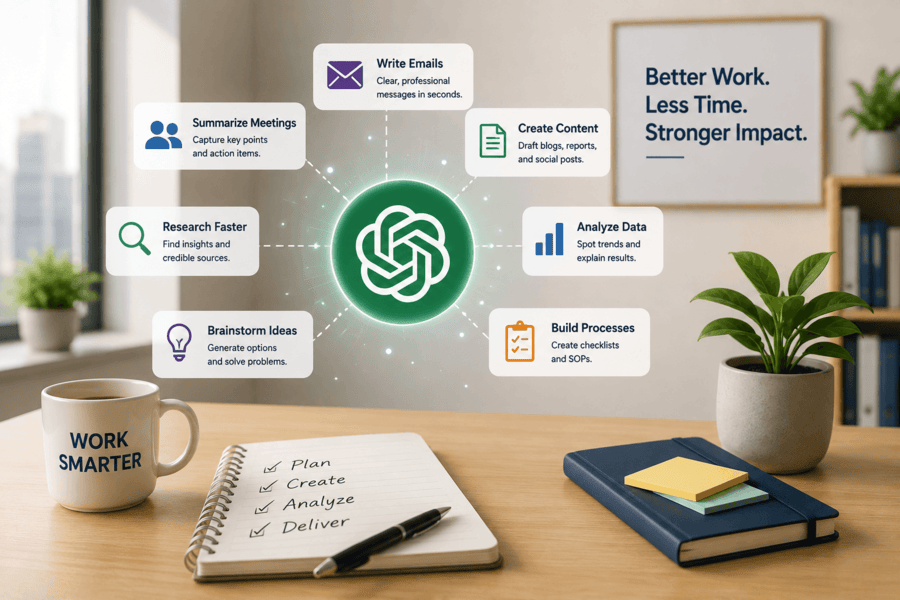
Generative AI can help employees handle repetitive or time-consuming tasks, including drafting documents, summarizing meetings, organizing research, and preparing initial presentations.
By reducing some of the manual effort involved in these activities, employees may have more time for problem-solving, strategic planning, and other work that requires human judgment. The actual productivity gains depend on the task, the quality of the AI tool, and the amount of review required.
2. Faster Content Creation
Marketing and communications teams can use generative AI to brainstorm campaign ideas, create content outlines, draft social media posts, and adapt messaging for different audiences.
For example, a marketing team could use AI to produce an initial draft of an email campaign and then refine it to reflect the brand's tone, audience needs, and campaign objectives. Human review remains important for accuracy, originality, and quality.
3. Better Customer Support
Generative AI can assist customer service teams by suggesting responses, summarizing conversations, and retrieving relevant information from approved knowledge bases.
AI assistants can also help answer routine questions when they are connected to reliable information sources. More complex, sensitive, or unusual issues should be directed to a qualified human representative.
4. Support for Data Analysis
Generative AI tools can help employees summarize reports, interpret research findings, and explore business information using natural-language questions.
For example, an analyst could use an approved AI tool to prepare an initial summary of a sales report. The analyst should verify the figures, calculations, and conclusions against the original data before sharing the findings or making decisions.
Businesses interested in the relationship between AI and analytical work can read What Does an AI Data Analyst Actually Do? for more insight into the role of AI in data analysis.
5. Faster Software Development
Software development teams can use generative AI to draft code snippets, explain unfamiliar code, prepare technical documentation, generate test cases, and explore possible debugging solutions.
These tools can support developers throughout the development process, but generated code should still be reviewed for security, reliability, performance, and maintainability.
To explore this topic further, read WFI's article, The Future of Coding: Mastering AI-Powered Development.
6. New Business Opportunities
Generative AI can help organizations explore new products, develop prototypes, personalize customer interactions, and test ideas more quickly. It can also support the development of new services built around content generation, knowledge assistance, and workflow automation.
The most useful opportunities often emerge when businesses combine AI capabilities with industry expertise, reliable information, and a clear understanding of customer needs.
Generative AI Use Cases Across Business Functions
Generative AI can support different departments in different ways. The right application depends on the organization's goals, available data, existing workflows, and risk requirements.
1. Marketing and Content Creation
Marketing teams can use generative AI to support content planning, campaign development, and routine production tasks.
- Drafting blog outlines and email campaigns.
- Generating social media content variations.
- Creating initial product descriptions.
- Brainstorming advertising concepts.
- Repurposing long-form content into shorter formats.
- Adapting messaging for different customer segments.
For example, an online retailer could use generative AI to prepare initial descriptions for a large product catalog using approved product specifications. Editors would then check each description for accuracy, clarity, and relevance before publication.
2. Customer Service and Customer Experience
Customer service teams often handle recurring questions about products, orders, billing, and account procedures. Generative AI can help teams retrieve information and prepare responses more efficiently.
- Drafting answers to common customer questions.
- Summarizing previous customer interactions.
- Helping agents locate relevant policy information.
- Supporting multilingual communication.
- Preparing conversation summaries for handovers.
For example, a software company could introduce an AI assistant that uses its approved help documentation to answer routine questions. When the assistant cannot find a reliable answer, it can direct the customer to a human support agent.
3. Human Resources and Employee Training
HR teams can use generative AI to assist with documentation, employee communication, and learning materials.
- Drafting job descriptions.
- Preparing employee onboarding guides.
- Creating training outlines and practice questions.
- Summarizing internal policy documents.
- Drafting answers to common employee questions.
For example, an HR team could use generative AI to prepare a first draft of an onboarding guide for new employees. HR professionals would review the content to ensure that it accurately reflects current policies and procedures.
Organizations can also explore WFI's article, AI Skills Gap 2026, to understand why developing relevant AI skills is important for the workforce.
4. Finance and Accounting
Finance teams can use generative AI to help organize information and prepare initial versions of routine reports.
- Summarizing financial reports.
- Drafting explanations of budget variances.
- Organizing financial documentation.
- Preparing initial management report summaries.
- Explaining approved financial procedures.
For example, a finance analyst could use an AI tool to draft an explanation of differences between actual spending and the approved budget. The analyst would verify the calculations and interpretation before sharing the report.
Generative AI should not replace appropriate financial controls, professional judgment, or compliance checks.
5. Software Development and IT
Generative AI can assist developers with selected coding and documentation tasks, helping them explore solutions and work through technical problems.
- Generating code snippets and code examples.
- Explaining unfamiliar code.
- Drafting technical documentation.
- Suggesting unit tests.
- Exploring potential debugging approaches.
For example, a developer could use an AI coding assistant to understand an error message or generate a preliminary test case. The developer would then test the solution and review its security and performance implications.
Businesses planning to develop these capabilities can explore the AI Software Engineer Bootcamp Curriculum for a related learning pathway.
6. Sales and Business Development
Sales teams can use generative AI to prepare communications, summarize customer conversations, and organize information for sales activities.
- Drafting personalized outreach emails.
- Summarizing sales meetings.
- Preparing proposal outlines.
- Creating initial presentation drafts.
- Summarizing relevant account information.
For example, a salesperson could use an approved AI tool to turn meeting notes into a follow-up email and a list of action items. Before sending the email, the salesperson would verify the details and personalize the message.
7. Education and Corporate Learning
Organizations can use generative AI to prepare learning materials and support employee development.
- Drafting training guides.
- Creating practice questions and exercises.
- Explaining complex concepts in simpler language.
- Developing role-play scenarios.
- Adapting learning materials to different experience levels.
For example, a company introducing a new software platform could use generative AI to prepare draft tutorials and practice exercises. Subject-matter experts would review the materials before using them in employee training.
Examples of Generative AI in Business
The following examples illustrate how organizations could use generative AI in everyday operations. They are illustrative scenarios rather than verified case studies or claims about specific companies' results.
Example 1: An E-Commerce Business
An online store has thousands of products and needs consistent descriptions across its website. Its team uses generative AI to draft descriptions from approved product specifications. Employees then review the content, correct inaccuracies, and ensure each description accurately represents the product.
Potential benefit: Faster content production and more consistent product information.
Example 2: A Customer Support Team
A service company receives many routine questions about account access, billing procedures, and product features. It introduces an AI assistant connected to approved support documentation. The assistant helps answer straightforward questions and directs more complex cases to human representatives.
Potential benefit: Faster access to information and more efficient handling of routine inquiries.
Example 3: A Software Development Team
A software company wants to reduce the time developers spend preparing documentation and repetitive tests. Developers use an AI coding assistant to draft documentation, suggest test cases, and explain code. The team reviews the output and continues to use its standard testing and security processes.
Potential benefit: Less manual effort on selected development tasks.
Example 4: An HR Department
A growing company needs consistent onboarding information for new employees. The HR team uses generative AI to prepare draft guides and organize answers to common policy questions. HR staff verify the content before making it available to employees.
Potential benefit: More consistent onboarding materials and easier access to routine information.
Example 5: A Marketing Agency
A marketing agency manages campaigns for several clients and needs content in different formats. The team uses generative AI to prepare initial campaign concepts, outlines, and content variations. Strategists and editors then refine the material to match each client's brand and audience.
Potential benefit: Faster ideation and more efficient content workflows.
Generative AI vs. Traditional AI in Business
Generative AI and traditional AI serve different purposes. Understanding the distinction helps businesses select the appropriate technology for each task.
| Area | Generative AI | Traditional AI |
|---|---|---|
| Main purpose | Creates new content or responses. | Analyzes data, classifies information, or predicts outcomes. |
| Typical outputs | Text, images, code, and summaries. | Scores, classifications, forecasts, and recommendations. |
| Marketing example | Drafts campaign copy. | Predicts which customers are likely to respond. |
| Customer service example | Drafts a response to a customer. | Routes a support ticket to the appropriate team. |
| Finance example | Summarizes a financial report. | Flags potentially unusual transactions. |
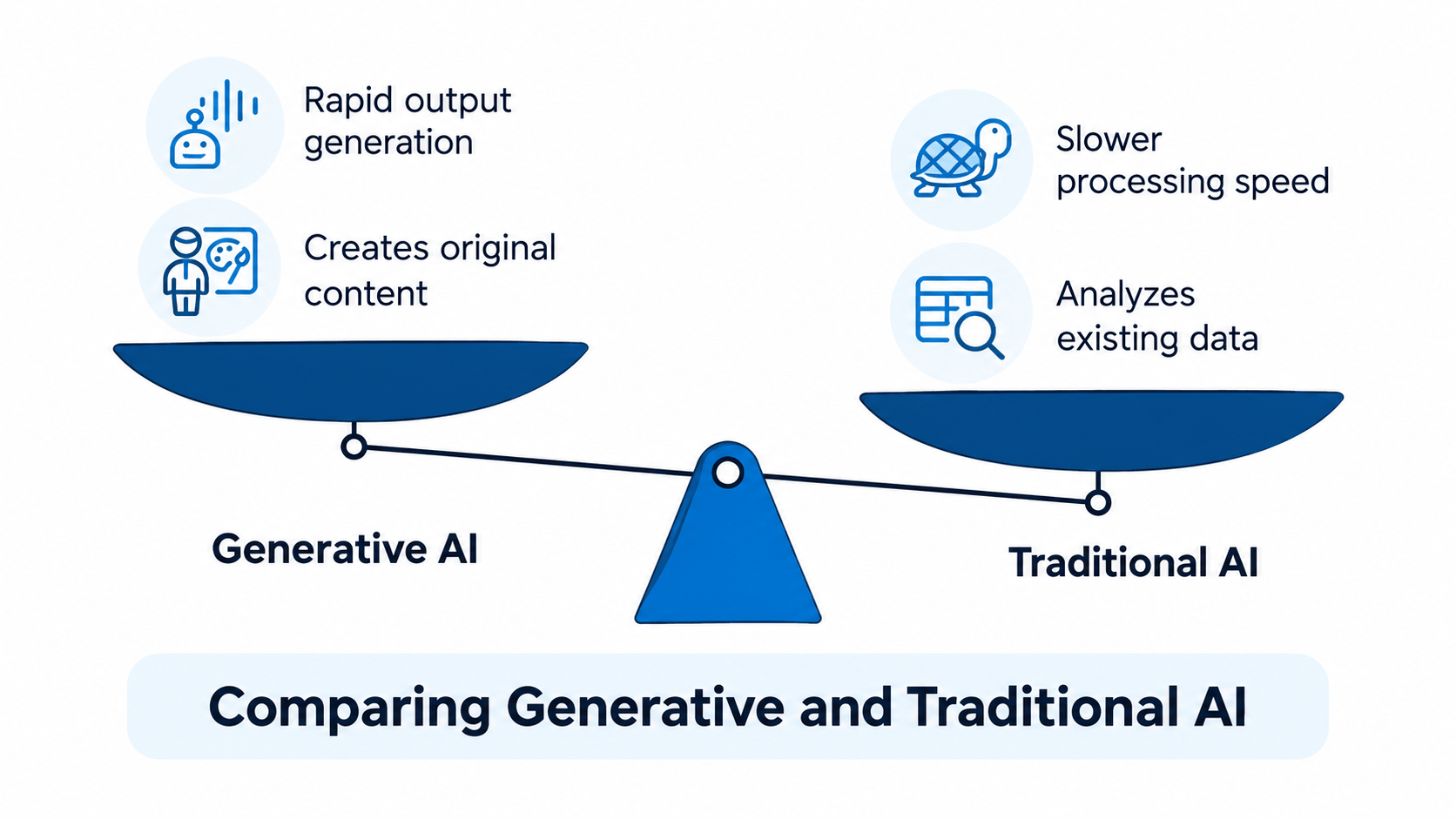
Neither approach is universally better. A business might use traditional AI to identify an unusual transaction and generative AI to help an analyst summarize the case for further investigation.
The right choice depends on the business problem, available data, required accuracy, and consequences of an incorrect result.
How to Measure the ROI of Generative AI
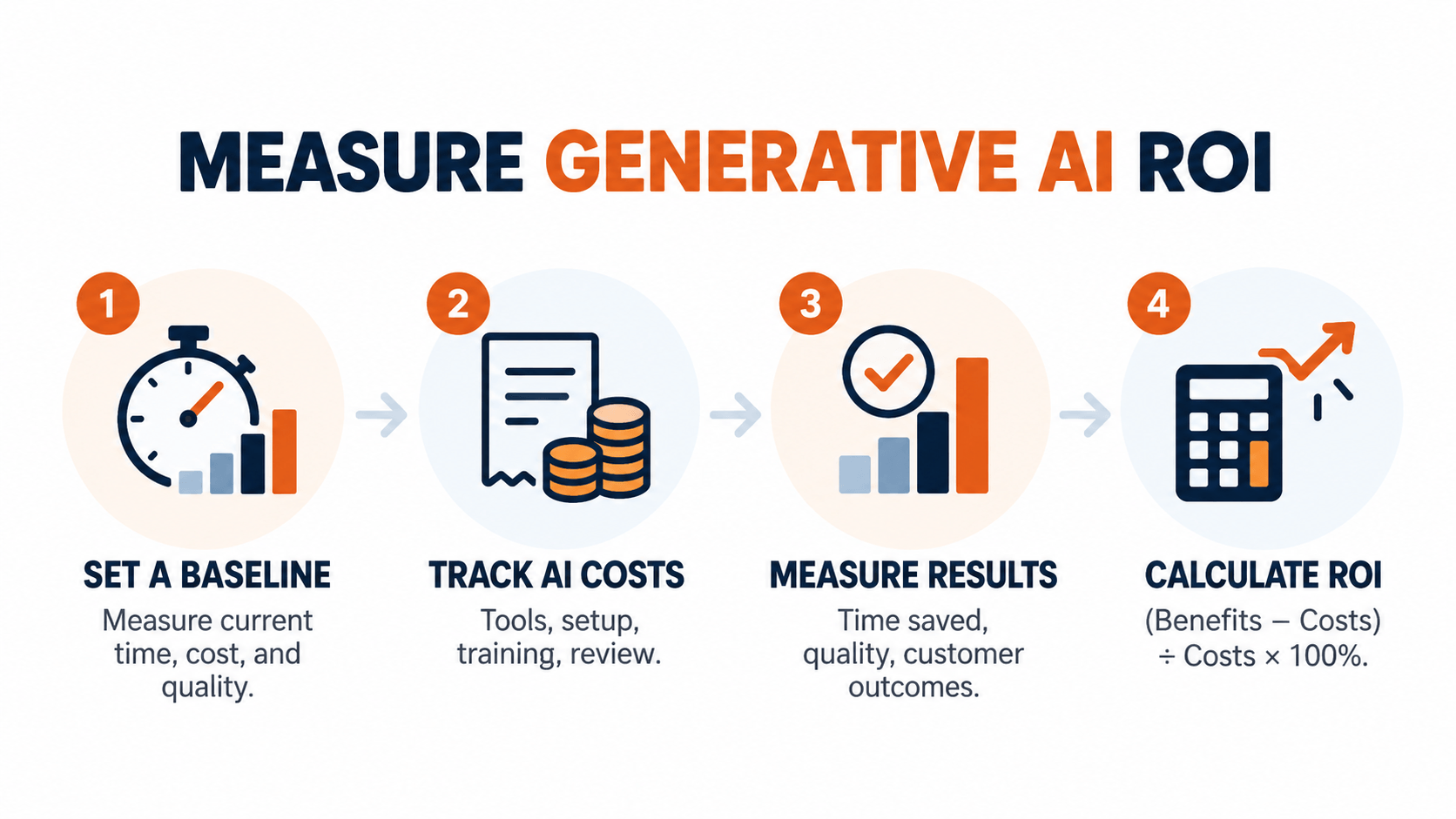
Adopting generative AI does not automatically produce a financial return. Businesses should measure whether a specific implementation improves a process enough to justify its costs.
1. Establish a Baseline
Measure how the process performs before introducing AI. Depending on the use case, this might include the time required per task, cost per interaction, error rates, response time, or customer satisfaction.
2. Define Success Metrics
Choose measurable indicators that connect directly to the business objective. Examples include time saved per task, cost per customer interaction, report preparation time, output quality, and customer satisfaction.
3. Calculate Total Costs
Include more than the subscription price. Consider implementation, integration, employee training, ongoing monitoring, security, and the human effort needed to review AI-generated outputs.
4. Run a Pilot Project
Test the solution on a limited workflow. Compare the results with the baseline and, where practical, with a similar process that does not use AI.
5. Evaluate the Results
A simple financial estimate is:
Net benefit = Measured financial benefits − Total implementation and operating costs
ROI (%) = (Net benefit ÷ Total costs) × 100
For example, if a pilot produces $15,000 in measured benefits against $10,000 in total costs, the estimated net benefit is $5,000 and the ROI is 50%. This is a hypothetical calculation, not a guaranteed result or industry benchmark.
Challenges and Risks of Generative AI
Inaccurate Information
Generative AI can produce plausible-sounding but incorrect information. Important facts, calculations, and recommendations should be checked against reliable sources before they are used.
Data Privacy and Security
Employees may expose confidential business or customer information when using unsuitable AI tools. Organizations should establish approved-use policies, access controls, and clear rules for handling sensitive data.
Bias and Unfair Outcomes
AI outputs can reflect biases in training data or surrounding processes. Applications that affect people or influence high-impact decisions require careful evaluation and appropriate human oversight.
Intellectual Property Concerns
AI-generated content and code can raise questions about licensing, ownership, originality, and permitted use. Businesses should review tool terms and establish suitable content and code review procedures.
Employee Adoption and Training
A tool may deliver little value if it does not fit existing workflows or employees do not understand how to use it. Training, feedback, and clearly defined responsibilities are important for successful adoption.
How to Implement Generative AI in Your Business
Businesses do not need to transform every department at once. A focused, measured approach can help organizations identify valuable use cases while managing risks.
- Identify a business problem: Choose a repetitive or time-consuming task where AI could provide measurable value.
- Select an appropriate tool: Evaluate its capabilities, data-handling practices, integration requirements, and cost.
- Set clear guidelines: Define what information employees can enter and which outputs require review.
- Train employees: Teach teams how to provide context, evaluate outputs, and recognize limitations.
- Run a pilot: Test the tool with a limited group and document the results.
- Measure performance: Compare productivity, quality, costs, and risks against the baseline.
- Expand carefully: Scale successful use cases while continuing to monitor performance and security.
Organizations should also consider whether employees have the skills needed to work effectively with AI tools. Developing practical AI capabilities can help teams evaluate outputs, improve workflows, and apply the technology responsibly.
Frequently Asked Questions
What is generative AI used for in business?
Generative AI can help businesses draft content, summarize documents, support customer service, assist with software development, prepare training materials, and work with business information.
What are the main benefits of generative AI for businesses?
Potential benefits include improved productivity, faster content creation, more efficient workflows, support for customer service, and faster development of ideas. Actual results depend on the use case and implementation.
What are some examples of generative AI in business?
Examples include AI-assisted product descriptions, customer support assistants, coding assistants, sales email drafts, employee onboarding guides, and marketing content workflows.
Is generative AI better than traditional AI?
Not necessarily. Generative AI is useful for creating content and responses, while traditional AI is often better suited to classification, forecasting, and anomaly detection. Businesses may benefit from combining both approaches.
How can a business measure generative AI ROI?
A business can compare measurable benefits against the total costs of implementation and operation. Useful metrics include time saved, cost per task, output quality, error rates, and customer satisfaction.
Is generative AI safe for business use?
Generative AI can be used responsibly when organizations select suitable tools, protect sensitive information, verify important outputs, establish clear policies, and maintain appropriate human oversight.
How can small businesses start using generative AI?
Small businesses can begin with a low-risk task, such as drafting internal documents or preparing marketing outlines. They should test the tool, review its outputs, measure the value, and expand only when the results justify it.
Conclusion
Generative AI offers businesses practical ways to support employees, improve selected workflows, and explore new opportunities. Its value is not determined by the number of tools an organization adopts, but by whether those tools solve real problems and produce measurable results.
Businesses should start with a clear objective, protect their data, review AI-generated outputs, and measure performance before expanding to more complex applications. Combining AI capabilities with human judgment, industry knowledge, and responsible implementation can help organizations turn experimentation into meaningful business outcomes.