Banks and other financial companies sit on a huge amount of data every day: card payments, loan applications, portfolios, and customer activity. That information is only useful if someone can actually read it.
Machine learning in finance is how banks, insurers, investment firms, and similar organizations look through that data, spot patterns, automate some of the work, and make better calls. A model learns from past records instead of relying only on a fixed rule or a person checking every case by hand. Then it uses those patterns to predict something or flag activity that looks off.
A bank might use it to catch a payment that looks fraudulent, estimate whether a borrower is likely to repay, or suggest a product that fits how that customer already banks. An investment firm might use it on market data. An insurer might use it on claims and risk.
It does not replace financial judgment, good governance, or a person who is accountable for the decision. How well it works depends on the data, how the model is built, whether anyone is watching it, and how the prediction is actually used.
This guide covers how machine learning is used in finance, where it shows up, what it does well, where it falls short, and the skills people need to work with these systems.
What Is Machine Learning in Finance?
Machine learning in finance means using algorithms and models to study financial data, find patterns, make predictions, and support or automate a financial decision.
Machine learning is a branch of artificial intelligence (AI). The system learns patterns from data. Nobody writes a separate rule for every situation.
In finance, these models may analyze information such as:
- Banking and payment transactions
- Credit histories and loan applications
- Market prices and trading volumes
- Customer behavior and account activity
- Insurance claims and policy information
- Economic indicators and financial reports
From that information, a model can estimate how likely something is, sort a transaction into a category, notice behavior that does not fit, or suggest a case for a person to review.
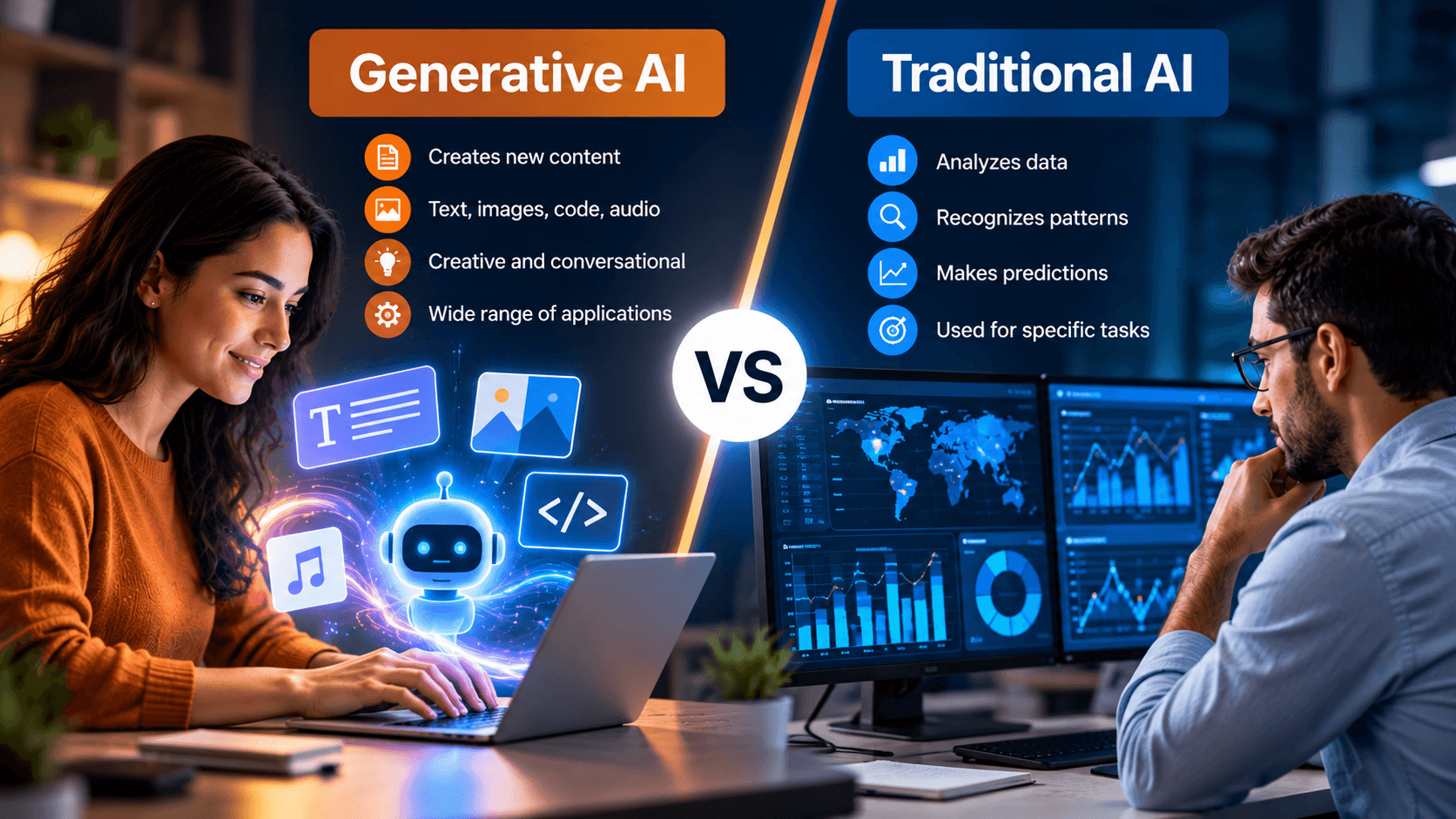
For a wider look at how AI systems learn from data, read WFI’s article, Generative AI vs. Traditional AI: Key Differences, Uses, and Examples.
How Does Machine Learning Work in Finance?
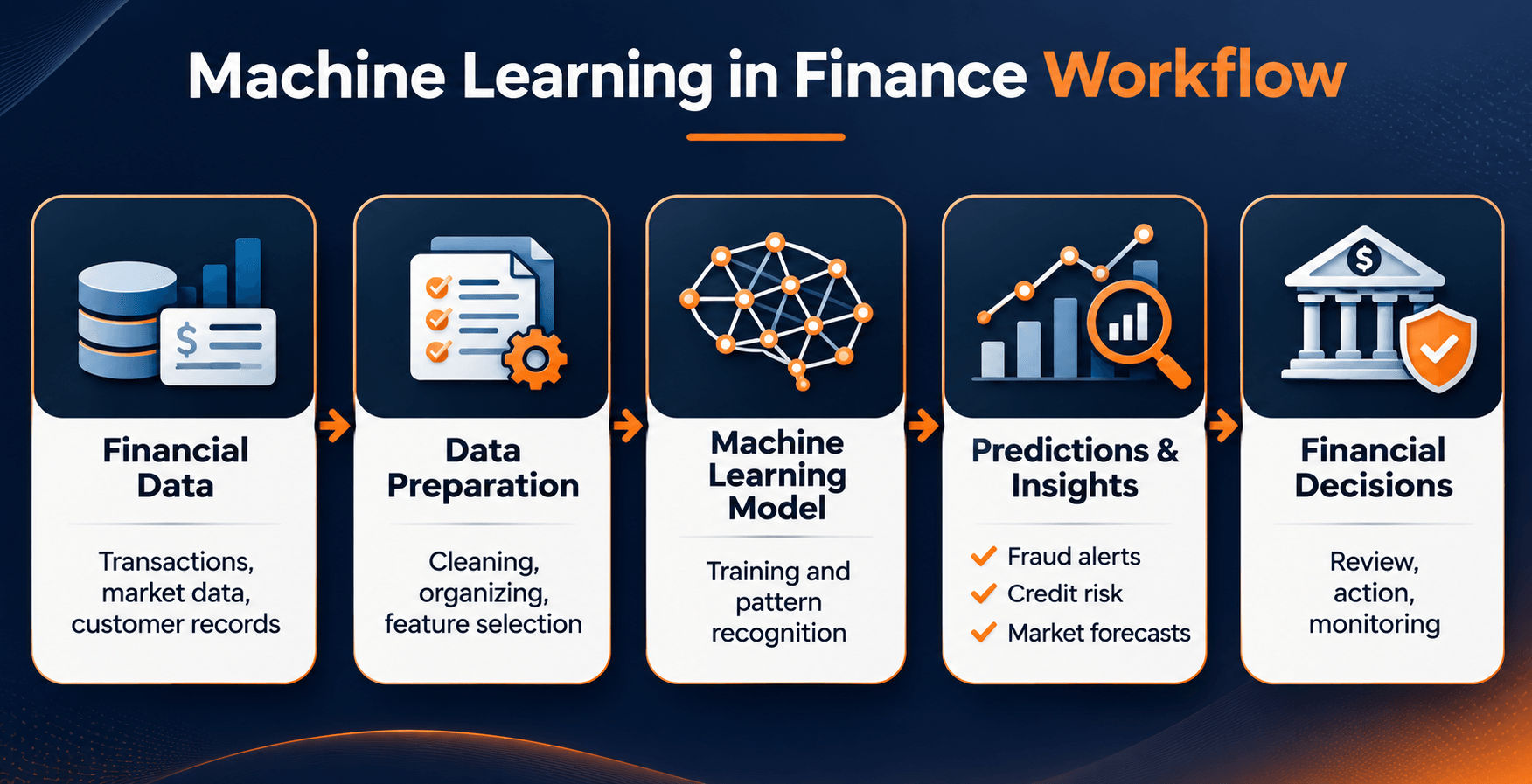
These systems usually follow the same path: collect the data, clean it, train a model, test how well it works, then keep watching it after it goes live.
1. Collect Financial Data
It starts with data that actually relates to the question. A bank building a fraud model might use amounts, times, merchant types, account activity, and cases already confirmed as fraud.
The data has to be good and relevant. Missing, old, or biased records lead to bad predictions.
2. Prepare and Clean the Data
Financial data rarely arrives in one clean file. It comes from different systems and formats. Before training, a team may have to drop duplicates, deal with missing values, make the formats match, and find the errors.
Sensitive financial information also has to be handled under the privacy, security, and regulatory rules that apply.
3. Train the Machine Learning Model
During training, an algorithm studies past examples and learns which patterns go with a particular outcome. A credit-risk model might learn how repayment history, debt, income, and past loan results tend to fit together.
The goal is a pattern that still works on new data, not a model that has only memorized the examples it was shown.
4. Evaluate Model Performance
Before a model is used on real decisions, it should be tested on data it was not trained on. Teams look at accuracy, precision, recall, how often it flags a legitimate case, and what a wrong call costs.
A fraud model that flags too many honest payments annoys customers. One that misses real fraud leaves the institution exposed.
5. Deploy and Monitor the Model
Once a model is approved, it can be plugged into an app or a workflow. Someone still has to watch it. Customer behavior, the economy, and fraud tactics all change.
When performance slips, or the data and the environment change, the institution may need to retrain the model, adjust it, or replace it.
Key Applications of Machine Learning in Finance
It shows up in banking, lending, insurance, investment management, and day-to-day financial operations. These are the uses that come up most often.
1. Fraud Detection and Prevention
Fraud detection is one of the most common uses. Institutions process so many payments that a person cannot look at every one.
A model can compare a transaction with how that customer usually spends. The signals might be an odd amount, a place they do not shop, a burst of payments, or a sudden change in account activity.
If something looks suspicious, the system can flag it, ask for another check, or take whatever next step the institution's policy allows.
Example: Someone usually makes small purchases in one area. A large charge from a place they have never shopped can be pulled for a closer look.
This will not catch every fraudulent payment. Fraud changes, and ordinary spending can look strange. The model needs ongoing checks, and a person still has to review the cases that matter.
2. Credit Scoring and Loan Underwriting
Credit scoring estimates how likely a borrower is to repay. Traditional scoring uses established methods and set criteria. Machine learning can look across a wider set of relevant data for patterns in how people repay.
What a lender may use depends on the institution. It might include credit history, existing debt, repayment records, and other information the law allows.
Machine learning can help lenders:
- Estimate the probability of loan default
- Identify patterns in repayment behavior
- Support loan application review
- Improve the consistency of risk assessment
- Identify applications that may require additional review
Example: A lender can use a model to estimate the risk on an application. That number can inform the decision. The institution is still responsible for a process that is fair, legal, and properly governed.
Credit decisions affect people's lives, so explainability, data quality, and the risk of discrimination all matter. The Consumer Financial Protection Bureau's compliance guidance is a useful place to understand those consumer-protection duties.
3. Risk Management
Institutions deal with credit risk, market risk, liquidity risk, and operational risk. Machine learning can help read the data for patterns or warning signs tied to those risks.
For example, a financial organization may use machine learning to:
- Identify changes in borrower behavior
- Estimate potential credit losses
- Analyze market conditions
- Detect unusual operational activity
- Support risk forecasting and scenario analysis
Example: A bank can look across a loan book and see which groups are missing payments more often. The risk team can then decide whether the trend needs tighter controls or a policy change.
Treat the prediction as one input. It still sits next to established risk practice, expert judgment, and proper stress testing.
4. Algorithmic Trading and Market Analysis
Investment firms and trading desks use machine learning to read market data, find patterns, and support a strategy. A model might look at past prices, volume, economic indicators, company information, and other relevant data.
Potential applications include:
- Analyzing market trends
- Identifying statistical patterns
- Estimating price movements or volatility
- Supporting portfolio allocation
- Evaluating trading strategies using historical data
Example: A research team can use a model to find market conditions that have lined up with higher volatility. Analysts can use that to judge risk and look at possible strategies.
Markets are moved by things a model cannot fully see. A strategy that worked on past data may not work next year. Backtesting, trading costs, risk controls, and ongoing monitoring still matter.
5. Customer Service and Personalization
Institutions use machine learning to understand how customers behave and to offer services that fit. A model might look at account activity, which products people use, and how they interact with the bank.
Applications include:
- Personalized financial product recommendations
- Customer segmentation
- Predicting customer churn
- Prioritizing customer service requests
- Supporting virtual assistants and chatbots
Example: A bank might notice customers who often send money abroad and tell them about account features or foreign-transaction options that fit that use.
Personalization still has to respect privacy, be transparent about the data, and not push a product that does not fit the customer.
6. Financial Process Automation
Finance teams handle a lot of repetitive work: documents, records, and transactions. Machine learning can sort documents, pull out details, spot inconsistencies, and send the work to the right team.
Examples include:
- Extracting information from invoices and financial statements
- Classifying expense records
- Identifying missing documentation
- Supporting reconciliation processes
- Prioritizing financial operations tasks
Example: An operations team can use a model to sort incoming invoices and pull out the supplier, the date, and the amount. Staff still check the uncertain ones before anything lands in the finance system.
Automation cuts manual work. Sensitive or high-impact processes still need a check and real controls.
7. Investment and Portfolio Management
It can help investment teams read financial data, see where a portfolio is exposed, and notice patterns that matter for a decision.
Potential applications include:
- Portfolio risk analysis
- Asset classification
- Analyzing company and market information
- Supporting portfolio rebalancing decisions
- Identifying changes in market conditions
Example: A portfolio team might use a model to group assets with similar risk, or to see how the portfolio might behave in different market scenarios.
This can support the analysis. It does not remove market risk or promise a return. Decisions still depend on the investment goal, how much risk is acceptable, and professional judgment.
8. Anti-Money Laundering (AML) and Compliance
Institutions have to watch transactions and customer activity for possible money laundering and other prohibited behavior. Machine learning can help find patterns that deserve a closer look.
A model might study networks of transactions, how an account behaves, payment patterns, and other relevant signals. Some of that activity is hard to catch with a simple rule.
Example: A system might flag a group of accounts that seem to move money through several transactions in an odd pattern. Compliance staff investigate and decide whether anything further is required.
The model can help the compliance team. It does not decide that a transaction is a crime. Investigations, reports, and compliance decisions still follow the law and the institution's procedures.
Benefits of Machine Learning in Finance
Designed and governed well, machine learning can help institutions read data faster, manage risk, and deliver services.
1. Faster Data Analysis
A model can work through a large volume of financial data faster than a manual review. That helps a team see patterns and decide what needs attention first.
2. Improved Fraud Detection
A model can look at several signals at once and notice patterns tied to suspicious activity. For some kinds of fraud, that works better than a fixed rule alone.
3. More Informed Decision-Making
It can produce a prediction, a classification, or a risk estimate that supports the analysis. People still use that output to judge the information and decide.
4. Operational Efficiency
Automating repetitive data work cuts the manual load, so teams can spend time on investigation, conversation, and judgment.
5. Personalized Customer Experiences
It can help an organization see what a customer needs and offer information or services that fit, when the data is used properly.
6. Adaptability to Changing Patterns
Models can be trained again as new data comes in. That helps when customer behavior, fraud tactics, or markets change, as long as someone is actually watching and maintaining the model.
Challenges and Limitations of Machine Learning in Finance
The upside is real, and so are the problems. Financial organizations have to deal with them before a model goes live and after.
1. Data Quality and Availability
The model is only as good as the data. Incomplete, wrong, old, or unrepresentative records produce unreliable predictions.
That means a real process for checking data, cleaning it, documenting it, and keeping the quality up over time.
2. Bias and Fairness
Past financial data can carry old inequalities and biased decisions. If a model learns those patterns without safeguards, it can repeat unfair outcomes.
Institutions should test for bias, ask whether the data is relevant and legal to use, and watch results across the groups that could be affected.
3. Explainability
Some models are hard to explain. That becomes a problem when a banker, a customer, an auditor, or a regulator needs to know why a particular result came out.
Explainability matters most in lending, insurance, and other decisions that can change someone's life.
4. Privacy and Security
Financial data includes sensitive personal and business information. Organizations need access controls, protection practices, security, and clear rules for how that information is collected and used.
5. Model Drift
A model can get worse when the real world changes. A fraud model, for example, can lose its edge when criminals change tactics.
Watching the model, testing it, and updating it is how you catch that slide.
6. Regulatory and Governance Requirements
Finance is regulated. A machine learning system may need documentation, testing, validation, monitoring, and a named person who is accountable.
The NIST AI Risk Management Framework is a practical guide for finding, assessing, and managing AI risk. It helps teams think through governance, reliability, transparency, and responsible use.
Real-World Examples of Machine Learning in Finance
Financial firms use machine learning in different ways. These examples describe common patterns. They are not claims about any one company's private model or results.
Example 1: Detecting Suspicious Card Transactions
A payment company handles a huge number of card transactions. A model looks at the amount, the time, the merchant, and how the account usually behaves, then estimates whether the charge might be fraud.
Higher-risk scores can be sent for review or an extra authentication step. That lets the company focus on the suspicious cases without ignoring how false alerts feel to customers.
Example 2: Supporting Loan Risk Assessment
A lender trains a model on past repayment data to estimate the chance a borrower will miss payments. That estimate can sit inside underwriting, next to other information and the lender's own policies.
The lender still has to check that the model is fair, accurate, and in line with lending rules.
Example 3: Identifying Unusual Insurance Claims
An insurer looks through claims for patterns that need another look. A model might flag an unusual mix of claim details, timing, or past behavior.
Claims staff investigate those cases. The flag is not proof of fraud.
Example 4: Analyzing Investment Risk
An investment team uses machine learning on market data to estimate how risk shows up across assets. The results can support portfolio analysis, scenario work, and risk management.
The prediction is still uncertain. It belongs next to ordinary investment analysis and the risk controls already in place.
Machine Learning vs. Traditional Financial Analysis
These two approaches can work together. Traditional analysis uses established models, statistics, expert judgment, and set rules. Machine learning adds the ability to find complicated patterns in large datasets.
| Aspect | Traditional Financial Analysis | Machine Learning in Finance |
|---|---|---|
| Approach | Often uses predefined models, rules, and analyst judgment | Learns patterns from data |
| Data | Often focuses on structured financial information | Can analyze structured and, with suitable methods, unstructured data |
| Pattern detection | May rely on known relationships and analyst interpretation | Can identify complex patterns across many variables |
| Adaptation | Models and rules are often updated manually | Models can be retrained or updated using new data |
| Interpretability | Many traditional methods are relatively easy to explain | Interpretability varies by model and implementation |
| Human role | Analysts interpret results and make decisions | Professionals design, evaluate, monitor, and use model outputs |
Machine learning is not automatically the better choice. The right approach depends on the problem, the data you have, how explainable the answer needs to be, and what happens if the answer is wrong.
Skills Needed for a Career in Machine Learning in Finance
People who work where machine learning and finance meet usually need technical skill, financial knowledge, and the ability to think through a problem.
1. Programming Skills
Python is the language most people use for machine learning and data analysis. SQL helps when the data lives in a financial database. It also helps to know data tools and machine learning libraries.
2. Statistics and Mathematics
Probability, statistics, regression, optimization, and model evaluation are what let you build a system and tell whether it is any good.
3. Machine Learning Fundamentals
The useful topics are supervised and unsupervised learning, classification, regression, feature engineering, model validation, and how you measure performance.
4. Financial Knowledge
You need to understand the products, the markets, credit risk, financial statements, and the rules. That is how a model ends up solving a real business problem.
5. Data Management
These projects need data that is prepared, checked, documented, and kept secure when it is sensitive.
6. Model Governance and Communication
You also have to explain what the model cannot do, share the results, write down the decisions, and work with risk, compliance, and the business.
Those skills show up in roles such as financial data analyst, machine learning engineer, quantitative analyst, risk analyst, and AI specialist in financial services.
The Future of Machine Learning in Finance
Machine learning is likely to stay part of financial technology as firms keep pushing data-driven decisions, automation, and more personal services.
A few areas are likely to keep moving:
- More advanced fraud detection: Models should get better at spotting new patterns in suspicious activity.
- More personalized financial services: Firms can use appropriate data to shape services around what a customer actually needs.
- Improved risk analysis: Teams can use machine learning to see complicated relationships across financial and economic data.
- Greater process automation: More document handling and operational work can be automated.
- Integration with generative AI: Generative AI can help explain financial information, summarize documents, and support conversations, alongside models that predict.
- Stronger model governance: As more firms adopt this, validation, transparency, accountability, and responsible use will matter more, not less.
How far this goes depends on data quality, technical progress, what regulators expect, and whether organizations can actually run reliable systems.
Conclusion
Machine learning in finance helps organizations read data, find patterns, support decisions, and improve some processes. The uses include fraud detection, credit scoring, risk management, algorithmic trading, customer personalization, and automating financial work.
That can make an institution faster and better informed. It also brings problems: data quality, fairness, privacy, explainability, model drift, and governance.
The systems that work combine the technology with real financial expertise, careful testing, and a person who is still responsible. As financial services change, people who understand both machine learning and finance will be the ones who can do this work well.
Frequently Asked Questions
1. What is machine learning in finance?
It is the use of algorithms and models to study financial data, find patterns, make predictions, and support financial decisions. Common uses are fraud detection, credit scoring, risk management, and investment analysis.
2. What are the main applications of machine learning in finance?
The main ones are fraud detection, credit scoring, loan underwriting, risk management, algorithmic trading, customer personalization, process automation, investment management, and anti-money laundering monitoring.
3. How is machine learning used in banking?
A bank might use it to spot suspicious transactions, estimate credit risk, personalize services, process documents, and support risk management. What it actually does depends on the bank's data, systems, and governance.
4. How does machine learning help detect financial fraud?
Models look at transaction details and patterns to find activity that may be suspicious. They can flag a payment for review or an extra check. They will not catch every case of fraud.
5. Can machine learning improve credit scoring?
It can find patterns in credit and repayment data that help assess risk. The model still has to be checked for accuracy, fairness, explainability, and compliance with lending law.
6. What are the benefits of machine learning in finance?
Faster analysis, better detection of suspicious activity, more informed decisions, less manual work, more relevant services, and a better chance of noticing when patterns change.
7. What are the risks of machine learning in finance?
Wrong predictions, biased results, privacy and security problems, models that are hard to explain, performance that drifts, and regulatory trouble. Testing, monitoring, and governance are how those risks get managed.
8. Is machine learning used in stock market prediction?
It can study past market data and other information to find patterns or estimate an outcome. Markets are still unpredictable. A model output is not a promise of future performance or a return.
9. What programming language is used for machine learning in finance?
Python is the usual language for machine learning and financial data work. SQL is useful for pulling the data. Math, statistics, and financial knowledge are what make the model worth building and worth trusting.
10. What is the difference between AI and machine learning in finance?
Artificial intelligence is the wider field of systems that do tasks associated with intelligent behavior. Machine learning is the part of AI that learns patterns from data. In finance, AI can include machine learning, rule-based systems, and other approaches.