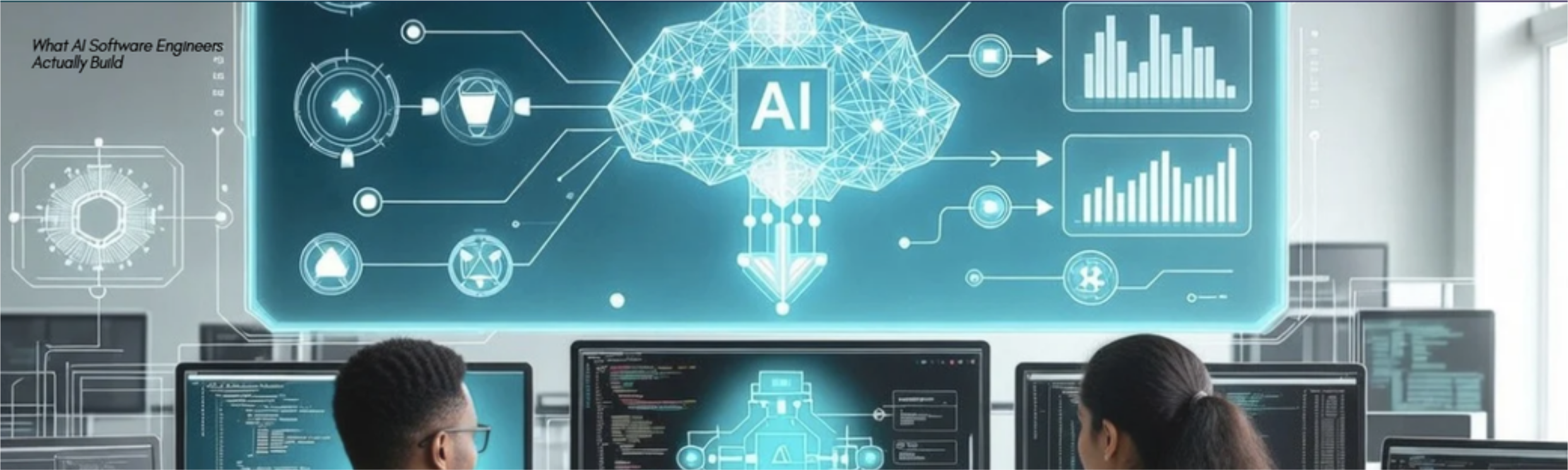
Why AI Software Engineers Actually Build Skills, Tools, and Career Path
The significance of the AI software engineer role is enormous right now. Each week introduces a new tool, claim, or promise, creating a cacophony that obscures the true nature of the job. However, the reality is far simpler than the surrounding hype. The role of an AI software engineer does not revolve around creating superhuman robots or developing novel models from scratch.
Most companies are not seeking researchers; they are looking for builders. They desire individuals who can leverage existing models to tackle practical problems. This is the essence of the AI software engineer position: connecting data, code, and model outputs into functional systems that people can utilize.
This insight is crucial for job seekers eager to enter the AI field but feeling overwhelmed. A PhD is not a requirement to begin. You do not need to train large models from the ground up. Rather, you need solid AI engineering skills, a strong foundation in software development, and a clear understanding of how modern AI products are constructed. This is where the AI software engineer role becomes actionable.
In many teams, the AI software engineer's responsibilities include developing tools with APIs, prompts, workflows, and private data sources. It involves shaping how models perform in real-world business contexts and often requires working with large language models (LLMs) to enhance functions like search, writing, support, reporting, and task management. Furthermore, it frequently entails creating Retrieval-Augmented Generation (RAG) systems, ensuring that answers derive from trusted company data rather than general assumptions.
This is why this career path is rapidly expanding. The market seeks individuals who not only comprehend AI terminology but can also build with AI in a practical and reliable manner. If you're looking to transition into this field, the first step is to grasp what the AI software engineer role entails, the skills employers are looking for, and how structured training can guide you on your journey.
What Employers Expect from AI Software Engineers
The hiring market has started to define the AI software engineer role in a more practical way. Employers want people who can build intelligent systems using current tools, not only talk about AI trends. They are looking for developers who can work across software, data, and product tasks.
That means the AI software engineer role usually sits between a standard software engineer and a data-focused product builder. You may work with APIs from model providers, build backend logic, manage prompts, connect databases, test output quality, and improve system results over time. Employers care about whether you can make these parts work together in a stable way.
- Source: U.S. Bureau of Labor Statistics, Software Developers outlook
- Microsoft Azure AI documentation
- Google Cloud Generative AI docs
- AWS Generative AI guidance
- OpenAI platform docs
Why AI Software Engineer Skills Are in High Demand
The biggest reason the AI software engineer role is in demand is simple. Companies want to use AI now. They do not want to wait years for custom model research. They want systems that improve work, reduce manual effort, and support customers today.
Generative AI changed what companies expect from technical talent. A few years ago, many firms treated AI as a special research lane. Now they want product teams and engineering teams to ship AI-enabled tools as part of normal work. That shift has increased demand for the AI software engineer role.
This demand is also being pushed by user expectations. Customers now expect chat help, smart search, personalized answers, content support, and faster task flow. Businesses need engineers who can deliver those experiences. That work lands inside the AI software engineer role.
- Model API experience
- Prompt design
- Vector databases
- LLM application work
- Retrieval workflows
- RAG systems for grounded answers
Core Software Skills Still Matter
Data Cleaning and Preparation
- Gather raw information
- Clean, messy text and records
- Remove duplicates and bad values
- Structure data before model use
SQL, Databases, and Querying
- Pull user and product data
- Query logs and internal documents
- Support retrieval pipelines
- Strengthen RAG system inputs
Visualization and Reporting
- Build dashboards and review views
- Track response quality
- Show business impact
- Support team decisions
Statistics and Problem Solving
- Compare outputs
- Measure quality
- Spot failures
- Debug messy system behavior
What Makes The Role Different From Traditional Software Work
The AI software engineer role overlaps with regular software work, but it has clear differences.
- Prompt and response design
- Model orchestration
- Retrieval and ranking
- Validation and guardrails
- Output evaluation
- Business-focused system building
Top AI Software Engineering Skills Employers Want In 2026
Machine Learning Basics
- Training basics
- Inference
- Evaluation
- Overfitting
- Embeddings
- Model limits
AI Tool Proficiency
- APIs and SDKs
- Prompt workflows
- Model parameters
- Logging
- Output handling
- Tools like OpenAI, Azure AI, AWS, and Google Vertex AI
Intelligent Data Exploration and Insight Generation
- Know what data matters
- Clean it well
- Retrieve it well
- Improve output with stronger context
Translating AI Into Business Value
- Save time
- Improve support quality
- Reduce repeat work
- Make search more useful
The Biggest Skill Gaps Hiring Managers See
- Watched tutorials but built no full systems
- Weak software basics
- Too much focus on prompts alone
- No portfolio work
- No proof of LLM or retrieval projects
How Structured Training Bridges The Gap
Targeted training matters because the AI Data Analysis role is broad.
- Connect software and AI skills
- Practice with real project workflows
- Build confidence through guided labs
- Create proof for recruiters
The WorkForce Institute Solution: Generative AI Data Analysis Bootcamp
For learners who want a practical path, the Generative AI Data Analysis Bootcamp from WorkForce Institute is positioned as a direct bridge into the AI software engineer role. The program is designed as a 12-week, beginner-friendly online course that focuses on real, job-ready AI work rather than vague hype.
Explore the Generative AI Data Analysis Bootcamp
Signup Now AI Data Analysis Bootcamp- Beginner-friendly online format
- Hands-on AI workflows
- Career-ready skill building
What You'll Learn In 12 Weeks
- AI and Data Foundations
- Data Collection, Cleaning, and Prep
- Generative AI and Visualization
- Model Training and Evaluation
- Capstone Project and Portfolio Build
Hands-On Practice That Builds Real Skill
- Sandbox labs
- Real project work
- Debugging practice
- Portfolio-ready output
Support Services That Help You Get Hired
- Resume support
- Interview prep
- Career guidance
- Better recruiter story
Real Outcomes: Careers You Can Pursue After The Bootcamp
- AI Software Engineer
- Junior AI Engineer
- AI Application Developer
- Automation-focused developer
- Data analyst using AI tools
- Source: Glassdoor: AI Engineer salaries
- Indeed: AI Engineer salaries
- ZipRecruiter: AI Engineer salaries
How This Bootcamp Helps You Stand Out
- Real project proof
- Better portfolio material
- Stronger skills narrative
- More confidence in recruiter screens
How to Get Started
- Review the bootcamp
- Apply online
- Build practical skills
- Create portfolio proof
- Get job-ready support
Apply for the 12-week Generative AI Software Engineer Bootcamp today
Signup Now AI Data Analysis bootcampFAQs
AI software engineers build tools with APIs, prompts, workflows, and private data sources.
Most AI software engineers use existing models to solve useful problems rather than training models from scratch.
RAG (Retrieval-Augmented Generation) systems provide answers from trusted company data instead of general guesses.
Employers are looking for people who can build AI systems with a solid base of software skills, not just work with prompts.
Yes, the Generative AI Software Engineer Bootcamp from WorkForce Institute is designed as a beginner-friendly course.