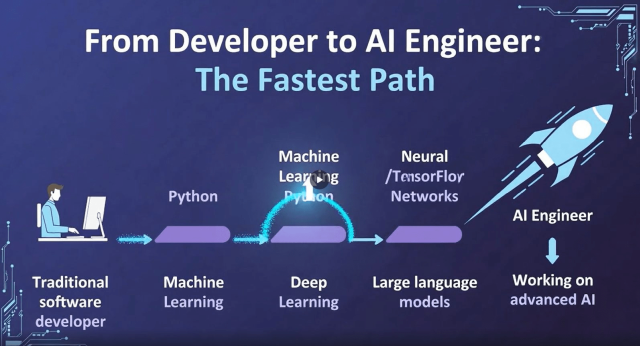
Software development is changing fast. Many roles now feel routine and easier to replace. At the same time, demand for AI Engineering Skills keeps rising across every industry.
Companies now expect developers to build smarter systems, not just functional ones. If you already write code, you are closer than you think. You already hold about 70% of the needed skills. The remaining 30%—the “AI Delta”—is what separates a standard developer from an AI engineer.
This guide shows how to close that gap. It breaks down what you already know, what you need next, and how to get there fast.
Why AI Skills Are Now in High Demand
The job market is shifting toward intelligent systems. Roles that combine software and AI now pay more and grow faster. That is why AI Engineering Skills are becoming a top requirement in job listings.
Across the U.S., AI-related roles continue to grow year over year. Companies want people who can work with data and automation. They need developers who understand how to build systems powered by machine learning and generative AI.
Generative AI has changed expectations. Businesses now expect tools that can summarize data, generate insights, and automate decisions. This shift increases the value of AI Engineering Skills in nearly every role. Developers who adapt early gain a strong edge. Those who wait risk falling behind.
What Sets AI Engineers Apart Today
Traditional development focuses on building features. AI engineers focus on building systems that learn and adapt. This shift defines modern AI Engineering Skills.
AI engineers use tools that automate tasks. They work with models instead of writing all logic by hand. They also design workflows that combine data, prompts, and outputs. Companies now value developers who can use AI tools well. Knowing how to guide models is as important as writing code. This new layer defines advanced AI Engineering Skills.
Top AI Skills Employers Want in 2026
Hiring managers now look for a clear mix of technical and applied skills. These define strong AI Engineering Skills in today’s market.
Machine Learning Basics
You do not need deep theory. You need to understand how models work and when to use them. This forms the foundation of practical AI Engineering Skills.
AI Tool Proficiency
Tools like AutoML and generative AI platforms are now standard. Knowing how to use them is critical. This is one of the fastest-growing areas of AI Engineering Skills.
Smart Data Exploration
AI helps you explore data faster. You still need to ask the right questions. This ability strengthens your overall AI Engineering Skills.
Turning Insights Into Action
Businesses care about results. You must connect outputs to decisions. This is where AI Engineering Skills create real value.
Why Structured Learning Makes the Difference
A clear program helps you focus on what matters. It removes guesswork and speeds progress. This is key when building AI Engineering Skills. Structured learning connects skills to real job tasks. It shows how companies actually use AI. This makes your learning practical and job ready.
Instead of random tutorials, you follow a path. This leads to stronger and more complete AI Engineering Skills.
Introducing the Solution: The Generative AI Data Analyst Bootcamp
The fastest way to close the gap is with focused training. The Generative AI Data Analyst Bootcamp is built for this purpose.
A 12-week, beginner-friendly online program designed to build real AI data analyst skills employers value.
Explore the BootcampThis 12-week online program helps you build real AI Engineering Skills. It is designed for beginners and working developers alike. You learn by doing. You work on real projects. You build skills that match what employers expect.
What You Learn in 12 Weeks
- AI and Data Foundations: Learn the core concepts of AI and data analysis, setting a solid base for future learning.
- Data Collection and Preparation: Master the skills to gather, clean, and prepare data for AI models.
- Generative AI and Visualization: Use generative AI tools to create insights and visualize data effectively.
- Model Training and Evaluation: Train and evaluate AI models to solve real-world problems.
- Capstone Project and Portfolio: Apply your skills to a comprehensive project, building a portfolio that showcases your abilities.
Hands-On Practice That Builds Real Ability
Practice matters more than theory. This program focuses on doing real work. That is how strong AI Engineering Skills develop. You work in sandbox labs. You solve real problems. You build systems similar to what companies use. This approach builds confidence. It also prepares you for real job tasks.
Career Support That Helps You Get Hired
Learning skills is only part of the journey. You also need support. This program helps you present your AI Engineering Skills clearly. This includes resume guidance, interview preparation, and access to job platforms.
Career Paths After the Bootcamp
Common paths include AI Data Analyst, Machine Learning Assistant, AI Solutions Developer, and Data Engineer with AI focus. These roles often offer higher pay and stronger growth.
How This Program Helps You Stand Out
Recruiters look for proof, not just claims. This program helps you show real AI Engineering Skills through portfolio projects, real project experience, and a clear skills story.
How to Get Started Today
Apply for the 12-week Generative AI Data Analyst Bootcamp today to close the skills gap and build a career companies are hiring for.
FAQs: AI Skills and Bootcamp Questions
No, the bootcamp is designed for beginners.
The bootcamp is 12 weeks, providing a fast track to AI engineering skills.
Structured learning offers a focused, practical path, filling gaps that self-learning often misses.
Yes, the program includes resume guidance, interview preparation, and job platform access.
The bootcamp focuses on hands-on practice, real-world projects, and career support to ensure job readiness.