
The 90-day clock. Why the current job market demands speed and specific technical skills.
Introduction: The 90-Day Window
The job market is moving fast, and employers are not waiting for slow learners. Marketing roles now reward people who can use data, handle digital tools, and show results early. That makes speed a real advantage for job seekers who need a practical path back into work. U.S. labor data shows strong ongoing demand for market research analysts and marketing specialists, with employment projected to grow 7% from 2024 to 2034 and about 87,200 openings each year on average.
That is why a 90-day plan matters. You do not need four years to become useful in digital marketing. You need focused training, real practice, and skills that match how employers hire now. SurveyMonkey found that 44% of marketers said new skills and education were their top growth strategy, while 41% felt they were ahead of peers because they adopted new technology and learned new skills.
So the clock starts now. In the current market, employers want proof that you can create content, read data, use AI tools, and support campaign results. A short, intense learning path makes more sense than drifting through random tutorials for months.
The New Marketing Stack
Traditional marketing is not enough anymore. Brand voice still matters, but today’s teams are judged by reach, cost, conversions, retention, and speed. Marketing has become more data-driven, more platform-driven, and more tied to performance. That is why the modern marketer needs more than writing skill or social media instinct. They need to work with analytics, AI tools, paid media systems, and testing workflows.
AI is now part of that toolkit. HubSpot reports that 61% of marketers say AI is causing the biggest shift in marketing in the last 20 years. Salesforce reports that 75% of marketers have adopted AI, while 81% say they would trust AI to help respond to customers at scale. That does not mean AI replaces the marketer. It means the marketer who knows how to use AI well moves faster and often performs better.
Paid media has also changed. Google’s Performance Max uses Google AI across bidding, budget optimization, audiences, creative, and attribution. Google says advertisers who adopt Performance Max can see an average increase of 27% more conversions or conversion value at a similar CPA or ROAS, even when they already use broad match and Smart Bidding. That tells you where the field is going. Campaign management is no longer just manual setup. It now includes machine learning, creative inputs, clean tracking, and strong data signals.
The modern marketer’s toolkit now includes a few core areas:
- AI-assisted content creation
- Paid media platforms
- SEO basics
- Analytics and reporting
- Conversion thinking
- Audience and message testing
That is the real shift. Marketing is no longer built around guesswork. It is built around data, AI support, and measurable outcomes.
The 30-60-90 Day Roadmap
Day 1–30: Learn the Core and Start Using AI
The first 30 days should build your base. This is where you learn the language of digital marketing and stop feeling lost. You need to understand channels, funnels, buyer intent, content basics, email basics, paid ads basics, and key terms like CTR, CPC, CPA, ROAS, bounce rate, and conversion rate. This stage should also include AI-assisted content creation, because that is already part of modern team workflows.
In this phase, focus on using AI as a helper, not a shortcut. SurveyMonkey found that 62% of marketers think AI will keep improving at content generation, but consumers still prefer human-created content and many react negatively to content that feels fake or low-trust. So your job is not to let AI replace your thinking. Your job is to use it to speed up drafts, outlines, testing ideas, and research while keeping the final work human and useful.
A strong first month should include:
- Marketing fundamentals
- AI content prompts and editing
- Basic copywriting
- Email and social content structure
- Audience research
- Intro analytics
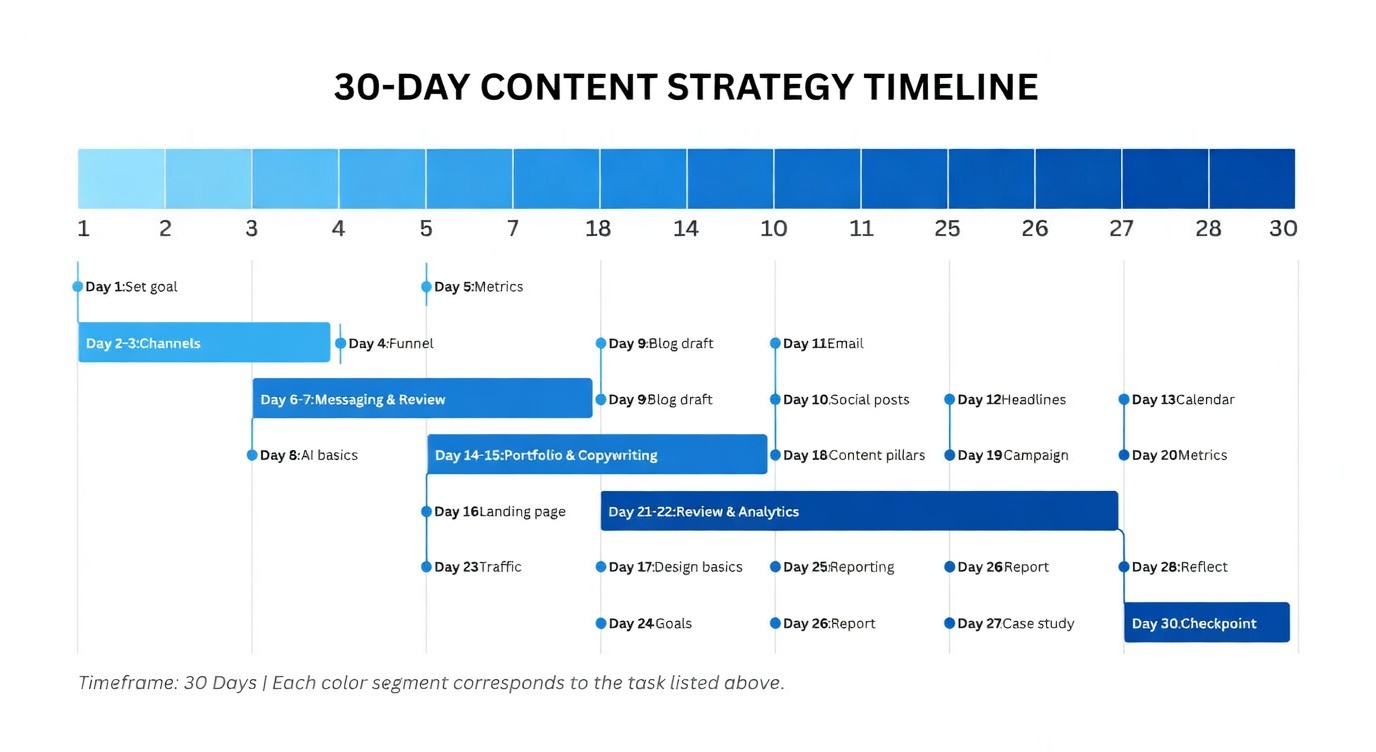
| AWeek 1 (Days 1–7) | Week 2 (Days 8–14) | Week 3 (Days 15–21) | Week 4 (Days 22–30) |
|---|---|---|---|
|
Day 1 → Set career goal + create schedule Day 2 → Learn digital marketing channels Day 3 → Study marketing funnel Day 4 → Learn key metrics (CTR, CPC, CPA, ROAS) Day 5 → Build customer persona Day 6 → Learn messaging basics Day 7 → Review + summarize learning |
Day 8 → Learn AI content basics Day 9 → Write AI-assisted blog draft Day 10 → Write social captions Day 11 → Learn email marketing basics Day 12 → Practice headlines Day 13 → Build 2-week content calendar Day 14 → Save best content (portfolio start) |
Day 15 → Learn copywriting basics Day 16 → Build landing page structure Day 17 → Learn design basics for marketing Day 18 → Build content pillars Day 19 → Create mini campaign Day 20 → Learn performance metrics Day 21 → Weekly review |
Day 22 → Learn analytics basics Day 23 → Study traffic sources Day 24 → Learn campaign goals Day 25 → Practice reporting questions Day 26 → Build simple report Day 27 → Create first case study Day 28 → Organize portfolio Day 29 → Reflect + identify gaps Day 30 → Month checkpoint |
Day 31–60: Build Platform Skill
The next 30 days should move from theory to channel work. This is the point where you learn how campaigns actually run. Paid media, SEO, and analytics should become your focus because those are the parts employers can measure quickly.
Start with paid media. Google’s own documentation shows how much modern ad work now relies on AI-powered campaign types like Performance Max. Learn campaign setup, keyword logic, audience signals, ad creative, landing page fit, and budget basics. At the same time, learn SEO basics like search intent, on-page structure, titles, metadata, internal links, and content quality. Then connect all of it to reporting. You need to know what the numbers mean, not just where to find them.
This phase should include:
- Google Ads basics
- SEO and keyword intent
- Google Analytics or similar reporting tools
- Campaign tracking
- Dashboard reading
- Data-backed decisions
The 90-day clock. Why the current job market demands speed and specific technical skills.
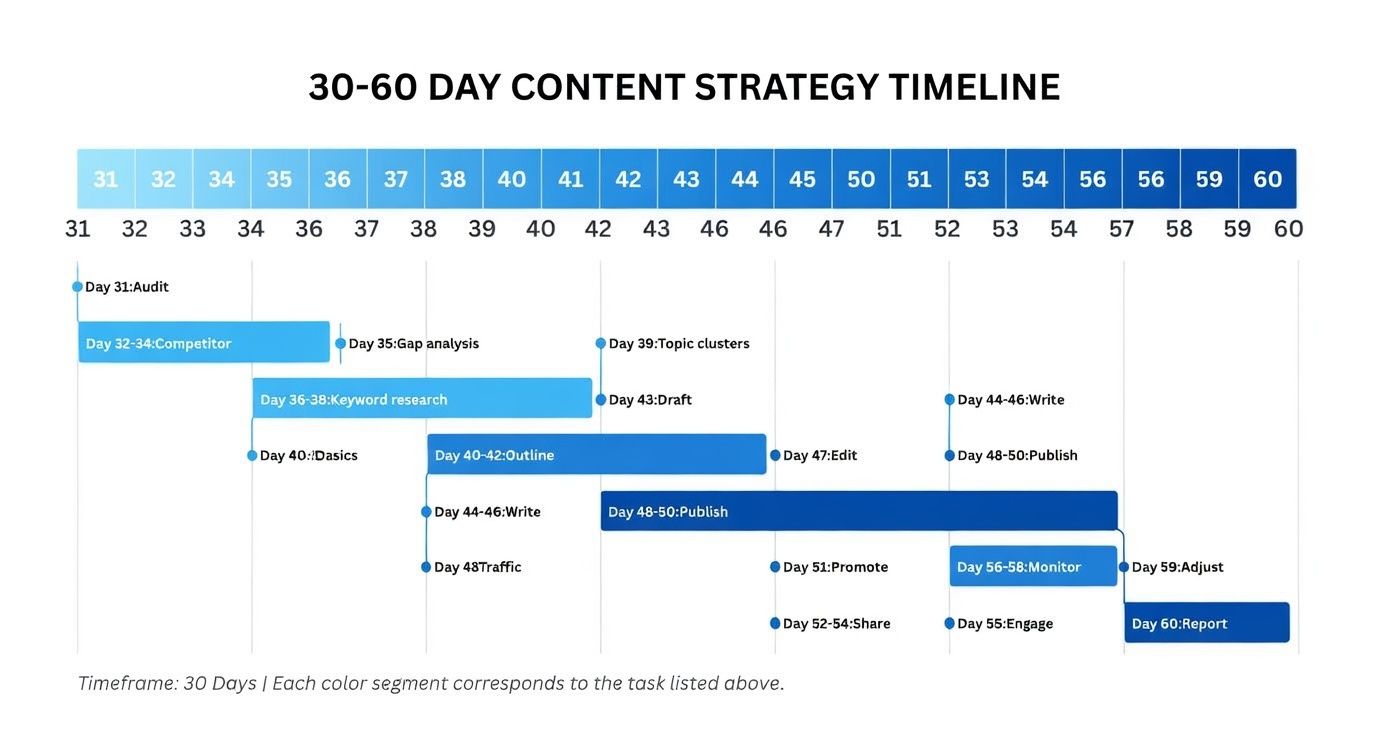
| Week 5 (Days 31–37) | Week 6 (Days 38–44) | Week 7 (Days 45–51) | Week 8 (Days 52–60) |
|---|---|---|---|
|
Day 31 → Learn paid media basics Day 32 → Study campaign structure Day 33 → Learn keyword intent Day 34 → Do keyword research Day 35 → Write search ads Day 36 → Study landing page alignment Day 37 → Save ad samples |
Day 38 → Learn SEO basics Day 39 → Study on-page SEO Day 40 → Practice keyword mapping Day 41 → Write SEO outline Day 42 → Draft blog post Day 43 → Edit blog Day 44 → Save SEO work |
Day 45 → Learn analytics deeper Day 46 → Build dashboard layout Day 47 → Practice campaign analysis Day 48 → Learn A/B testing Day 49 → Write report summary Day 50 → Build full campaign concept Day 51 → Weekly review |
Day 52 → Learn AI marketing workflows Day 53 → Practice AI prompts Day 54 → Improve content with AI Day 55 → Build AI content pack Day 56 → Learn performance strategy Day 57 → Build second case study Day 58 → Organize all work Day 59 → Plan final projects Day 60 → Month checkpoint |
Day 61–90: Build Projects and Start the Job Hunt
The last 30 days should be about proof. Employers do not hire because you watched videos. They hire because you can show work, explain choices, and talk through outcomes. That means projects, portfolio pieces, campaign mockups, dashboards, and case-study thinking.
This stage should include at least one real or simulated project in content, one in paid media or SEO, and one in reporting. It should also include resume work, interview prep, and a clear story about your career shift. WorkForce Institute’s Generative AI Data Analyst Bootcamp page emphasizes hands-on sandbox labs, capstone work, career simulations, portfolio building, resume help, interview prep, and career coaching. Those are exactly the things that help turn training into job proof.
The final 30 days should focus on:
- Real-world projects
- Portfolio proof
- Resume updates
- Interview preparation
- Job applications
- Clear career story
| Week 9 (Days 61–70) | Week 10 (Days 71–80) | Week 11–12 (Days 81–90) | |
|---|---|---|---|
|
Day 61 → Start Project 1 Day 62 → Build strategy Day 63 → Create content assets Day 64 → Finish project Day 65 → Write case study Day 66 → Start Project 2 Day 67 → Build assets Day 68 → Finish project Day 69 → Write case study Day 70 → Weekly review |
Day 71 → Start Project 3 Day 72 → Build report/dashboard Day 73 → Finalize project Day 74 → Write case study Day 75 → Build portfolio layout Day 76 → Write “About Me” Day 77 → Refine portfolio Day 78 → Gather proof work Day 79 → Update resume Day 80 → Update LinkedIn |
Day 81 → List target companies Day 82 → Study job descriptions Day 83 → Tailor resume Day 84 → Practice interview answers Day 85 → Practice project storytelling Day 86 → Apply to 5 jobs Day 87 → Apply to 5 more jobs Day 88 → Network on LinkedIn Day 89 → Mock interviews Day 90 → Final review + apply again |
|
Weekly Non-Negotiables for All 90 Days
Do these every week, no matter what phase you are in:
- Review your notes
- Save your best work
- Clean up one portfolio piece
- Learn 5 new terms
- Write one short reflection
- Track your progress
What You Should Have by Day 90
- A basic digital marketing skill set
- AI-assisted content practice
- Paid media basics
- SEO basics
- Analytics and reporting practice
- 3 portfolio-ready projects
- 3 case studies
- Updated resume
- Updated LinkedIn
- Active job applications
Simple Rule for Staying on Track
Every day, ask:
- What did I learn?
- What did I build?
- What proof did I save?
If you can answer those three questions daily, this 90-day clock will move you forward.